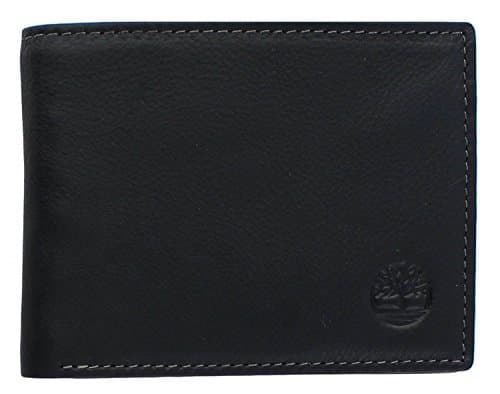
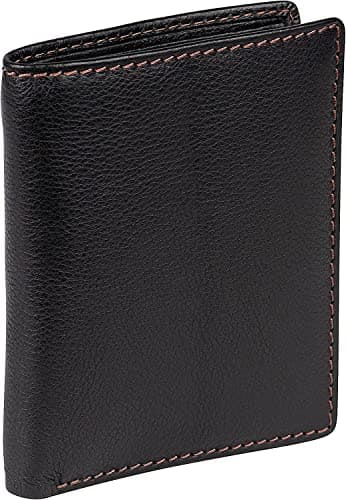
The short version: black is the most-bought wallet color and the hardest one to shop, because black is opaque to everything you would normally judge leather by. The grain pattern disappears into the dye. The patina that is the entire payoff of a good hide is invisible. And when a black wallet does wear, it wears pale— a scuff on black leather shows as a gray or whitish line, which is the most visible kind of damage there is. So the inclusion rule for this page is mechanical and the ranking follows from it: the listing has to state that the wallet is black, and then we rank on the three things that are still knowable in black — the stated leather grade, the finish, and the stitching.
What black hides, and what it shows
This is worth getting straight before you spend ninety dollars on a hide you will never see.
Black hides the grain. The difference between full grain, top grain and “genuine” is a difference in the surface layer of the hide: full grain keeps the original grain intact, top grain has it sanded off and a finish sprayed back on. In tan or brown you can often see which one you are holding. Under a black pigment finish you usually cannot, which means in black the claim on the listing is doing all the work. That is the single reason this page ranks the way it does.
Black hides patina and shows abrasion.A brown veg-tan wallet darkens and deepens with handling, and the marks it collects read as character. Black leather has nowhere darker to go. What it does instead is lose dye at the high-wear points — corners, fold, card-slot edges — and the exposed leather underneath is lighter than the surface, so wear appears as pale streaks. This is not a defect in any particular wallet; it is what black does. If what you want from leather is visible aging, you want our brown leather wallets page instead, and we would rather tell you that at the top than sell you the wrong color.
Black shows edge paint.Most wallets at every price have painted edges, and on black the paint and the leather are the same color until the paint cracks, at which point the crack line is obvious. A wallet with a folded or turned edge instead of a painted one has nothing to chip — worth looking for, and almost never stated in a listing.
The inclusion rule, and the listings it cut
We read the live Amazon title of every product in our catalog on 23 November 2026 using the same API we use to resolve every ASIN we rank. 150 returned a current listing, and 42 of them state black in the seller's own title. That is the pool this page ranks from. Nothing here is a color we inferred from a photograph.
Three kinds of listing were cut, and the exclusions are more useful than the picks:
- The self-contradicting listing. One wallet in our registry has a title that says “Black, Law Enforcement Officer Gifts (Brown)”— the color word appears twice and disagrees with itself. It is a perfectly good badge wallet and it is not on this page, because a listing that states two colors in one title has not told us which one ships.
- The black things that are not leather.The two highest-capacity black card cases in our catalog are machined aluminum with no hide in them at all, and one of the best-known black cardholders is sold as “Jet Black” anodized metal. They are ranked on metal wallets, where they belong. A page about black leather should not be padded with black metal.
- The two-tone listings.A wallet whose title states a “Black/Brown Colour Combination” — the listing's own words — or a black body with red stitching, is a design choice rather than a black wallet. We mention the contrast-stitch option below because some people are specifically looking for it; we do not rank it as black.
What this category publishes, and what it does not
Three facts about the six picks, because they frame every decision underneath:
- Four of the six state a leather grade or tannage.Two state full grain, one states top grain, one states vegetable-tanned. That is a markedly better hit rate than most categories we rank — the western aislemanaged zero out of five — and it is the reason this page can be ranked honestly at all.
- Not one publishes a closed thickness. Universal in this trade and still worth naming. Our thickness guide has the per-slot arithmetic you need to estimate it yourself.
- Nobody states the dye method. Drum-dyed leather is colored through; surface-dyed or pigment-finished leather is colored on top, which is what produces the pale scuff described above. No listing in the category distinguishes the two. If a black wallet must never show a pale mark, the honest answer is that no listing on Amazon will promise you that, and the best proxy available is a textured finish rather than a smooth one.
The one black wallet we would talk you out of
Our catalog contains a full-grain, vegetable-tanned black card holder from HISCOW at around forty-five dollars — the strongest leather claim of any black product we carry. It is a lovely object and we are not ranking it first, because veg-tan's whole argument is that it ages visibly and black is the color that hides aging. You would be paying a premium for a property you have chosen not to see. If that trade appeals to you anyway, the same brand's cognac version is on our brown page and the tannage is on our veg-tan roundup. The reverse advice also holds: if you want black, you can stop paying for patina and spend the money on construction instead. That is the most useful sentence on this page and it earns us nothing.
How to buy a black wallet, in four decisions
1. Buy the stated grade, because you cannot see it
In brown you can hold two wallets up and often tell which one has an intact grain. In black you are buying a sentence on a listing page. So treat the grade words as the primary specification and read them precisely: full grain is the claim worth paying for, top grain is a sanded surface with a finish sprayed back on, and “genuine leather” is a floor rather than a grade — it means real leather and nothing more. Our grade explainer is the long version. Two picks here state full grain, and in black that statement is the whole difference between them and the cheap ones.
2. Choose a finish that hides marks, not one that shows them
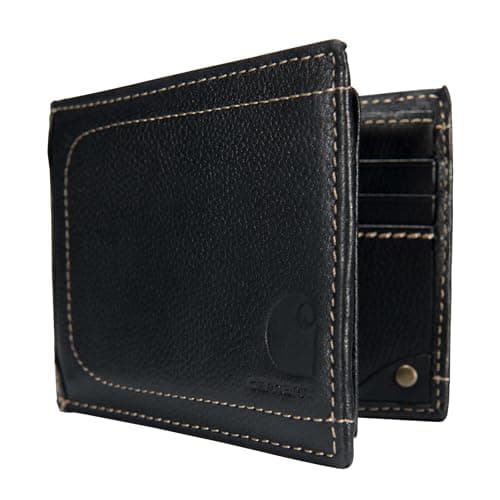
If the scuff problem is what you are actually solving, texture beats smoothness. Pebbled leatherbreaks up reflections and a pale scratch has to compete with the pattern, which is why the Carhartt sits at number two on a page where it is not the cheapest or the slimmest. A smooth, glossy black panel is the most unforgiving surface in this entire catalog: every fingernail mark on it reads. The middle ground is an oiled or waxed black, where the finish can be rubbed back with a fingertip — our guide to getting scratches out of a leather wallet covers what can and cannot be recovered.
3. Decide whether you want the stitching to show
On a black wallet the thread is the only visible design element, and it goes one of two ways. Tonal black-on-black reads as formal and makes the wallet look like one solid object; contrast stitching in tan, white or red turns the thread into a feature and is how most of the workwear and heritage brands sign their work. Neither is better. What matters is that contrast thread also shows dirt, and light thread on a black wallet is the first thing to go gray. If you want the formal version, tonal is the answer and it is the default on four of these six.
4. Match the format to the pocket, then come back to color
Color is the last decision, not the first, and it is worth saying plainly on a color page: no black wallet will fix a format that is wrong for you. If you carry a lot of cards, a vertical bifold or a ten-slot wallet solves more than a color change will. If you sit on your wallet, read whether sitting on your wallet is bad for your back and then buy a front-pocket bifold. Our overall best leather wallets page ranks on quality with color held out entirely, and it is the better starting point if you are flexible.
What black is not
- Black is not RFID. Three of these six state RFID blocking and three do not, and the color has nothing to do with it. Our honest read on RFID is more skeptical than most; if you want it anyway, RFID wallets is the page.
- Black is not formal by itself. A thick black trifold is not dress-code correct just because it is black. If a suit is the use case, thinness is the requirement and wallets for dress pants is the page that ranks for it.
- Black is not a sign of real leather. Black is the easiest color to fake convincingly, because the coating that gives cheap vegan leather and bonded leather their surface is most plausible in black. How to spot fake leather is the test to run before you trust a cheap black wallet, and one of our own picks is only on this page because its listing states a tannage rather than a vibe.