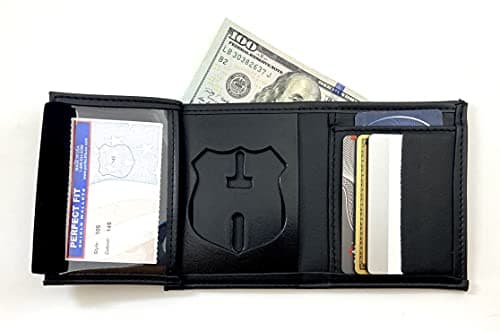
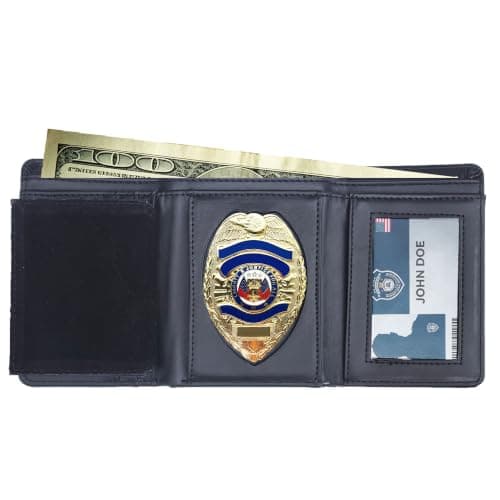
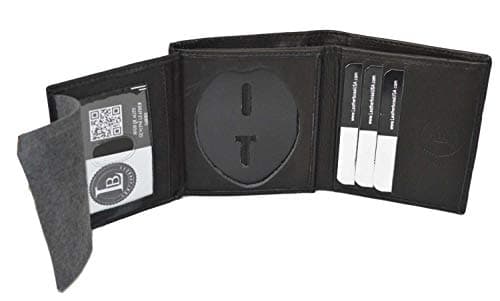
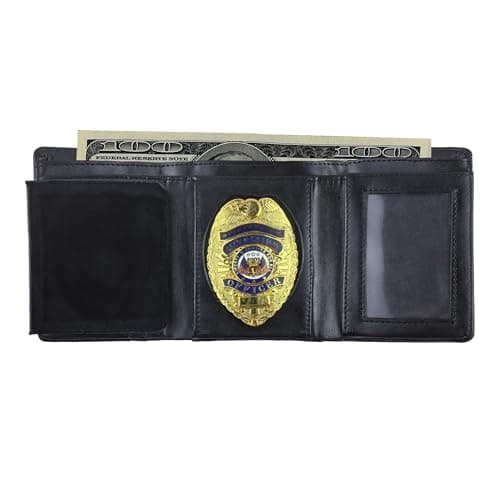
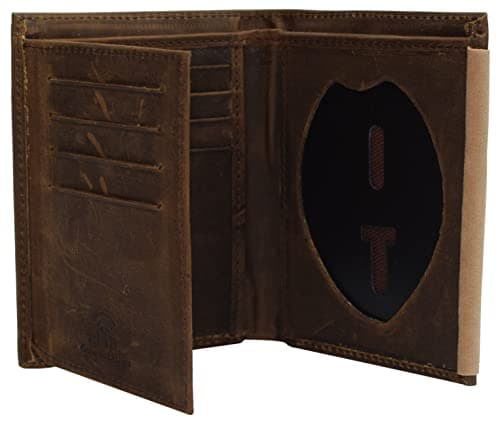
The pick for most people is the CAZORO Police Badge Bifold — it takes any pin-back badge shape rather than one department's outline, and it is the only pick here that is also a complete eight-slot wallet with an aluminum RFID lining. If your badge is a named department shield, the Perfect Fit NYPD patrol wallet is cut for it, publishes the cut, and is the only pick made in the USA. And if you want the badge itself protected rather than just carried, the SHANMMY eagle trifold is the one with a felt flap between the metal and the leather.
Measure your badge first. Everything else is secondary
This is the only category of wallet we rank where the deciding spec is not thickness, capacity or leather grade. A badge wallet has a die-cut opening sized to a specific badge outline, and if your badge does not fit that opening the wallet is returned — no other quality matters. So before you buy anything on this page, take two measurements with a ruler: the badge's overall height and its widest point, in inches, and note whether it has a pin back or a clip.
Then compare them against the cutouts these sellers publish. Three of the five do, and the figures are genuinely different from one another:
- 3.14 x 2.18 in — JSHYGOUP, cut for eagle-shaped pin-style badges.
- 3.14 x 2.17 in — SHANMMY, also eagle, and effectively the same opening to within a hundredth of an inch. That the two independent eagle cuts agree this closely is the best evidence on this page that there is a de facto standard eagle size.
- 2.65 x 2.40 in — Perfect Fit, cut for an NYPD patrolman shield. Note how different that is: shorter and considerably wider than the eagle cuts. A shield is not an eagle, and a wallet for one will not hold the other.
- Any shape with a pin back — CAZORO, which publishes no dimension because it does not need one.
- “Shield shape”, no dimension — Leatherboss. This is the weakest position on the page and the reason that pick is fourth rather than higher: shield badges vary between departments and there is no number here to check yours against.
The rule for getting on this page
Two conditions. The listing has to describe a badge opening or badge compartment as a named feature — not an ID window, which is a different thing for a different document — and the wallet has to be real leather. That second rule removes most of what a search for this returns: the bulk of the category is PU and nylon duty gear, and the lanyard-style ID holders that dominate the cheaper results are neither leather nor badge wallets. If a clip-on ID holder is actually what you need, the ID-window roundup is the closer page — it ranks wallets with a clear document panel, which is what most non-sworn work badges require.
Hidden badge or flap? The two designs solve different problems
Every pick here uses one of two approaches, and the listings use the terms loosely enough that it is worth separating them.
A hidden badge compartment
The badge sits inside the closed wallet and is only visible when you open it. Three picks do this — CAZORO, Perfect Fit and SHANMMY — and it is the right design for anyone who does not want the badge on display while off duty or in plain clothes. The cost is thickness: the badge is inside the fold rather than flush with a face.
A cutout with a protective flap
The badge shows through an opening, and a leather flap folds over it. Leatherboss and JSHYGOUP work this way. It is faster to present and it keeps the wallet thinner, and the flap exists because a badge pressed against the inside of a folded wallet will mark it.
One listing is unusually candid about the consequence either way, and it applies to all five: JSHYGOUP states that once a badge is inserted, the wallet becomes slightly thicker. A duty badge is a solid metal casting. Nothing on this page makes that disappear, and any listing implying otherwise is selling you something.
What the badge does to the leather, and the one mechanism that addresses it
The failure specific to this category is not the leather wearing out — it is the badge wearing the wallet, and the wallet wearing the badge. A plated badge face rubbing against a leather lining for a few thousand open-and-close cycles dulls the plating, and the badge's pressed edges score the lining.
Exactly one pick publishes a mechanism for it: SHANMMY's high-density felt flap, which sits between the metal and the leather when the wallet shuts, plus a molded slot shaped to the badge so it is retained by the recess rather than by its own pin. Whether felt solves it completely we cannot tell you — no seller in this category publishes a wear test and we have not run one. What we can say is that it is the only pick that names the problem and does something structural about it, and that it costs an inch of published closed thickness to get.
A note on RFID, which matters differently here
Two picks state RFID blocking, and on a duty wallet the usual advice needs an extra sentence. Contactless payment cards and most proximity access badges both operate on the 13.56 MHz band. So a lining that blocks skimming of your bank card will equally block the building fob or access card you may need to tap at a door — which is the product working as designed, not failing. If your credential is a proximity card you tap several times a shift, an RFID-lined wallet means taking it out each time. Our general position on shielding is unchanged and is in are RFID wallets worth it: a tiebreaker, never a reason.
Leather grade in this category, printed as it is
Not one of the five listings publishes a grade. We get “genuine leather”, “100% premium genuine leather”, “100% premium leather” and “genuine leather made in USA” — none of which is full grain, top grain or split, which are the words that would mean something. The grade guide explains exactly what is being withheld.
One contradiction is worth naming because we resolved it against the seller. CAZORO's title says “Full Grain Genuine Leather” while its own first feature bullet says only “Genuine Leather”. Those are different grades and both cannot be true, so the spec table above publishes the lower claim. Two of the five do name a construction detail that is worth more than the grade word anyway: drum-dyed leather, which is colored through the hide rather than sprayed on the surface, so a scuffed edge does not reveal a pale core. On a wallet opened and closed all shift, that is the more useful fact.
Do you want one wallet or two?
The honest split, and it is the decision most people on this page have not made yet.
One wallet means the badge wallet is also your everyday wallet, and only the CAZORO really supports it — eight card slots, two slip pockets, a bill pocket and an ID window is an ordinary wallet's capacity. The Perfect Fit, with five card slots and a separate cash pocket, does it adequately.
Two wallets means a slim badge carrier on duty and your own wallet off it. The SHANMMY (three card slots, an inch thick closed) and the Leatherboss (no published card count at all) are this, and there is nothing wrong with it — a duty carrier that lives in a uniform pocket and never gets sat on will outlast a wallet that does both jobs. If you go this way, the second wallet can be anything on the slim roundup or the front-pocket hub.
Military ID, and where this page stops
A meaningful share of searches that reach a page like this are about a military ID rather than a badge, and we would rather say plainly that this is the wrong page for it. A CAC or military ID card is a card: it is ISO-sized, it is frequently a proximity credential, and what it needs is a clear window and no shielding over it — not a die-cut badge opening. The ID-window roundup is the page, and the RFID caution two sections up is the thing to read before buying anything lined. We do not rank a CAC-specific wallet because we have not found one in real leather whose listing publishes a window dimension; when we do, it will go there rather than here.
Buying advice that earns us nothing
If your department issues a badge holder, use it until it fails. And if your badge is an unusual shape with no published cutout anywhere, the right purchase is not the cheapest shape-cut wallet on this page — it is the universal pin-back CAZORO, or a wallet from whichever duty-gear supplier your colleagues already use, because a fit you can see on someone else's wallet beats a dimension you are guessing at.
Prices, and what we earn
Every price here is read live from the Amazon Product Advertising API and stamped with the date it was read, which is why no dollar figure appears in this prose. Buy links are affiliate links; the ranking is score-ordered and would be identical if they paid nothing. See the editorial policy.
How we picked
We do not run a testing lab
The standard five-metric wallet rubric is the wrong tool here, so this page scores on a modified one and says so. The decisive criterion is fit: does the listing publish a badge cutout, and does it name the badge shapes and attachment types it accepts? A listing that publishes a cutout to two decimal places is treated as better than one that says “shield shape” and leaves you guessing, independent of price or leather.
After fit we scored badge protection (a flap, a felt liner, a molded recess — any published mechanism for keeping metal off leather), everyday usability (card slots, a cash provision, an ID window, published closed size), construction (drum dyeing, reinforced stitching, stated origin) and value. We did not handle any of these wallets, we have not fitted a badge into one, and we make no claim about retention strength or wear life — every figure above is the seller's own published bullet, and where a seller publishes nothing the spec table says so with a dash.