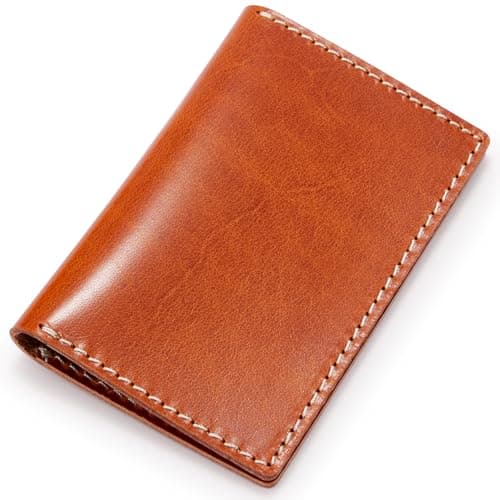
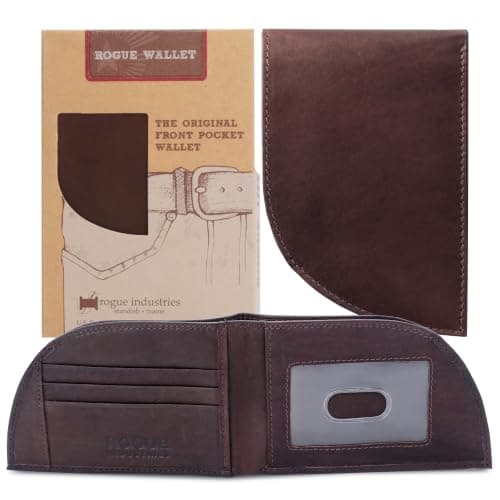
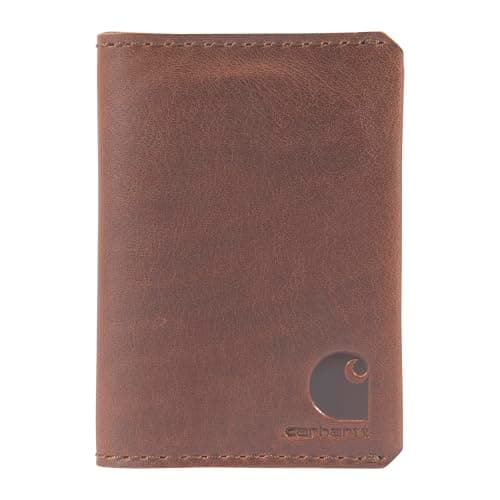
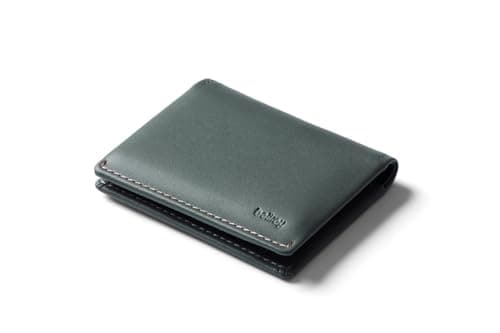
The pick for most people in tailored trousers is the Bellroy Slim Sleeve — the smallest footprint on this page that still folds around a note, in a leather that will not look wrong against a suit. If you are willing to stop carrying cash in your pocket, the HISCOW vegetable-tanned card holder is thinner still and is the genuinely correct answer for a slim-cut trouser. And if the problem is a shallow pocket rather than a tight one, the two quarter-inch bifolds at the bottom of the list — the Rogue curved leather and the Carhartt Craftsman — are the thinnest published figures we have found anywhere, and both are cut to sit in a front pocket rather than across it.
Why dress trousers are a different problem from jeans
Three differences, and together they change the answer.
The cloth is thin and it drapes. Denim is stiff enough to hide a wallet's outline; worsted wool is not. A wallet that looks fine in jeans will show as a rectangle through a suit trouser, and that single fact is why “slim” in a listing title is not good enough here. It is also why the best answer is often a softer wallet rather than merely a thinner one: a flexible single-layer sleeve follows the leg, where a stiff lined bifold holds its shape and prints.
The pocket is cut shallower and narrower — and often on a curve, which is the whole reason the front-pocket format exists. A wallet cut as a plain rectangle fights that curve and rides up; a wallet cut with a radius sits down into it. Rogue holds patents on exactly this idea — a wallet shaped to the cut of a front pants pocket — and the curve is the reason both of its entries here feel thinner in the pocket than their numbers suggest.
You sit down in it, formally, for hours. A front pocket under a seated thigh is the one carry position where total bulk is felt continuously rather than noticed occasionally. This is also the argument against solving the problem by moving the wallet to the back pocket, which we go through in front versus back pocket.
The rule for getting on this page: published thickness, or a layout that proves it
We would have liked to rank this page purely on published closed thickness. We cannot, because most listings in this category do not publish one — and we will not take a dimension from a marketplace item-dimensions table, which measures the shipping carton rather than the wallet.
So the rule is: a pick qualifies if its listing publishes a closed thickness at or under half an inch, or if its published layout makes a thin result structural — a single-piece construction, no RFID film, no ID window, few enough slots that there is nothing to stack. Two picks clear the first test outright: the Carhartt Craftsman publishes 0.25 in with two card pockets, a single-piece build, no lining and no window, and the Rogue curved bifold publishes 5 x 3.4 x 0.25 in with three cards plus an ID slot and no RFID lining. Those two figures are the floor of this entire market as far as our record goes, and the price of admission is printed right next to them: you get three cards.
The arithmetic that decides this
Ten of the wallets and card cases we rank publish a closed thickness. Lined up against their published slot counts, those figures run from 0.25 in at two card pockets to 1.18 in at twenty-four slots, and the relationship is close to linear at roughly 0.035 to 0.040 in of extra closed thickness per slot the maker added. A payment card is 0.030 in. So an empty slot costs about as much thickness as a card does, which inverts the way these listings are written: the slot count is an argument against a wallet for this use, not for it.
The practical consequence is the rule we would give a friend buying for a suit: count the layers, not the capacity. Fewer layers per card beats fewer cards. The full derivation, the counter-example that proves the point, and the honest limits of the finding are in the wallet thickness guide. Cash, by the way, is almost never the culprit: a US note is 0.0043 in thick, so ten folded bills add under 0.09 in — less than three cards. Receipts are the paper that actually accumulates.
Thinnest, softest or smallest? Pick one
These three are not the same requirement and the listings treat them as if they were.
Thinnest is what you want for a shallow pocket, and it points at the single-piece bifolds. They sit low and flat and they hold almost nothing. Softest is what you want for a thin, draping cloth, and it points at the unlined sleeves and the card-and-elastic builds — they deform rather than print. Smallest footprint is what you want for a narrow, tight pocket, and it points straight at a card holder, which is the only format here that gives up the cash channel entirely and gets the length of a payment card plus a seam in return.
What we left off, and why
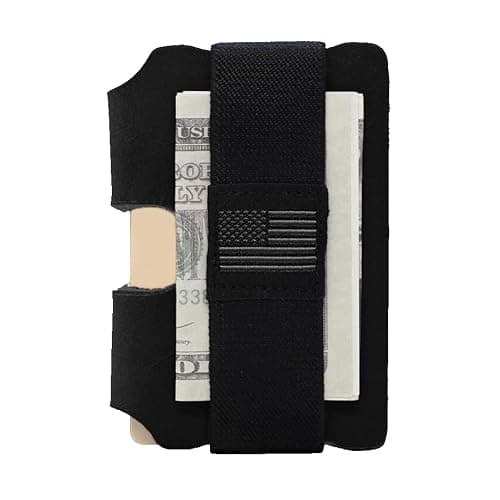
We left off everything with an RFID lining from the top of this ranking, not because shielding is bad — it is close to free, and we rank it elsewhere — but because a film is one more layer in a page whose entire axis is layers. We left off money-clip wallets: a clip is a rigid metal part in the softest possible pocket, which is the one place it is most likely to show. Those are ranked on the money-clip page. And we left off every metal cage wallet, which is thin, rigid, and the most likely of all of these to read as a hard edge through a suit trouser.
One honest note on the Rogue curved bifold: it is the only pick on this page without a verified live price in our last refresh, so its buy row falls back to checking the price on Amazon rather than showing a number. We would rather show you that than a stale figure.
If nothing here is thin enough
Then the wallet is not the problem — the load is. Strip the cards you have not used in a month, bin the receipts, and move the loyalty cards to your phone; the method is in how to organize your wallet. After that, the two real options are a card holder in the trouser and a second wallet for the days you need more, or a MagSafe holder on the phone you are carrying anyway.