A front pocket wallet is a wallet designed to be carried in the front trouser pocket rather than the back, and the format has two defining properties rather than one. It is thin — under about half an inch closed, with a published floor of a quarter inch — and the good ones are cut on a curve, so the body follows the arc of a front pocket instead of bridging across it. The thinness is what every listing advertises. The curve is what actually distinguishes the format, and it is the part almost nobody explains.
The curve is the real idea
A front trouser pocket is not a flat envelope. It is cut on a radius that follows the hip, it is shallower than a back pocket, and it narrows towards the bottom. A rectangular wallet dropped into it bridges the curve at its corners, which means it sits high, shifts when you walk, and presents its stiffest edge to the one place you least want one.
A wallet cut to match that radius sits down into the pocket and stays there. It is a geometry advantage rather than a thickness advantage, which is why a curved wallet and a flat one of identical published thickness feel different in the same trouser. Rogue Industries, the Maine company that popularized the format, holds two patents on exactly this: a wallet “shaped to fit the cut of your front pants pocket”. The same shape makes a curved wallet worse in a flat back pocket, which is the honest trade and the reason we rank the two carry positions on separate pages.
What to look for, in order
Four things, ranked by how much they matter.
1. Layer count, not slot count
This is the one that decides whether the wallet works. Across the ten wallets and card cases we rank that publish a closed thickness, the figures climb by roughly 0.035 to 0.040 in for every slot the maker added. A payment card is 0.030 in. So an empty slot costs about as much thickness as a card does, and a listing boasting twelve slots is advertising eleven slots of bulk you may never fill. Count the layers — outer panels, slot leathers, linings, ID windows, middle flaps, RFID film — and prefer the wallet with fewer. The derivation is in the thickness guide.
2. Shape
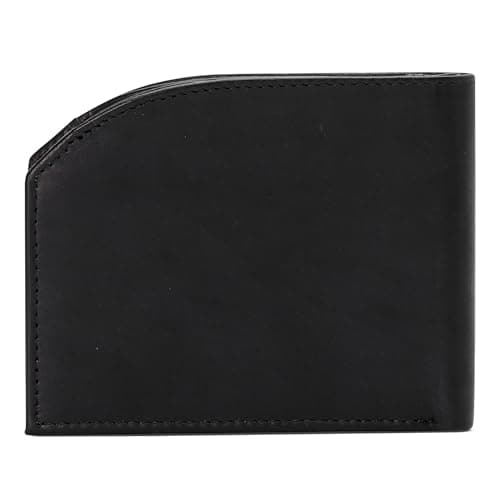
Curved if the pocket is curved and you sit down a lot. Flat-and-small if the pocket is shallow and tight, where footprint beats contour. The listings almost never publish a radius, so the photograph is your evidence: look at the bottom edge.
3. The cash decision
A full-length bill channel is two faces of leather carried every day whether or not there is a note in it. Giving it up for a card holder roughly halves the thickness; keeping it buys you somewhere to put cash without folding it twice. There is no right answer, only a choice you should make deliberately — how much cash should you carry is the page that helps you make it.
4. Softness
An under-rated one. In thin cloth a soft, unlined wallet deforms with the leg where a stiff, heavily lined wallet of the same thickness holds its shape and prints through. This matters most in tailored trousers and is the whole subject of the dress-trouser page.
Three wallets that show what the format looks like
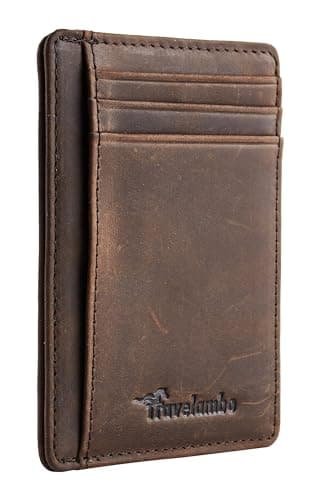
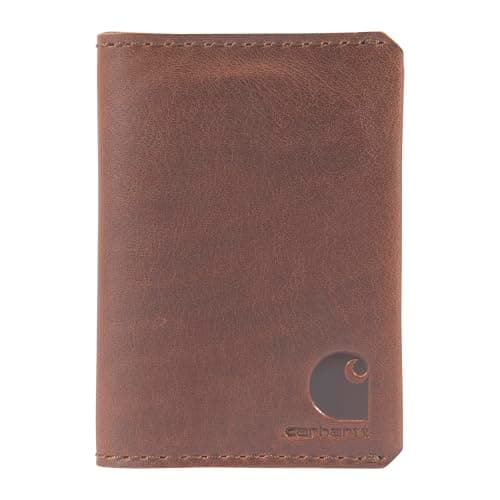
One curved leather front-pocket bifold with a cash channel, the budget bestseller most people actually buy, and the single-piece wallet that publishes the thinnest figure we have found. They are here as illustrations of the three shapes the format comes in — the full ranking is on the front-pocket roundup.
The floor, and what it costs
The thinnest closed thicknesses we have found published anywhere in this category are a quarter of an inch, and two wallets state it: a single-piece bifold with two card pockets, no lining and no ID window, and a curved leather bifold published at 5 x 3.4 x 0.25 in with three cards plus an ID slot and no RFID film.
The price of admission is printed right next to the number, and it is the honest headline of this whole format: you get about three cards. There is no wallet that is a quarter of an inch thick and holds twelve cards, and any listing implying otherwise is describing a wallet measured folded and empty. If three cards is not enough, the right move is to accept half an inch rather than to look for a thinner twelve-slot wallet, because that object does not exist.
One useful counter-example keeps this from becoming a rule about capacity. A slim bifold in our records publishes 0.4 in while claiming eight to ten cards, by using pull-tabs and ID windows instead of eight discrete stacked slots. So the rule is fewer layers per card, not fewer cards — a distinction worth more than any single number on this page.
Why carry in front at all
Two reasons that survive scrutiny. It is much harder to pickpocket — a front pocket is in your field of view and against your thigh, where a back pocket is neither — and it is better for your cards, because you are not applying a sustained bending load to the stack every time you sit down. The card side of that is worked through in do card holders damage cards.
We deliberately make no health or comfort claim about back-pocket carry. There is a large search cluster connecting it to back, hip and leg pain, and we are a wallet review site with no clinical expertise — so we do not diagnose it and we do not imply that buying a wallet treats it. The carry comparison on its own merits is in front versus back pocket.
What a front pocket wallet is not
It is not simply any slim wallet: plenty of slim wallets are flat rectangles sized for a back pocket, and they are ranked on the slim roundup. It is not a money clip, though many front-pocket wallets include one — those are on their own page. It is not a card holder, which is thinner still and gives up the cash channel entirely. And it is not a metal cage wallet: those are thin and rigid, and rigidity is the wrong property in a soft pocket you sit on.
A note on dimensions
Every thickness figure on this page comes from a seller's own published title or feature bullets. None comes from a marketplace item-dimensions table, which measures the shipping carton rather than the wallet — a limitation we have now hit on four separate pages and record every time. Where a listing publishes no thickness, we say so rather than estimating one.