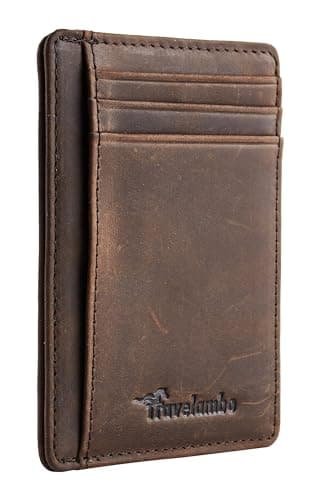
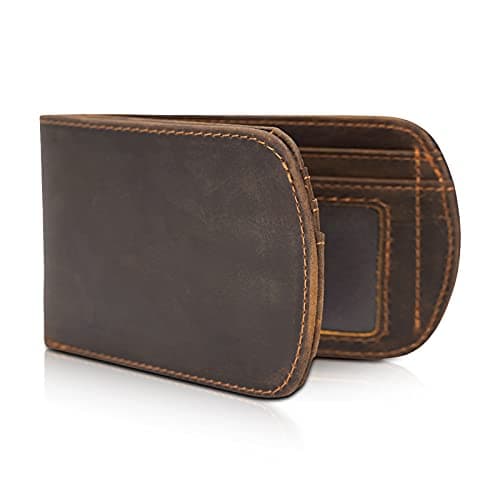
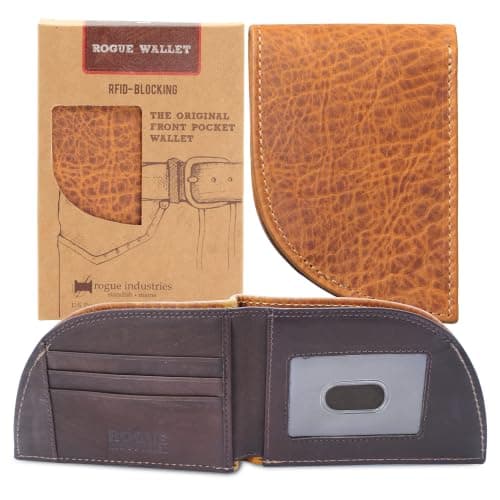
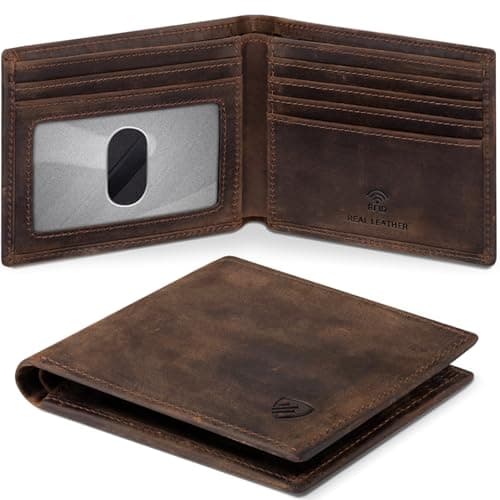
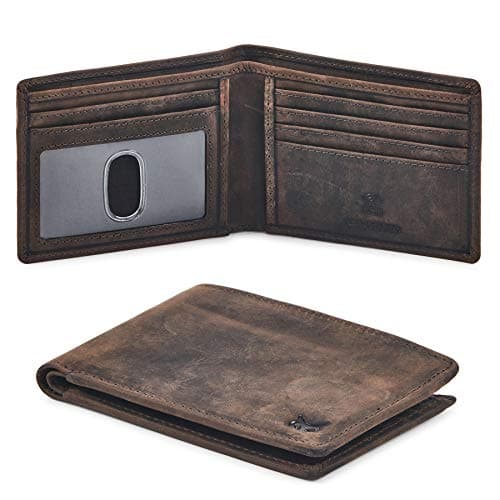
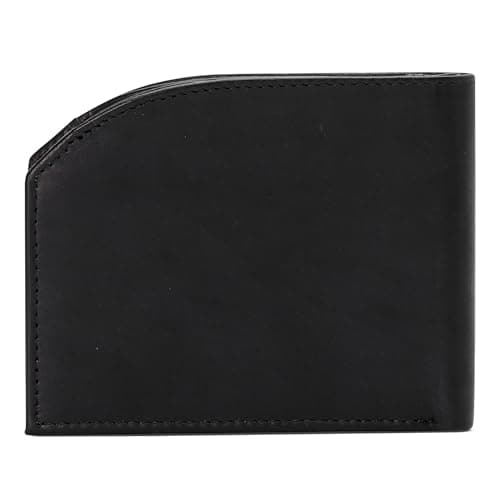
The pick for most people is the Rogue Wallet Slim Leather Front Pocket (RFID): top-grain leather, a full-length cash channel, stated shielding, and — the part no rectangle wallet can copy — a body cut on a curve to sit down into a front pocket rather than bridge across it. On a budget, Travelambo states the same feature for a fraction of the money and is the most-bought wallet we rank. If you want US manufacture with the shielding, Rogue's bison model is the only pick here that states both.
Read this before you choose on RFID
Wireless skimming is a small and shrinking way to lose money next to card-not-present fraud, and contactless payments are tokenized precisely so that a captured transmission cannot be replayed. The case is laid out with its evidence in are RFID wallets worth it, and the conclusion holds here: a lining is close to free on a modern leather wallet, so take it — but never accept a worse wallet to get it. Every pick below had to earn its rank on shape, leather and layout first.
The rule for getting on this page
Three conditions. The wallet must be real leather — which rules out the metal cages and the synthetics. Its listing must state RFID or NFC blocking; we do not infer it. And it must be a genuine front-pocket wallet: either cut to the pocket's curve, or slim and short enough that a front pocket is where the maker intends it to go. A conventional back-pocket billfold with a foil lining does not qualify, however thin the title claims it is.
That third condition is what makes this page worth having next to the main RFID roundup, and it is a bigger gap than it sounds: that page ranks the best shielded wallets in any format, leads with an aluminum cage and a pop-up cardholder, and carries exactly one front-pocket wallet among seven picks. If you have already decided that the wallet is going in your front trouser pocket, almost all of that ranking is answering a different question.
What the shielding does and does not cover
The lining is a conductive film laminated between leather and lining that attenuates the 13.56 MHz field contactless cards answer on. Three consequences, none of them printed on any listing here.
It protects a card only where the layer is. Four of these six have an ID window or an external slot, and a card sitting in one is unshielded — which is worth knowing, because an ID window is where people put the card they tap with. It is frequency-specific: it does nothing to a magnetic stripe, which is read by contact, and nothing to the chip. And it will block your own transit card and door fob while they are inside, which is the product working rather than failing.
Where the honesty problems are in this set
Two worth naming before you spend anything.
Leather grade. Of the six, two state top-grain, one states bison, one claims “full-grain Italian” without naming a tannery, and two say “genuine leather” or “real leather” with no grade at all — and “genuine leather” is a specific, low rung on the ladder rather than a reassurance. The spec table prints the lower claim wherever a listing contradicts itself. The ladder itself is explained in the grade explainer.
Country of manufacture. Rogue is a Maine company and that is a genuine selling point, but the company's own FAQ states plainly that only its Made in Maine collection is made in the USA and that products outside that collection are not. Of the Rogue models we rank, the bison wallet is the one that states Maine manufacture. Do not read the brand name as an origin claim on the others; if provenance is what you are buying, start from the made-in-USA roundup.
The layer problem this page cannot escape
An RFID film is an extra layer, and layers are what make a front-pocket wallet thick. Ten of the wallets we rank publish a closed thickness, and against their published slot counts the figures run roughly 0.035 to 0.040 in thicker per slot the maker added — about what a 0.030 in payment card costs. The two thinnest published figures in our whole record, both a quarter of an inch, come from wallets with no RFID lining at all and two or three card pockets.
So there is a real trade here and it is worth stating plainly: if the pocket is the binding constraint rather than the shielding, look at the wallets ranked purely on thinness instead, and accept that most of them do not shield. The derivation behind the per-slot figure is in the thickness guide.
Capacity claims, and which number to believe
Read the feature bullets, not the title. In this set, two listings publish a slot count in the bullets that is lower than the card count in the title, and the honest reading is always the bullets — a title that says “up to” is describing a squeeze with nothing else in the wallet. Where a listing publishes a range, that is the most trustworthy format you will see in this category, because a wallet genuinely does hold a comfortable minimum and a strained maximum.
What we left off, and why
Every metal cage wallet, because this is a leather site and because a rigid aluminum block is the wrong object for a soft pocket — the comparison is in leather versus metal. Every wallet whose listing does not state shielding, including several we rank highly elsewhere; silence is not a yes. And every back-pocket billfold, however slim the marketing — those are on the back-pocket page, which ranks on a completely different failure mode.