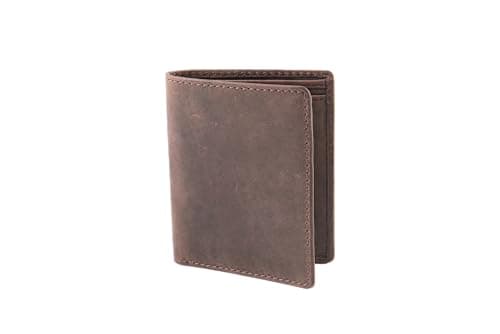
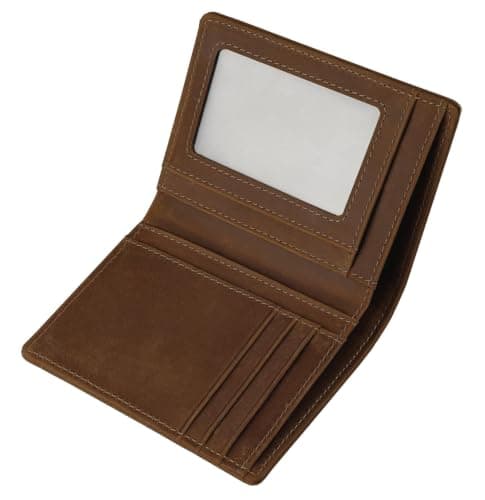
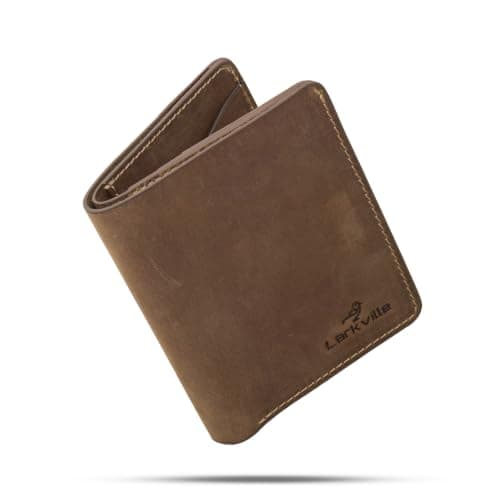
“Vertical” is doing two completely different jobs in this category, and almost no listing tells you which one it means. It can mean the wallet is rotated — taller than it is wide, so it stands up in a pocket rather than lying across it. Or it can mean only the card slots are rotated inside an ordinary bifold, so you thumb cards upward out of a conventional 4.5-inch-wide billfold. Those are different objects that carry differently, cost differently and hold cash differently, and they come back under the same search. Sorting them is what this page is for.
The rule for getting on this page
Three conditions, all mechanical, all checked against each listing itself on the day this page was published. First, the listing has to call the wallet vertical — not merely its slots — in its own title or feature bullets. Second, it has to fold: the listing calls it a bifold. A flap that snaps shut over a card stack is a different format, however vertical it is, and two good ones are named at the bottom of this page rather than ranked in the middle of it. Third, it has to state real leather, and we record the grade at whatever level the listing claims it — no higher.
Seven wallets passed. One of them, the LnxLtw at the bottom, passes the words and fails the arithmetic, and it stays on the page deliberately because it is the clearest example of the confusion in the first paragraph. The ranking uses our standard five-metric rubric — slimness, leather, capacity, build, value — and the picks are listed in score order, with ties broken on leather and then build.
Why a rotated wallet comes out about 3.5 by 4.3 inches
This is checkable rather than assertable, and it is the test the picks above are measured against. A payment card is a standardized object: ISO/IEC 7810 fixes the ID-1 card at 85.60 by 53.98 mm, which is 3.37 by 2.125 inches. In a conventional bifold the card lies on its side, so its long edge sets the closed width and the wallet comes out about 4.5 by 3.5 inches — the arithmetic our standard bifold wallet size guide works through, and the footprint three unrelated makers publish.
Turn the card upright and the two governing numbers swap axes. The card's long edge now runs up and down, so 3.37 inches becomes the height floor, and the short edge sets a width floor of 2.125 inches. Add a stitched slot wall, an edge and a fold and you land somewhere around three inches wide by four and a bit tall. Read what the listings actually publish against that prediction:
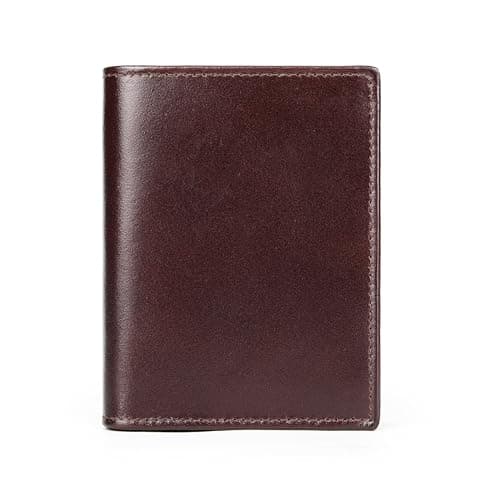
- Larkville: 3.5 in W x 4.3 in H x 0.5 in, with the W and the H labeled. The only listing in the whole set that says which number is which.
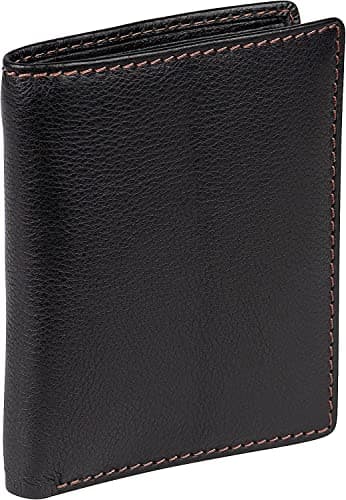
- Theodore Vertical Bifold: 3.5 x 4.4 in, unlabeled, no thickness. Read the ordinary way it is taller than wide, so the figures agree with the claim.
- NIUCUNZH: 4.62 x 3.72 x 0.75 in, stated as folded and empty. Taller than wide only if the 4.62 is the height, which the listing never says.
- LnxLtw: 4.5 x 3.6 x 0.7 in — the conventional bifold footprint, almost to the tenth. See below.
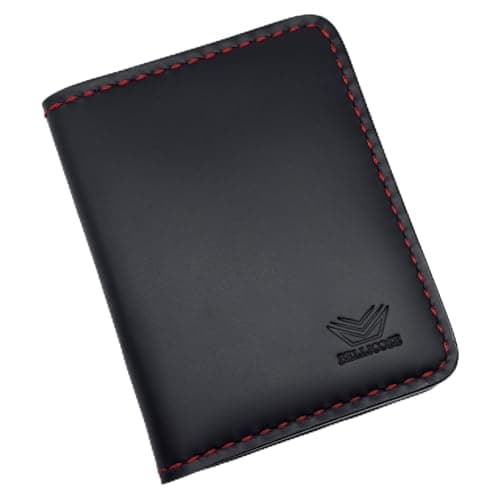
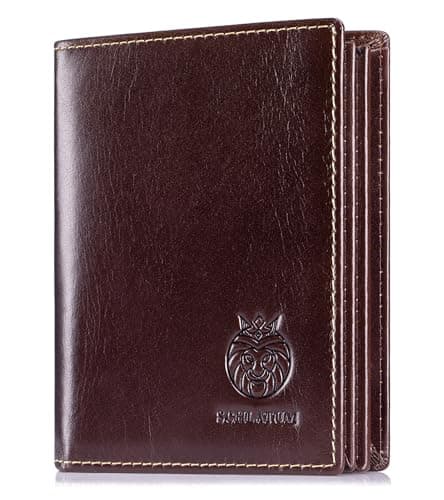
- Bellicose, SCHLATUM, Theodore Slim: no dimensions in the bullets at all. We have not filled the gap from Amazon's item-dimension table, which on the Larkville returns 3 x 3 x 2 inches — that is the gift box, not the wallet.
Three of seven publish a footprint. One of seven says which way round it is. On a format whose entire selling point is which way round it is, that is the finding, and it is why the wallet that prints a labeled width and height wins a ranking it would not otherwise have led.
Rotated wallet, or rotated slots?
The LnxLtw is the useful case. Its own first bullet publishes 4.5 by 3.6 by 0.7 inches, and its third publishes two full-length cash pockets for US bills. A Federal Reserve note is 6.14 inches long; folded once it is 3.07 inches across. A pocket that takes a note along its full length needs a wallet whose long axis is its width — which is exactly what 4.5 by 3.6 describes. This is a conventional bifold with its card slots turned upright. That is a real product, a real thing people search for, and not the same purchase as the wallets above it.
The same reading explains the cash difference across the whole page. A once-folded note is 3.07 inches across, so a 3.5-inch-wide rotated wallet clears it by less than half an inch — which is why the Larkville and the Theodore have cash compartments at all, and why every vertical wallet narrower than that which we looked at stops calling itself a bifold and starts calling itself a cash wallet with a flap. If cash is the main event, our best wallet for cash and cards guide is the better starting point than any shape argument.
What rotating a wallet actually gets you
It changes the pocket, not the volume. A rotated wallet is roughly a quarter narrower and a quarter taller than the equivalent bifold. In a front trouser pocket, narrower is the dimension that matters, because the pocket opening runs across your hip — which is why five of the seven listings here lead with front-pocket carry. In a back pocket or a jacket, the same change buys you nothing. Our front-pocket vs back-pocket guide covers that comfort argument properly, without the medical claims some wallet listings attach to it.
Cards come out upward instead of sideways. Whether that is better is a preference, not a fact, and no listing on this page offers evidence either way. What is true is that a rotated slot shows you more of the card face at rest, which makes a stack of similar-looking cards easier to tell apart, and that an upright wallet in a front pocket presents the top edge of the stack to your thumb rather than the long edge.
Cash gets folded, not laid flat. This is the real trade and the one buyers miss. A conventional bifold has a bill section that takes a note folded once, down its length, hidden behind the cards. A rotated wallet has compartments about three and a half inches across, so a note goes in folded once and sits proud of nothing — fine for a few bills, cramped for a stack. The vertical wallets that kept a full-width bill section, like the LnxLtw, did it by keeping the conventional footprint.
The 15-and-16-slot wallets are one layout with several names
Two picks here sit at the capacity end: the NIUCUNZH (16 slots, 2 expandable bill compartments, ID window, 19 pockets) and the SCHLATUM (15 slots, 2 cash compartments, flip-out ID). Searching the category surfaces the same wallet under other brand names too — SAIION and LUKZIJAES among them — with bullet copy that overlaps the NIUCUNZH's almost word for word, typo in “bill comparments” included. We ranked the two with the best published numbers and the healthiest stock rather than filling four slots on this page with the same wallet, and you should assume the pattern when you shop it: in this corner of the category you are choosing a price and a leather claim, not a design.
Worth being blunt about what fifteen slots in a fold costs. At the ISO card thickness of 760 micrometres, sixteen payment cards are about half an inch of plastic on their own, before any leather. The NIUCUNZH publishes three-quarters of an inch folded and empty, which is honest of it and also means the wallet in your pocket is not the wallet in the specification. Our guide to how many cards a wallet should hold makes the case that almost nobody needs sixteen, and if you do, a dedicated large-capacity cardholder handles the load better than a fold does.
Leather claims, read at face value and no higher
The grade ladder on this page runs further than usual. Two picks claim full-grain cowhide with something to back it: the Larkville names a crazy horse finish and describes how it behaves, the Bellicose names hand-stitching. Two Theodores claim full grain, one of them naming napa. Then it drops: the SCHLATUM says genuine cowhide and keeps saying genuine cowhide, which is the most honest material bullet here. The NIUCUNZH claims top-grain Italian leather at a price that cannot support the phrase and names no tannery or origin. And the LnxLtw says “full-grain genuine leather”, which is not a grade — full grain and genuine are two different, mutually exclusive rungs. Our full-grain vs top-grain vs genuine guide is the ladder itself, and crazy horse leather explains why the top pick's finish is the one that improves with a front pocket.
Considered and not ranked
DiLoro 1809 Bifold Flip ID. Full-grain cowhide, two flip ID windows, twelve slots the listing explicitly calls vertical, a center zipper and a coin compartment — and a published 4 3/4 by 3 3/4 by 1 inch body. That is the rotated-slots wallet, done properly and at the top of the price range. It is the best thing in this search that is not a vertical wallet, and it fails rule one on purpose.
SAUCLW Slim Vertical Cash Wallet and AMERICAN PERSONALIZED Hand-Stitched Crazy Horse. Both are leather, both publish a genuinely rotated footprint — 3 by 4 inches and 2.75 by 4 by 0.4 inches respectively — and neither folds. They close with a flap, which is the narrower answer to the same question and a format our minimalist wallets hub is the right home for.
Theodore Vertical Bifold Card Case. Top-grain leather, six slots, a published 2.76 by 3.94 by 0.39 inches, and it does fold — but it has no cash compartment at all. A wallet with nowhere for a note is a cardholder, and it belongs with the cardholders.
SAIION and LUKZIJAES 15-and-16-slot verticals. Same layout and overlapping bullet copy as the NIUCUNZH and SCHLATUM picks, with thicker published bodies and thinner stock on the day we checked. Ranking four versions of one wallet would pad the page without helping anyone.
CIERRSSCVV Crazy Horse Vertical Bifold. A real listing with a real vertical variant, but its feature bullets describe four different wallets at once — “horizontal bifold / vertical bifold / long bifold / tri-fold snap closure” — so not one number in them can be attributed to the thing you would actually receive. We do not compile specs from copy that does not know which product it is describing.
How to choose a vertical bifold
Decide whether you want the shape or the slots. If the appeal is a narrower object in a front pocket, you want a rotated wallet, and the only way to confirm you are getting one is a published width smaller than its published height. Three listings here print a footprint and one labels the axes. If the appeal is thumbing cards upward and you are happy with a normal billfold outline, the rotated-slot wallets are cheaper to find, hold cash flat and include the DiLoro named above.
Count your cards before you shop, not after. This format splits hard at about ten. Below that you are in six-slot territory, where the leather is better, the wallet is half an inch thick and two picks claim full grain. Above it you are in the 15-and-16-slot factory layout, where the leather claim gets weaker, the body gets thicker and the brand name on the listing means very little. There is almost nothing in between, so pick the side you are actually on.
Work out how you carry cash. A rotated wallet takes notes folded once into a compartment roughly three and a half inches across. That is fine for a few bills and cramped for a wad. If you carry real cash daily, either accept the fold or buy the conventional footprint and get a full-width bill section — our money clip vs bifold comparison is the same decision from the other direction.
Treat an unpublished dimension as a missing feature. Four of the seven listings here do not print a size. That is not a small omission on a format sold on its proportions, and it is the right thing to downrank for. Where a seller does print one, read the qualifier: the NIUCUNZH says folded and empty, which is the useful version, and every payment card you add is another 0.76 mm on top of it.
Weigh the leather claim against the price, not on its own. Full-grain crazy horse at a mid-range price from a listing that describes how the finish behaves is a claim you can act on. Top-grain Italian at a budget price with no tannery and no origin is a claim you cannot check, and the sensible response is to enjoy the wallet and not pay a premium for the adjective. Genuine leather honestly labeled is better than full grain asserted and unsupported.
What we would buy
For most people, the Larkville: it is the only wallet in the category that publishes a labeled width, height, thickness and weight, the leather claim is specific enough to argue with, and it sits in the middle of the price range. If hand-stitching and a full-grain hide matter more than knowing the footprint, the Bellicose is the craft buy, and you should know before ordering that its RFID protection is a card in the box rather than a lining in the wallet. If you want ten slots without dropping to genuine leather, the Theodore is the compromise, bought on the ten its title states rather than the sixteen its bullet claims.
At the capacity end, the SCHLATUM is the one we would actually spend on — it says genuine cowhide and means it, which is more useful than the NIUCUNZH's unverifiable upgrade for a couple of dollars less. And if what you wanted all along was a normal bifold with upright slots, buy that on purpose: the LnxLtw at the bottom of this page is the budget version, the DiLoro is the good one, and neither is the narrow wallet the other six are.