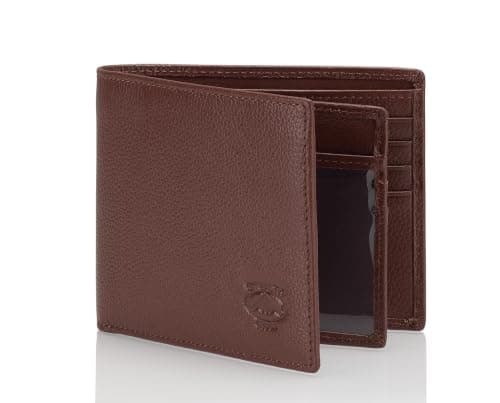
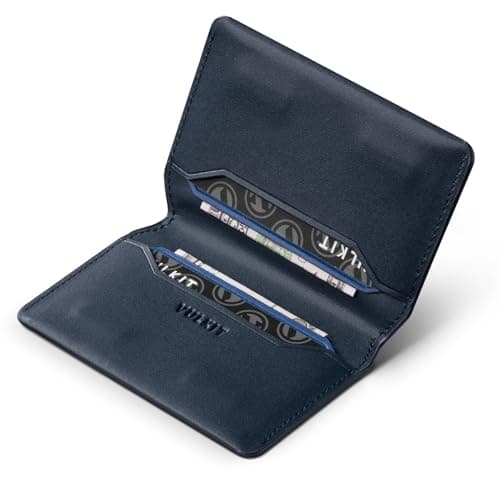
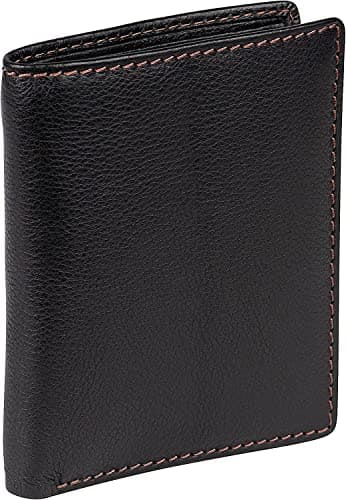
The short version: buy the Theodore vertical bifold. It is the only wallet on this page that pairs the nappa claim with the top grade — its listing says full-grain napa — and it publishes a 3.5 by 4.4 inch footprint and ten card slots while doing it. It is for someone who wants a soft hand and a hide that will age. The budget pick is the VULKIT slim nappa card holderat under sixteen dollars: four slots, a magnetic flap, and the only wallet in that brand's range that names its leather at all.
Here is what the word commits a seller to, which is less than most buyers assume. Nappa (or napa) is a softness, achieved by a tanning and finishing route that leaves a full-chrome hide unusually supple and smooth. It describes the hand. It says nothing at all about which layer of the hide you were sold. A nappa finish can sit on full grain, on top grain, or on a corrected split — and because an opaque, uniform, buttery surface is the ideal place to hide a corrected grain, this is a word that deserves a follow-up question rather than a nod.
The ranking rule: does the listing name a grade as well?
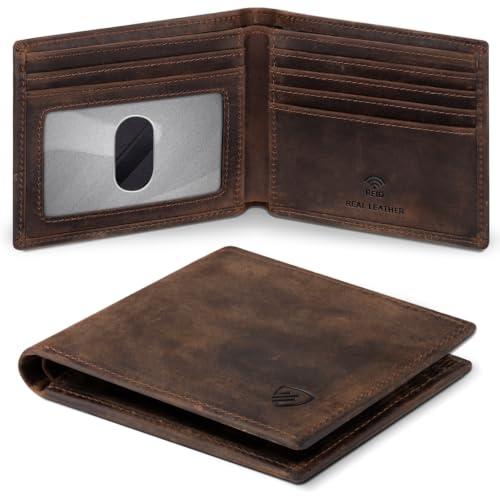
That is the whole page, and it sorts these four cleanly. Theodore states full-grain napa— the strongest pairing available, and it sits first. Stealth Mode states top-grain napa, one rung down and still a real claim, in a body with twelve published slots, an ID window and an RFID claim. RUNBOX names the leather as nappa or crazy horse depending on the variant you pick, which is honest about the range and vague about your particular wallet, so it ranks third despite publishing nine slots and an ID window for under twenty-five dollars. VULKIT states nappa and stops, which at under sixteen dollars is exactly the bargain it looks like and exactly as much as you should read into it.
What nappa is genuinely good at, and what it costs you
A nappa hide is soft, smooth and drapey in the hand, and in a wallet that is a real advantage: thin, supple panels fold without bulking at the spine, which is why two of the four picks here are slim bifolds and one is a vertical bifold that has to fold short. The cost is marking. A soft, smooth, lightly-finished surface shows fingernail scratches and pocket abrasion more readily than a pebbled or waxed one, and it does not buff back the way an oiled hide does.
So the honest positioning is this: nappa is the opposite choice to crazy horse, which is designed to mark and therefore cannot be ruined by marking, and a softer cousin of pebbled leather, which breaks up reflected light so wear does not read. If you want something that looks new for years, buy pebbled. If you want something that looks lived-in immediately, buy crazy horse. Buy nappa because you want it to feel expensive in the hand, and accept that it will show its life.
Nappa, napa and the designer confusion
The search for this term is split between people shopping wallets and people shopping designer handbags, where nappa is the standard interior and strap leather for several large fashion houses. That is the same material word in a very different price bracket, and it is worth saying plainly that a nappa wallet at thirty-five dollars and a nappa bag at several hundred share a finish vocabulary and nothing else. We rank wallets; if the word brought you here from the handbag aisle, the useful takeaway is the same — ask what grade sits under the nappa, because the word itself does not answer it.
Advice that earns us nothing
If a listing says nappa and nothing else, assume a corrected split and price it accordingly — which, at under twenty dollars, is a perfectly good deal and not a disappointment. What you should not do is pay a premium for the word. On this page the two picks that name a grade cost almost exactly the same as each other and barely more than the two that do not, so there is no reason to settle for the vaguer claim. Our genuine leather wallets page is the same argument at the bottom rung of the ladder.
Buying notes
Nappa is a finish, so care it like a finish
A chrome-tanned, finished hide takes conditioner slowly and does not need much. Clean it, keep it out of direct sun, and condition sparingly once or twice a year. It will not develop the patina a veg-tanned wallet does, because the finish sits between your hands and the fibre. See how to care for a leather wallet.
Soft is not the same as thin
A supple hide folds without fighting you, but it also compresses less predictably once the slots are loaded. Two picks here publish slot counts in double figures; a payment card is 0.76 mm thick before the leather around it, so a twelve-slot nappa bifold filled to twelve cards will be noticeably fatter than its photograph. Our bifold wallet thickness guide has the arithmetic.
If the softness is the point, handle the format first
Three of these four are folds and one is a flat card sleeve, and the hand of the leather matters far more in a sleeve — there is nothing else to it. If you want the material to be the experience, the card holder is the purest version of that and the cheapest. Our card holders page ranks that format properly.
Advice that earns us nothing
Nappa is the single most common way for a listing to sound premium without promising anything. If two wallets in front of you cost the same and only one names a grade, the grade is the better information and the softness claim is decoration. Buy the one that told you more.