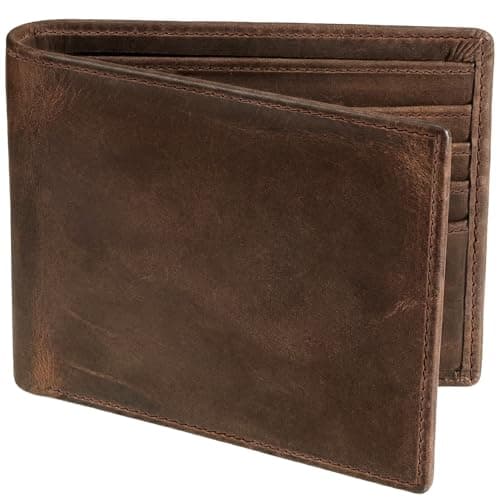
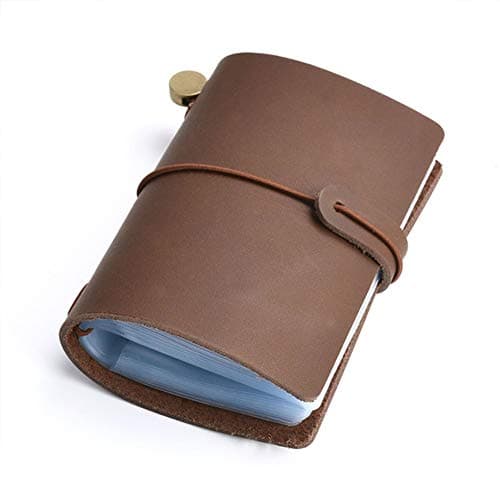
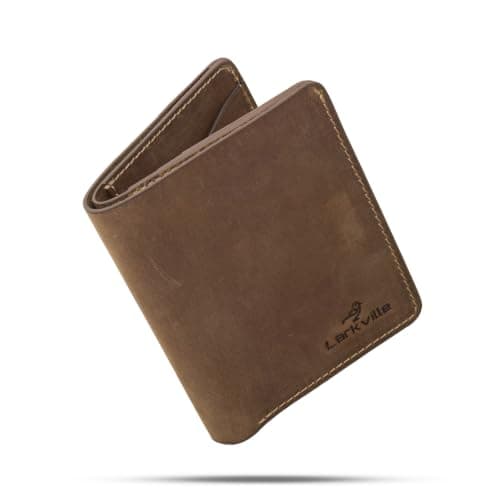
The short version: buy the Larkville Vertical Crazy Horse Bifold— full-grain crazy horse, and the only listing in this category that publishes both a closed size (3.5 x 4.3 x 0.5 in) and a weight (80 g), which on a page about an unregulated finish word is the behaviour worth rewarding. The budget pick is the aolaso Crazy Horse Card Book, a 20-slot side-loading book at a published 0.31 in. And the thing nobody selling this leather will tell you plainly: crazy horse is a FINISH, not a grade and not a tannage. It describes what was rubbed into the surface, not the quality of the hide underneath.
What crazy horse actually is
Crazy horse — sometimes sold as “wild horse” — is a heavily waxed and oiled pull-up finish. The wax and oil sit in the top of the hide, and when you bend or scratch it they migrate out of the stressed area, so the colour lightens along the mark. That is the whole effect. It is why a crazy horse wallet shows a pale scuff in its first week and why that scuff buffs back with a thumb.
Two consequences follow, and the second one is the reason this category exists at all. The first is that it marks constantly, which some people hate. The second is that a surface designed to mark cannot be ruined by marking, which is the opposite of a smooth pigmented finish where the first deep scratch is permanent and conspicuous. If you are rough with a wallet and it bothers you, this finish is the category that stops it bothering you.
What the word does nottell you is the grade. Nothing about a wax rub requires the hide beneath it to be full grain — and because the finish is opaque and textured, it is the ideal surface for hiding a corrected split. Which is why this page ranks the way it does.
It does not tell you the color either, which is worth knowing if you came here for a brown wallet: crazy horse is a finish, and two of the best crazy horse listings in our catalog state no color at all. If the shade is the decision, our best brown leather wallets page only ranks wallets whose own titles state a brown, and it sets this finish against oil-tan, veg-tan and pigment on how far each one moves.
The ranking rule: what is stated underneath the wax
Of the six wallets here, three state “full grain” behind the crazy horse claim (Larkville, RUNBOX, Belemay), one states a tannage— the F&L Classic says oil-tanned, which is the process the finish belongs to — and two say only “crazy horse” (Cavelio, aolaso). The first four outrank the last two for that reason alone, before any question of layout. We have recorded each at the level its own listing claims and no higher, which is the rule that governs the whole of our leather guide.
You will notice the ranking does not follow price. The $37 Belemay sits above the $30 F&L and the $20 Cavelio, and the cheapest pick is last. That is the grade claim doing the work, not the money.
One finish, six different objects
The genuinely useful thing about this category is that the finish spans the whole catalog, so you can pick the format first and still get the hide. That is unusual — most material categories on this site collapse into one or two formats.
- A vertical bifold(Larkville) — cards rotated ninety degrees so the wallet is taller than it is wide. Our vertical bifold roundup explains why that matters in a front pocket.
- A conventional bifold with two ID windows(RUNBOX) — the format most people actually carry, with the one feature most bifolds get wrong.
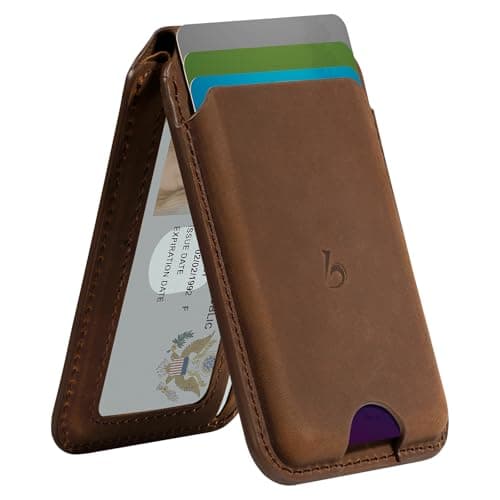
- A phone-back card holder (Belemay) — crazy horse on a MagSafe sleeve, with a stand and N52H magnets.
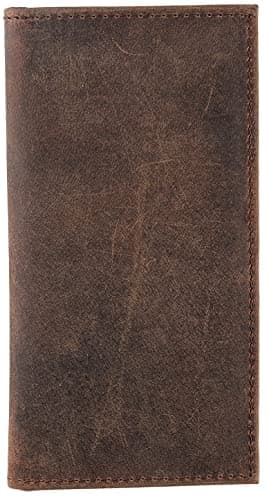
- A long bifold(F&L Classic) — bills flat, nine slots, a published 6 5/8 x 3 5/8 in. See long wallets.
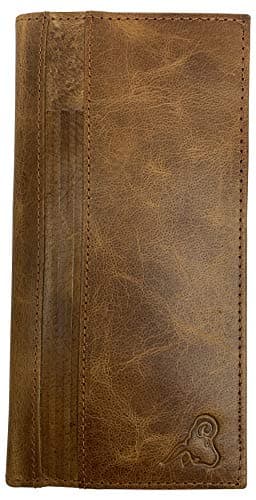
- A checkbook cover(Cavelio) — with a carbon-copy divider, which is the spec that decides a checkbook cover.
- A side-loading card book(aolaso) — twenty slots at 0.31 in, the budget pick, and the densest card storage in the whole catalog per dollar.
Living with it
Three practical notes, none of which help us sell anything. First, do not condition a new crazy horse wallet. It arrives loaded with wax and oil; adding more darkens it unevenly and kills the pull-up effect you paid for. Wait until the surface stops lightening when you flex it, which on a daily-carry wallet is a year or more. Our conditioner roundup says the same thing in more detail.
Second, the colour you receive will not be the colour in the photograph, and that is not a seller problem. A pull-up hide photographs under lights that flatten the wax bloom. Expect darker and more mottled than the listing image.
Third, if the marking doesturn out to bother you, this is the wrong category and the fix is not a product — it is a smoother finish. Saffiano is the opposite end of the same axis, and our saffiano guide is where to go.
Crazy horse is a finish sitting on top of a tannage, and the tannage underneath is usually an oiled one. If it is the chemistry rather than the look you are shopping for, see best oil-tanned leather wallets.
Buying notes
The category's one genuine measurement gap
Four of these six publish no closed thickness. The Larkville publishes 0.5 in and 80 g; the aolaso publishes 0.31 in. Everything else is unstated, and at ISO card thickness — 0.68 to 0.84 mm per card — a loaded wallet differs from an empty one by a quarter inch or more. If thickness is your deciding spec, the two picks that publish one are the only two you can actually compare, and our thickness arithmetic is the way to estimate the rest.
What crazy horse is not
It is not a breed, an animal or a tannery. It is not a quality tier. And it is not the same thing as oil-tanned leather, though the two overlap: oil tanning is a process applied during tanning, and crazy horse is a surface treatment usually applied to an oil-tanned hide. One pick here states both, and it is the only one that does.
If you want the look without the marking
You want pebbled. A pebbled grain hides wear through texture rather than through self-healing, so it stays looking new instead of looking lived-in. The two are the two honest answers to the same problem and we rank them separately — pebbled leather is the other one.