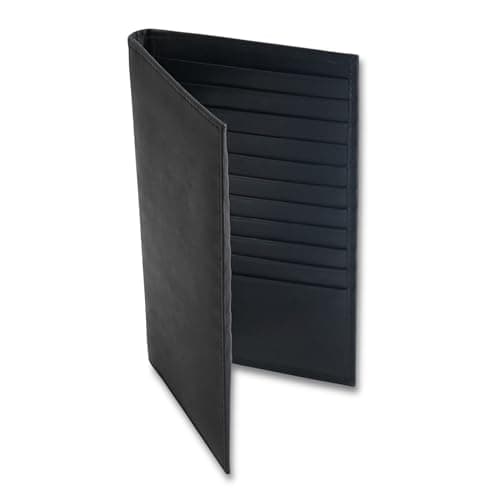
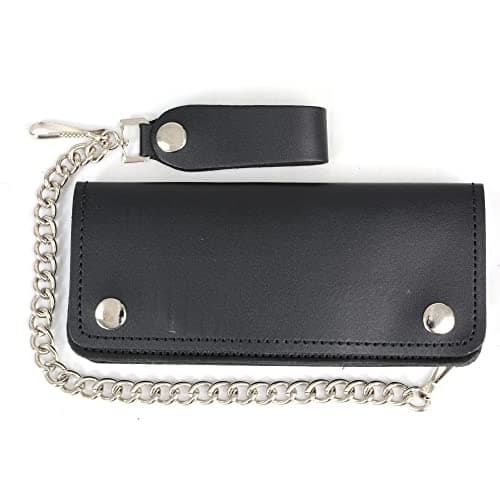
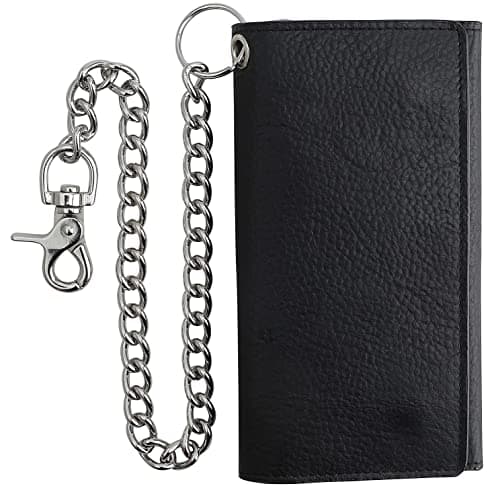
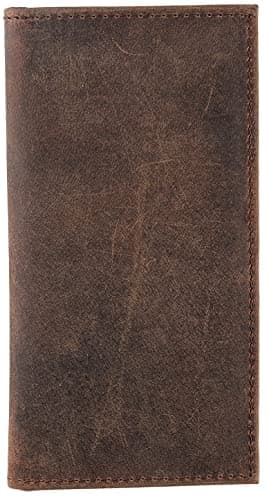
The short version: buy the F&L Classic Long Bifold Checkbook Wallet— oil-tanned crazy horse, nine slots and an ID window, and it publishes its closed size (6 5/8 x 3 5/8 in), which only two wallets in this whole category do. The budget pick is the F&L Classic Long Trifold Chain Wallet at under $24, the cheapest long wallet in our registry that claims full grain. And the measurement that defines the entire format, which almost no seller states: a US banknote is 6.14 x 2.61 in (156 x 66.3 mm), the same for every denomination — so a long wallet is simply any wallet longer than 6.14 inches inside.
The format is a measurement, not a style
Every other wallet category on this site is defined by a feature or a shape. This one is defined by arithmetic. A conventional bifold is about 4.5 inches wide, which means your cash goes in folded in half. A long wallet is wide enough to take the note flat.
Three things follow from that, and they are the entire trade:
- Your cash stops curling. A bill folded in a bifold for a month keeps the crease. Flat cash stays flat, counts faster at a counter, and feeds a vending machine or a ticket slot without being flattened first.
- You get an enormous amount of card space for free. A 6.5-inch panel has room for two columns of slots where a bifold has one. Every pick on this page holds nine cards or more; two hold twenty or more.
- It will not go in a trouser pocket.This is not a compromise you can design around — 6.5 inches does not fit a front pocket and sticks out of a back one. A long wallet lives in a jacket, a bag, or a back pocket you accept will bulge. If that is not your carry, stop here and read front-pocket wallets instead. We would rather lose the sale than sell you a wallet you cannot carry.
Four different long formats, and how to choose between them
“Long wallet” covers at least four distinct objects, and the autocomplete rows behind this page mix all of them together. Separating them is most of the decision.
The long bifold(picks 1, 2 and 3) folds once, the short way. Cash lies flat along the full length and cards sit in two columns. This is the classic and the one to default to. The F&L takes a checkbook as well, which is the reason it tops the page — it is the only pick that makes the format do a second job.
The long trifold (pick 6) folds twice, so it ends up nearly as compact as a conventional wallet while keeping a full-length cash channel. Sixteen slots, an eighteen-inch chain, and the cheapest pick here. The cost is thickness: three panels stack.
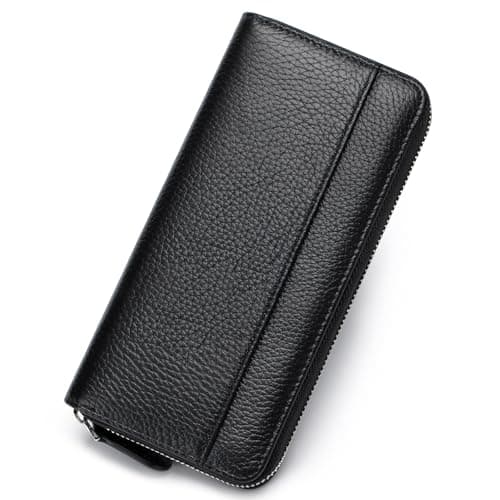
The long zip clutch (pick 4) closes all the way round, so nothing escapes into a bag. Up to eighteen cards. The cost is that you need two hands to open it, which matters more at a till than people expect.
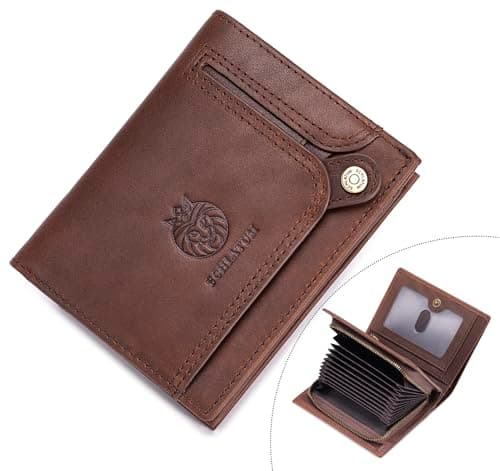
The accordion(pick 5) is a card book with a cash pocket and an ID window — twenty-one slots, and the densest card storage on the page. It is the choice if the cards are the point and the cash is an afterthought.
What the category does not publish
Only two of these six publish a closed size, and not one publishes a closed thickness. That is a real problem for a format whose whole appeal is capacity, because capacity is what makes a wallet thick. At ISO card thickness — 0.68 to 0.84 mm each — and our own per-slot figure of roughly 0.035 to 0.040 in of bulk per filled slot, a twenty-slot wallet loaded to capacity is three quarters of an inch of cards before you count the leather. If you intend to fill one of these, assume a brick and be pleasantly surprised. Our thickness arithmetic is the way to do the sum for any wallet whose listing stays quiet.
The second gap is the grade. Two picks state full grain, one states oil-tanned crazy horse, one states genuine leather and two state a leather word with no rung behind it. We have recorded each at the level its own listing claims, and the grade ladder explains what each rung is worth.
Who should actually buy one
Four readers, and if you are not one of them this is the wrong format. Someone who carries real cash daily and is tired of curled notes. Someone whose card count has outgrown a bifold — and before you buy capacity, read how many cards a wallet should hold, which argues most people should thin the deck instead. Someone who carries a bag or wears a jacket, so the footprint costs nothing. And someone who still writes checks, for whom the top pick replaces two objects with one.
Buying notes
Measure your pocket, not the wallet
The single most common regret in this format is a wallet that does not fit the way the buyer carries. Take a ruler to the inside of the pocket you actually use. If it is under seven inches of usable width, nothing on this page will sit in it comfortably, and the honest answer is a conventional bifold or a trifold.
Foreign cash is a separate question
Euro notes are shorter than US notes at the low denominations and longer at the high ones, which is exactly the case where a long wallet earns its keep in a way a bifold cannot. We work through the dimensions in do euros fit an American wallet.
The chain is not a biker affectation
Two picks here come with a chain, and the reason is structural rather than stylistic: a long wallet in a back pocket is the easiest wallet in the world to lose, because it sits high and proud. A chain solves that completely. If the look is wrong for you, both chains are removable, and our chain wallet roundup ranks the format properly.
Advice that earns us nothing
If the only reason you are considering a long wallet is that your current one is overstuffed, the cheaper fix is to carry fewer cards. A long wallet does not solve a capacity problem; it gives the problem more room to grow. Half the readers of this page would be better served by the minimalist end of the site.