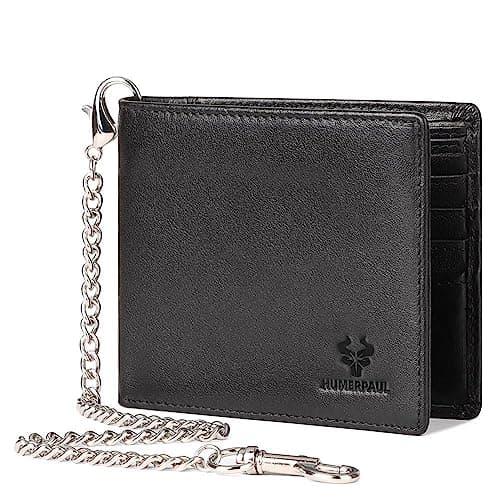
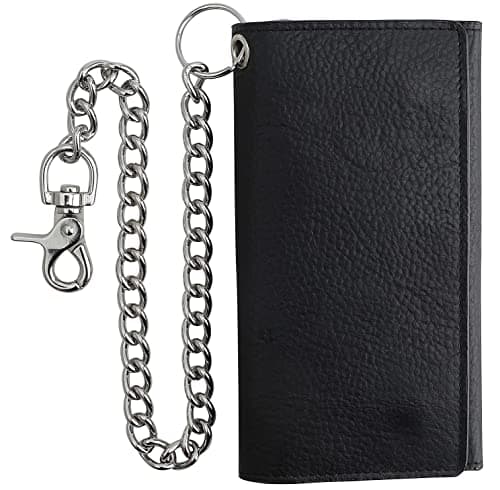
A wallet chain is the only wallet feature that has a measurable job: it stops the wallet leaving. Everything else in everyday carryis a judgment call about bulk and taste, but a tether either holds when the wallet slides out of a pocket at sixty miles an hour or it does not. So this list is ranked on the hardware — chain length, gauge, clasp type, whether the thing detaches — and on the leather grade the seller is willing to put in writing. The graphics on the front cover are not a criterion.
One rule got applied before anything else: the chain has to ship with the wallet.Search “leather chain wallet” on any marketplace and roughly half the results are bare wallet chains — a length of braided leather or steel with a clasp, sold on its own. Those are a perfectly good product and they will convert a wallet you already own, but they are not what someone typing that phrase is shopping for, and mixing them into a wallet roundup is how these pages become useless. Every pick below is a wallet, with a chain, in one box.
The second thing worth knowing before you scroll is that this category splits hard down the middle. About half of what is sold as a chain wallet is a biker long wallet: seven to eight inches tall, built to live in a jacket or a back pocket with the chain visible, and sized around a checkbook rather than a card stack. The other half is an ordinary bifold or trifold with a hook screwed onto it. Those two wallets solve different problems for different people, and buying the wrong one is the most common way this purchase goes wrong. We have ranked them together and labeled which is which, because the format is the decision.
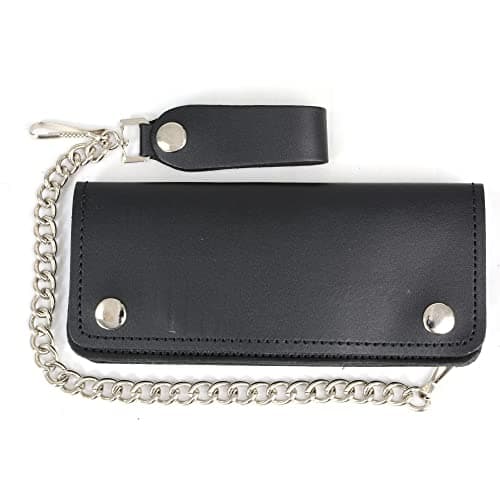
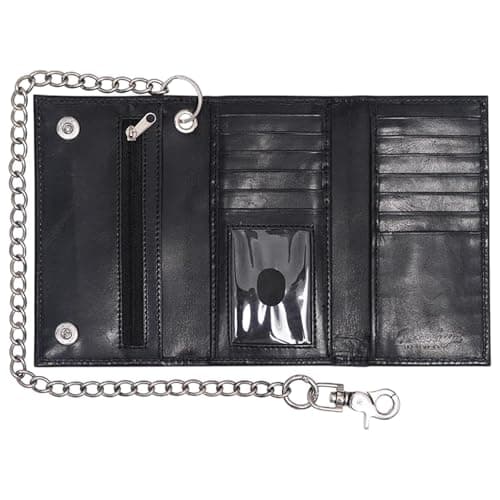
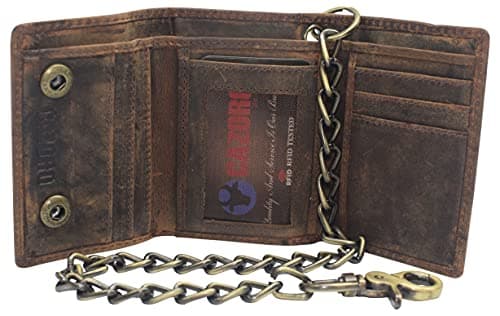
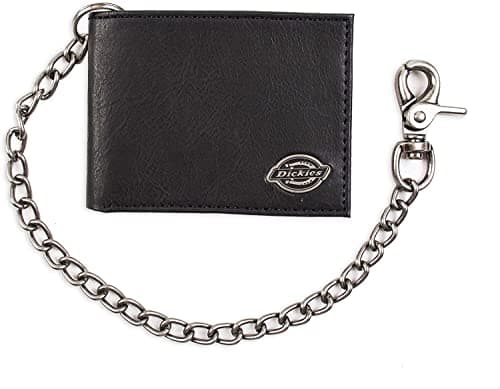
Our best overall is the F&L Classic long trifold— it publishes the most complete spec of anything here (full-grain claim, RFID, sixteen card slots, a zippered coin pocket, an 18in steel chain) at a mid-bracket price. The Milwaukee Leather MLW7812 is the one to buy if you actually ride: full-grain cowhide, a leather snap belt clip and a removable 10-gauge chain. The RAW HYD trifold is the pick if the hide matters more than the feature list. The CAZORO is the compact one that fits a pocket, the Dickies bifold is the cheap way to test whether you want a chain at all, and the FOUTOUKEEP card wallet is the only one whose listing says in plain words that the chain comes off. Full reasoning, specs and honest cons on all six below.
What a wallet chain is actually for
There are three real reasons to tether a wallet, and only one of them involves a motorcycle. The first is motion: riding, climbing a ladder, working on a roof, anything where a back pocket empties itself without you noticing. The second is crowds: a chain does not make a wallet pickpocket-proof, but it turns a silent lift into a tug you can feel, which is most of the battle at a festival or on a packed train. The third is the least glamorous and the most common — people who simply lose wallets. If you have replaced your cards twice in three years, twenty dollars of steel is a cheaper fix than another bank call.
What a chain does not do is protect the cards themselves. Four of the six picks here claim RFID blocking and two do not, and the two that do not are the two with the best leather — that trade is discussed below. If wireless shielding is your actual concern rather than physical loss, start at our RFID wallets roundup instead and treat the chain as a bonus. And if what you want is for a lost wallet to be findable rather than un-losable, an AirTag walletis a different and often better answer — a chain stops the wallet leaving your body, a tracker tells you where it went when it did.
How to read a chain spec, in four numbers
Sellers describe chains badly, so here is what the words mean and which of them appear on the listings above.
Length.Eighteen inches is the common figure and it is the right one for most people: long enough to pull the wallet out and pay without unclipping, short enough that it is not swinging around your knee. Fourteen inches, which is what the Milwaukee ships, is a rider length — deliberately shorter so it cannot snag. Two picks here, the Dickies and the FOUTOUKEEP, publish no length at all, which is a genuine gap in their listings and one of the reasons neither ranks higher.
Gauge.The thickness of the wire. Only Milwaukee publishes it (10 gauge), which tells you something about who is confident in their hardware. Everyone else says “heavy duty” and leaves it there. Gauge is what decides whether the chain or your belt loop fails first, and on a cheap chain the answer is usually a stretched link at the clasp end.
Clasp. A lobster or claw hook clips to a belt loop in one motion and is fine for everyday use. A dog-lock or trigger clasp is stiffer and harder to knock open. A plain split ring is the weakest of the three and is normally a sign the chain was an afterthought. Most listings here name the clasp, which is a good habit and worth rewarding.
Removability.The most useful spec and the one most often missing. A wallet whose chain detaches is two wallets — chained for a shift or a ride, bare for a jacket pocket at a wedding. Only two picks on this page state it: the Milwaukee (removable chain) and the FOUTOUKEEP (detachable with a clasp). Everywhere else the listing is silent, and we have recorded that silence in the cons rather than assuming the answer.
Belt loop, belt clip, or both
There are two ways to anchor the wallet end and they are not equivalent. A chain that ends in a key ring passed through a grommet on the wallet is the standard arrangement — cheap, universal, and dependent on that one grommet. A leather snap belt clip, which the Milwaukee and the RAW HYD both have, is a strap that folds over the belt itself and snaps shut, carrying the wallet's weight independently of the chain. Riders want both, because it means one failure is not a lost wallet.
The failure point almost nobody thinks about is the belt loop on your jeans. A 0.45lb wallet swinging on a 14in chain applies real leverage to a stitched loop, and cheap denim gives out long before the steel does. If you carry a heavy long wallet, clip to a belt or to the reinforced loop nearest the fly, not to a rear loop on thin jeans.
Long wallet or pocket wallet: the actual decision
The three biggest picks here — the F&L Classic at a stated 7.25in, the Milwaukee at 8in, the RAW HYD at 7in — are long wallets. They are the traditional shape for a reason: bills lie flat instead of folding, a checkbook fits, and the extra height means double-digit card slots without stacking. The cost is that they do not go in a front pocket and they are obvious in a back one. If you have read our guide to carrying without a back pocket and decided front-pocket carry is what you want, none of the three is for you.
The other three are normal wallets. The CAZORO is a 4.3in trifold, the Dickies a 4.5in bifold, the FOUTOUKEEP a 4.53in compact bifold — all three sit in a pocket the way any wallet does, with a chain hanging off the outside. That is the right buy for the crowds-and-lost- wallets use case, and the wrong buy for a rider who wants a checkbook-sized billfold with the cash lying flat. Work out which of the two wallets you are shopping for before you compare prices, because the two halves of this list barely compete with each other. If capacity is the thing you are optimizing for and the chain is negotiable, our trifold roundup covers the same shape without the hardware.
Leather grade in a category that hides it
Chain wallets are unusually bad at naming their leather, which is why the spec table above shows four different phrasings. Three listings say full-grain— F&L Classic, Milwaukee (“100% full-grain cow leather”) and RAW HYD — and that is the grade worth paying for, because it keeps the outer layer of the hide and therefore darkens and softens instead of wearing through. The CAZORO says “vintage leather,” which describes a finish and not a grade. The Dickies says “genuine naturally milled leather” and the FOUTOUKEEP says “genuine leather,” and in the leather trade genuine is a specific and fairly low rung on the ladder, not a synonym for real. We have printed each one at the level its own listing claims and gone no further; the grade ladder explains what separates them.
This matters more on a chain wallet than on most wallets, because the chain guarantees the wallet gets dragged, sat on and yanked for years rather than quietly replaced. Run the cost-to-own math and a full-grain wallet that survives eight years at a mid price beats a genuine-leather one replaced every two, even before you count the annoyance. The counter-argument is real too: if you are not sure a chain suits you, spending the least possible to find out is a legitimate strategy, and that is exactly what the Dickies pick is here for.
What we left off, and why
Three groups of product did not make it. Bare wallet chains— braided leather or steel lengths sold as an accessory — were excluded by the inclusion rule at the top of this page, even though several are well reviewed and cheap. If you already own a wallet with a grommet, that is genuinely the smarter purchase and we would rather say so than sell you a new wallet. Wallets whose listing never states the material were also cut, including one widely-sold trifold from a mainstream denim brand: the copy covers the chain, the card count and the logo, and never once says leather. On a leather site that is a hard stop. Finally, near-identical clones of the picks above were collapsed to one entry each. The long-trifold shape in particular is sold by a dozen sellers with the same layout and different flag graphics; listing six of them would be padding, not a ranking.
Two honest omissions are worth naming. There is no premium heritage-maker chain wallet on this list, because the small American workshops that would make one mostly do not sell through the retailer we can price and link honestly — the same problem our made-in-USA roundup ran into. And there is no chained cardholder, because at that size the chain outweighs the wallet; if you want minimal carry with something clipped to you, a leather key holder alongside a slim wallet is the arrangement that actually works.