Every listing in this category leads with a number. Twenty slots, twenty-four slots, twenty-six slots. Not one of them tells you the thing you actually need to know, which is what those cards do to the object once they are inside it. A payment card is 0.76mm thick under ISO/IEC 7810, the standard that defines the card in your hand right now. Twenty of them is 15.2mm — 0.6in of solid plastic, before a single layer of leather, lining or stitching. That is the entire closed thickness of the slim trifold we rank elsewhere on this site, whose listing publishes 0.6in. Nobody selling a 26-slot card holder puts that sentence in their bullets.
So this page ranks seven leather card holders on two published numbers side by side: the slot count the seller advertises, and the closed size the seller also publishes and hopes you will not read next to it. Where the two do not reconcile, we say so. One pick here advertises twenty-six slots in a case its own listing measures at 0.7in closed — which is less than twenty-six cards of plastic occupy. That is not a lie; it is a published empty dimension. But it is the difference between the object on the box and the object in your bag, and it is the single most useful thing on this page.
The inclusion rule is mechanical and you can check it yourself. To be ranked here, a listing has to publish, in its own title or feature bullets, a capacity of sixteen or more cards, and it has to state real leather. That second half did more work than expected: one of the cheapest and most prominent results for this search calls itself a “Leather Credit Card Holder” in its title and then says “synthetic leather” in its own first bullet. It is named further down, and it is not ranked.
One honest thing to say before the list. No premium brand makes one of these. Bellroy, Ekster, Ridge, Nomad and Main Street Forge — the five brands this site reviews in depth — top out somewhere around twelve to fourteen cards, and most of them are built to talk you down from that. The high-capacity shelf is marketplace brands, and it is priced accordingly. If you want a heritage maker's leather, you want the main cardholder rankings and a smaller number of cards. If you want to carry everything, this is the shelf, and these are the seven worth knowing about.
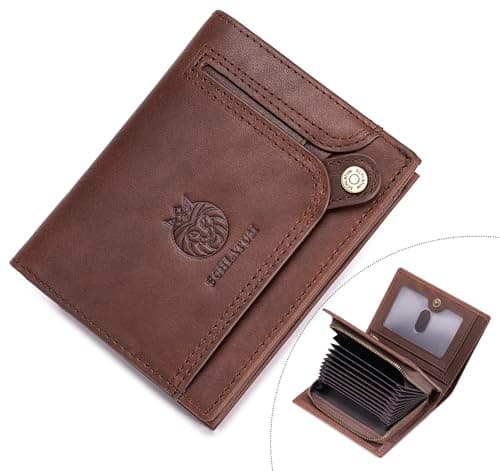
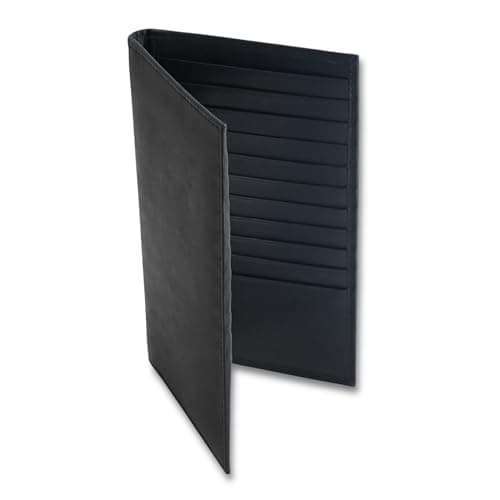
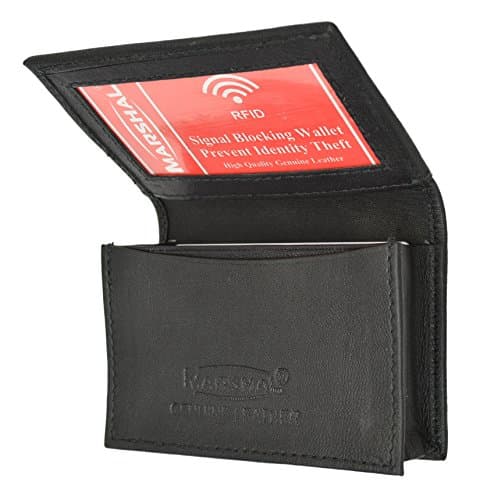
Our best overall is the boshiho 24-Slot Card Organizer— the only pick that gets past twenty slots by adding a second column rather than by stacking, and its listing states 100% genuine leather and prints its own weight. The SCHLATUM 21-Slot is the pick if you also need cash and an ID window. The A|G Wallets 20-Card Long Wallet spends its bulk on length instead of height, so notes come out flat. The Marshal Expandable Card Case has no slots at all, which is a more sensible answer than it sounds. The Easyoulife 26-Slot has the highest number and the least money attached to it, the aolaso Crazy Horse card book is a published 0.31in thick, and the Ashlin has the fewest slots, the highest price and the only real construction claim on the page. Full reasoning, specs and honest cons on all seven below.
A slot count is not a card count
This is the whole page in one heading, so it is worth being precise about. Under ISO/IEC 7810, an ID-1 card — every credit card, debit card, driver's license and hotel key you own — measures 85.60 x 53.98mm and is 760 ± 80 µm thick. Round that to 0.76mm, or 0.030in, per card and the arithmetic falls out:
- 10 cards— 7.6mm / 0.30in of plastic
- 16 cards— 12.2mm / 0.48in
- 20 cards— 15.2mm / 0.60in
- 26 cards— 19.8mm / 0.78in
Those figures are floors, not estimates. They assume the cards are perfectly stacked with nothing between them — no leather divider, no PVC sleeve, no RFID lining, no stitching. Add the case and a full twenty-card holder is comfortably over three-quarters of an inch whatever the box says. Embossed cards, the ones with raised numbers, stack worse still, because the raised digits of one card do not sit flat against the next.
What that means in practice is that the closed dimensions in every listing on this page describe an empty object. The seller is not hiding anything — an empty measurement is the only one you can take consistently — but the buyer reads it as a finished size, and it is not. The honest way to shop this category is to take the published thickness, add 0.030in for every card you actually intend to carry, and see whether you still want the result in the pocket you had in mind.
Where the bulk goes: thickness or footprint
There are only two places a card holder can put capacity, and every pick here picks one.
Upward. Stack the slots behind each other and the case gets thick. The boshiho is 1.18in, the SCHLATUM 1.2in. Both are honest objects, and both are bag objects — nobody is carrying an inch and a fifth of leather in a trouser pocket, and the sellers do not claim you will. The advantage is a small footprint: the boshiho is 4.13 x 5.12in, so it takes up less bag area than a paperback.
Outward. Spread the slots across a bigger sheet of leather and the case stays thin. The A|G Wallets long wallet holds twenty cards at 0.75in because it is 7.25in long. That length has a second benefit that nothing else here offers: a US banknote is 6.14in wide, so it lies completely flat inside, and cash comes out uncreased. The cost is obvious the first time you try to sit on it.
There is no third option, and any listing that appears to offer one is publishing an empty measurement. The one genuinely different answer on this page is the Marshal, which refuses to pick: it has no slots, so it is 0.5in when it is nearly empty and 1in when it is full, and the listing publishes both numbers. That is the most honest spec on the page and it comes from one of the cheapest picks here.
The five mechanisms, and which one you want
The two-column slotted organizer. Slots run in two banks rather than one, so the case gets wider and taller instead of endlessly thicker. This is how the boshiho gets to twenty-four without doubling cards up in a pocket, and it is the layout to look for if you genuinely intend to fill it. It is also the least pocketable.
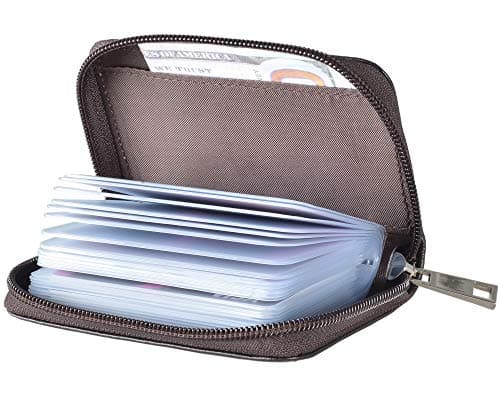
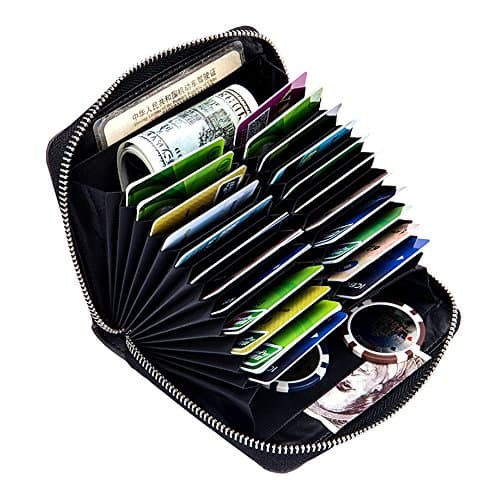
The accordion or concertina case. Slots hang off a folding spine and fan out when you open the zip. Dozens of near-identical versions of this body exist on the marketplace under different brand names, from about seven dollars up. The advantage is that the body collapses toward its empty thickness when it is lightly loaded; the disadvantage is that the fan takes two hands and the spine is the part that eventually gives.
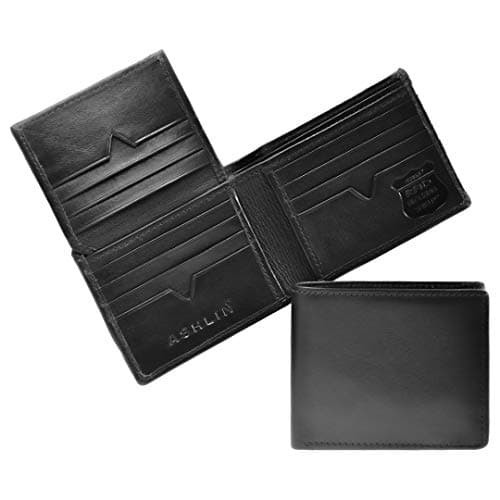
The long bifold. A conventional wallet layout stretched to banknote width. You get card slots, bill compartments and usually an ID window in one object, and the capacity is paid for in length rather than in bulk. It has been the standard business wallet in most of the world for a century, which is worth remembering before dismissing it as oversized.
The expandable pocket. No slots at all — just a compartment with a gusset that grows. It holds exactly as much as you put in it and shrinks when you take cards out, which means it is never carrying empty pockets around. The trade is organization: you thumb a stack instead of pulling a known card from a known slot. If fast access to the same three cards is what you want, a pop-up cardholder does that job far better and holds a fraction as much.
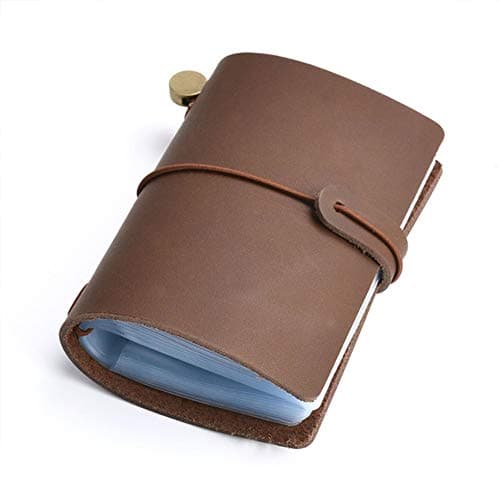
The side-loading card book. Sleeves bound like pages, loaded from the side so nothing slides out. This is the thinnest format by a wide margin — the aolaso is a published 0.31in — because a sleeve adds almost nothing to the card it holds. It is also the format most likely to have been cut for business cards rather than payment cards, which brings us to the next section.
Business cards and payment cards are not the same shape
Several high-capacity cases in this category are business-card books that also mention credit cards, and the two card types are close enough in size to sell the same product to both buyers but not close enough to guarantee a fit. A US business card is the de facto 3.5 x 2in. An ID-1 payment card is 3.370 x 2.125in. So the payment card is a little shorter and, critically, an eighth of an inch taller.
A sleeve cut to a business card's height is therefore slightly too short for a bank card. It will usually still take it — the card simply protrudes — but that is a different experience from one that fits, and it is exactly the detail a listing leaves out when it lists “business name cards, credit cards, ID card, bank card” in one breath. If the case you are looking at leads with business cards, treat the payment-card capacity as unverified rather than as a spec. We have done that on the aolaso above.
Leather, in a category where it is mostly the cover
Read the material bullets on this page carefully and a pattern appears: the leather is the outside, and the card slots are frequently PVC. The Easyoulife states it outright (“Genuine leather and PVC card slots”), and so does the aolaso (“genuine cowhide leather cover and PVC card sleeve”). That is not a scandal — leather slots are thicker than PVC ones, and on a twenty-six-slot case leather dividers would add half an inch on their own. But it does mean the part of the product that wears out is not the part the price is attached to.
Grade language is thin across the whole shelf. Three listings say “genuine leather”, which in the leather trade is a specific and fairly low rung rather than a synonym for real — our grade ladder explains what actually separates the tiers. Two say only “cowhide” or “leather” and name no grade at all. The Marshal names no material in any bullet; the word appears in its title and nowhere else. The one genuine bright spot is the aolaso's crazy horse leather cover, a wax-finished hide that is meant to scuff and lighten, which suits a case that lives loose in a bag better than a polished finish would.
If leather quality is what you care about most, this is the wrong shelf and we would rather say so. Run the cost-to-own math on a full-grain wallet and it beats a genuine-leather case replaced every two years — but there is no full-grain twenty-slot card holder to buy, so the trade here is capacity for grade, and it is not optional.
Should you carry twenty cards at all?
Probably not, and it costs us money to say it. The honest reason most people end up searching for a twenty-slot card holder is that a drawer's worth of loyalty cards, old gift cards, insurance cards and membership cards has migrated into a wallet that was never meant to hold them. The cheaper fix is to take them out: most loyalty schemes work from a phone number or a phone app, most gift cards can be added to a digital wallet, and an insurance card photographed once is an insurance card you have always got. Our guide to how many cards a wallet should hold goes through that exercise properly, and organizing your wallet covers what to do with the cards you keep.
There are readers for whom none of that applies, and they are who this page is for: people who carry a company card and a personal card and a fuel card and a badge, people with several bank accounts, tradespeople with certification cards, anyone whose job comes with plastic. For them a twenty-slot case is not clutter, it is a filing system — and the right pattern is often two objects rather than one. Keep the daily four or five in a slim wallet on your person, and leave the other fifteen in a case like the boshiho in a bag. That is why the SCHLATUM's zip-case split is more useful than it first looks.
What we left off, and why
One listing was excluded by the leather half of the rule and it deserves naming, because it is one of the cheapest and most prominent results for this search. The KUVAO 20-slot zip case is titled “Leather Credit Card Holder” and its own first bullet reads “The exterior material is made of soft and durable synthetic leather.” There is nothing wrong with a synthetic case at that price, but it is not a leather one, and a title that says otherwise is the reason this page has a stated rule at all.
Two near-identical accordion cases were collapsed out. The Linno 20-slot publishes exactly one feature bullet — “Material: Genuine Leather” — and nothing else, not even the slot breakdown its own title promises, so there is nothing to compare it on. The NEMIBAD 20-slot is the same accordion body and actually publishes the most useful breakdown on the shelf (18 credit-card slots plus 2 cash slots), but describes its hide as “the finest ground cowhide”, which is not a grade in any leather vocabulary we can check. Both are real, in-stock products; neither adds a mechanism the ranked seven do not already cover.
Desk-scale business-card books were excluded on purpose. There are leather card books on the marketplace holding 96, 120 and 240 cards. They are useful objects and they are not card holders — they are filing systems that live in a drawer, and shopping for one is a different task from the one this page is for.
Colorways are not picks. The boshiho 24-slot is sold in at least six colors under six separate ASINs, and the Easyoulife under at least seven. Each has its own stock level and sometimes its own price. Read the model and the slot count in the title and treat the color in brackets as a variant, not a different product.
And one omission worth stating plainly: there is no premium leather brand on this page, because none of them build for this capacity. If that surprises you, it is worth taking seriously as a signal about the format rather than as a gap in our research. Every maker with a design reputation in this category has decided that past roughly a dozen cards the object stops being a cardholder, and they are not entirely wrong — our cardholder versus wallet comparison walks through where that line actually sits.