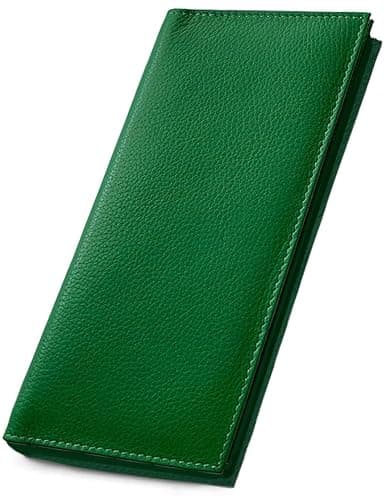
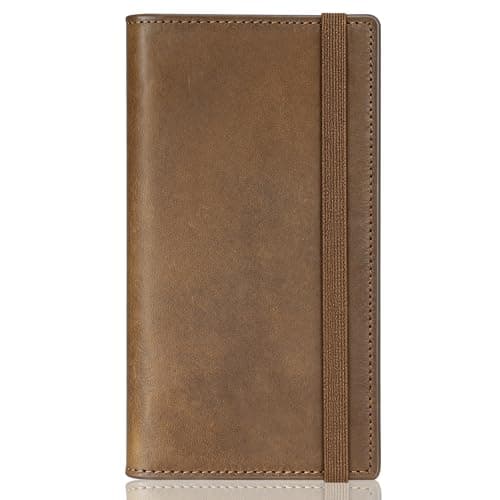
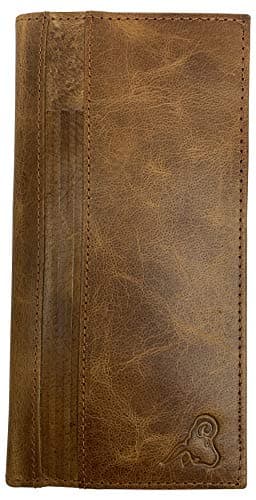
If you would rather carry one object than two, the pick is the F&L Classic long bifold — oil-tanned crazy horse cowhide, nine card slots and four compartments, one of which swallows a checkbook whole, at a published 6 5/8 inches wide so nothing has to fold. If you want an actual cover and your checks have carbon copies, the 123 Cheap Checks calf cover is the only pick that states which check format it fits. And the Espera is the best-thought-through cover on the page: an elastic band so it cannot spring open in a bag, plus a pen slot.
Two specs decide this purchase, and almost no listing publishes both
A checkbook cover is one of the few leather goods whose dimensions are dictated by a standardized piece of paper rather than by a pocket, which makes it unusually easy to get wrong by ordering the pretty one.
1. Which way does your checkbook tear?
Personal checkbooks come in two layouts — top-tear (checks stacked and torn upward, the common personal format) and side-tear (checks bound along the left edge). A cover built for one holds the other badly or not at all, and it is the single most common reason one of these gets returned. Exactly one pick on this page says which it takes: 123 Cheap Checks states it fits top-tear standard checkbooks. The others say “standard checkbooks” and leave you to find out. That one sentence is why a fifteen-dollar cover is ranked second on this page.
2. Do your checks have duplicates?
If your checkbook has carbon copies, you need a plastic divider — the stiff insert you slide behind the check you are writing so the pen does not print through to the next one. Two picks publish one (123 Cheap Checks and Cavelio) and two do not (Espera, F&L). It is a two-cent piece of plastic that makes the difference between a cover that works with your checkbook and one that does not, so check for it before you check the leather.
The published footprints, and what they tell you
Three of the four publish a closed size in their own feature bullets, and the spread is instructive:
- Approx. 3.5 x 6.75 in — 123 Cheap Checks. A plain cover, sized to the check and nothing more.
- 7.0 x 3.74 x 0.47 in — Espera, and the same bullet says this is compatible with standard checks and registers, which is the pair of things people actually carry.
- 6 5/8 x 3 5/8 in — F&L, which is a long wallet rather than a cover and is still the narrowest of the three.
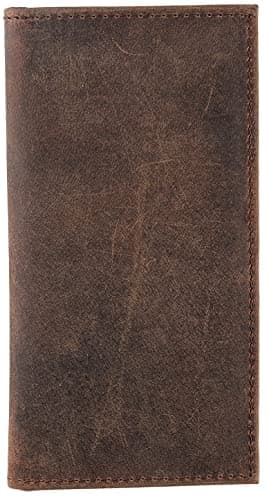
- Not published — Cavelio, whose entire listing is three feature bullets. It is ranked last for that reason and not for the leather, which is the nicest-sounding of the four.
Every one of those numbers comes from the seller's own bullet copy. We do not use the item-dimensions table that marketplaces attach to a listing — it is unreliable, it frequently describes the shipping box, and it is a standing rule across this site.
The honest part: most people reading this do not write many checks
Check volume has been falling for decades and most of the searches that reach a page like this come from one of three readers, who want different things.
You write a handful of checks a year — rent, a contractor, a gift. You do not need a cover at all. The checkbook can live in a drawer, and the honest purchase is nothing. That costs us the sale and it is the right advice for more readers than the rest of this page.
You carry a checkbook for work — a small business, a landlord, a treasurer. You want the Espera or the F&L: a closure that holds, a pen, and somewhere for receipts. The elastic band is not a gimmick; a cover that springs open in a bag sheds checks.
You are replacing a cover that wore out — which is most of this traffic. Buy the same format you already have, and use the two questions above to make sure you do.
Cover or wallet? They are different objects
Worth separating, because the top pick is not the same kind of thing as the other three. A cover is a leather jacket for a checkbook with maybe a slip pocket: it travels in addition to your wallet. A long wallet that fits a checkbook replaces your wallet instead. The F&L is the latter — nine card slots, an ID window and four compartments — and that is why it wins on the rubric while also being the pick most people should think hardest about, because buying it means giving up the wallet you already like.
The format question behind this is the same one in bifold versus long wallet, and it turns on one number we keep coming back to: a US note is 6.14 inches long and a check is longer still, so a long wallet keeps both flat while a bifold folds them. If a long wallet is what you want with or without the checkbook, the large-capacity page ranks the format on slots.
What we left off, and why it matters here more than usual
Most of this category is not leather. A search for a checkbook cover returns page after page of PU and vinyl at a third of these prices, and they are perfectly functional — we do not rank them because this site ranks leather, not because a vinyl cover is a mistake. If the cover is going in a bag and you do not care what it is made of, buy the cheap one and spend the difference elsewhere; we would rather say that than imply leather is necessary for a job plastic does fine.
We also left off every check-printing result. A search in this space is full of “wallet-style checks” and “wallet checks for business”, which are the checks themselves in a wallet-sized format, not leather goods. Different product, different industry, and nothing to do with this page.
Leather grade, printed as it is
One pick names a tannage and a layer: F&L publishes top-layer cowhide, oil-tanned, in a crazy horse finish, which is the most specific material claim on the page and the reason it tops it. One names an animal: 123 Cheap Checks says 100% genuine calf, which is a finer grain than a generic cowhide, though “genuine calf” still covers full grain, top grain and split alike. Cavelio names a finish (“premium crazy horse”) and no grade. And Espera says “genuine leather and water-resistant fabrics”, which means part of the product is not leather and the listing does not say which part — the claim we like least on this page, stated here rather than buried. The grade guide explains the ladder, and the crazy horse explainer covers why that waxed pull-up finish is the right choice for something that lives in a bag: the scuffs rub back out.
Looking after one
A checkbook cover has an easier life than a wallet — it is not sat on and it is not opened thirty times a day — so the only real risk is the one leather always has, which is getting wet and then drying badly. Are leather wallets waterproof covers that properly: dry it slowly, away from heat, and do not condition it while it is still damp. Beyond that, a fingertip of conditioner once or twice a year is the whole routine — the conditioner roundup is sized for a wallet rather than for boots, and a 2 oz jar is years of supply.
Prices, and what we earn
Every price here is read live from the Amazon Product Advertising API and stamped with the date it was read, which is why there is no dollar figure in this prose. Buy links are affiliate links; recommending that some readers buy nothing, and others buy a vinyl cover we do not stock, is worth less to us than not saying it. See the editorial policy.
How we picked
We do not run a testing lab
The standard wallet rubric does not fit a checkbook cover, so this page scores on a modified one. The decisive criterion is fit: does the listing publish a closed size, and does it say which check format it takes? A cover that states “top-tear standard checkbooks” is treated as better than one that says “standard checkbooks”, because the second sentence is the one that gets a product returned.
After fit we scored function (a duplicate-check divider, a closure, a pen slot, card or register pockets), leather on what the listing actually names rather than what it implies, construction and value. We have not handled these covers and we have not fitted a checkbook into one; every figure above is the seller's own published bullet, and where a seller publishes nothing the spec table says so with a dash rather than a guess.