Skip to content
Hide Thread

Bifold · Bifold & Trifold Wallets

Best Wallets for Carrying a Lot of Cash

Only a handful of listings anywhere publish a bill count. These five do, or publish two full-length compartments instead — and the arithmetic below explains why your cash wallet is thicker than the cash in it.

By Stephen V.Updated How we research
#ad

We earn a commission when you buy through our Amazon links, at no extra cost to you. It never affects our picks, and we say so when the cheaper wallet is the better buy. How this works.

The pick for most people who carry a working float in cash is the Housmai Pop-Up Bifold — its listing rates the cash slot at fifteen bills and itemises nine card positions alongside it, which makes it the most completely specified cash wallet in our record. If you want the most of everything, the miyozi Pop-Up Trifold publishes the same fifteen-bill slot plus up to thirteen cards and two ID windows, and is honest enough to print its own 0.82 in thickness. And if what you want is for notes to lie flat rather than folded, the LnxLtw Vertical Bifold is the one with two full-length bill pockets.

The number almost nobody publishes

Wallet listings publish card counts constantly and bill counts almost never. We have a hundred and twenty-seven products in this site's registry and three of their listings state how many notes the cash section is rated for. That is the gap this page exists to close, and it is why the inclusion rule here is mechanical and narrow:

  • the listing publishes a bill count for its cash section, or
  • the listing publishes two separate full-length bill compartments, which is a capacity statement made in layout rather than in numbers.

Everything else in the registry is excluded, including wallets we rank first on other pages. Every pick on the minimalist cash-and-cards roundup is out, because that page answers the opposite question — the smallest wallet that still handles some cash. Every card sleeve and MagSafe holder on the slim roundup is out for the same reason. If you carry forty dollars and three cards, those are your pages, not this one.

The cash is not what makes it thick. The fold is

This is the finding, and it reverses what almost everyone assumes. A US note is 0.0043 inches thick. Run the arithmetic on a carry that genuinely counts as a lot of cash:

Notes carriedFlat stack thicknessFolded once (a bifold)Folded twice (a trifold or a card slot)
100.04 in0.09 in0.17 in
250.11 in0.22 in0.43 in
500.22 in0.43 in0.86 in
1000.43 in0.86 in1.72 in

A hundred notes — two thousand dollars in twenties — is under half an inch lying flat. That is thinner than six payment cards. Fold that stack once and it doubles; fold it twice and it doubles again, and at that point a hundred notes is a brick that no pocket wants.

So the thing that decides whether a cash wallet works is not the compartment's rated capacity. It is how many times the format asks you to fold. A long wallet asks for none. A bifold asks for one. A trifold, or a note squeezed into a card slot, asks for two. That is the whole hierarchy, and it is why the LnxLtw sits third on a page about cash despite being the lowest-scoring bifold in our vertical roundup: two full-length pockets means a note goes in unfolded.

Fifteen bills is the ceiling anyone admits to

The two picks that publish a figure both publish the same one, which is interesting in itself. Housmai and the miyozi trifold each rate their cash slot at fifteen bills; the miyozi money clip says ten or more. Nobody in the category claims fifty.

Fifteen notes is 0.065 in flat and 0.13 in folded once, which is almost nothing — so the fifteen is not a thickness limit, it is a retention limit. A slot grips a stack by friction against two leather faces. Past a certain stack depth the outer notes stop being gripped and start sliding, and fifteen is apparently where these sellers think that happens. Read it that way and the number becomes useful: it is not telling you the compartment is full at fifteen, it is telling you the compartment stops holding reliably at fifteen.

What we did not put on this page

No zip wallet. A zip solves retention completely and we rank several on the zip-around page, but not one of those listings publishes a bill count or two full-length compartments, so none of them clears the rule. That is a gap in the category rather than a verdict on zip wallets — if containment is your actual worry, start there.

No long wallet or checkbook format. The format that handles cash best is the one that never folds it, and the F&L long bifold we rank first there is published at 6 5/8 in wide against a 6.14 in note — notes and checks both lie flat. It is not on this page because its published specs are a checkbook spec set, not a bill count, and we do not reshape a listing's claims to fit a page. Go and look at it anyway; for a large flat cash carry it is the right object.

No bare money clip. We rank combined clip wallets on the money-clip page, and the honest note we make there applies double here: for a genuinely large cash float, a bare clip plus a separate card sleeve beats every combined product, because the clip holds a flat stack with no fold at all and the cards go somewhere that is not pressed against them. That costs us the sale of a wallet and it is still true.

The short answer

Quick picks

#ProductBest forScorePrice
01
Housmai Housmai Pop-Up Bifold
Housmai Pop-Up Bifold

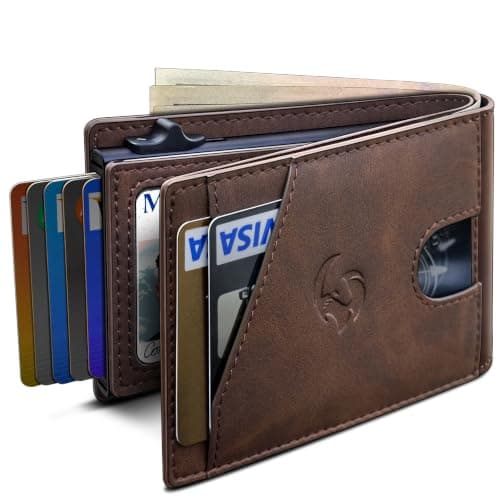
The pick that proves a card ejector and a real bill slot can coexist: five cards fan out of an aluminum cage, four more sit in leather, and the listing publishes a fifteen-bill cash slot alongside them.

Best overall
6.8
$39.99Amazon
02
miyozi miyozi Pop-Up Trifold
miyozi Pop-Up Trifold

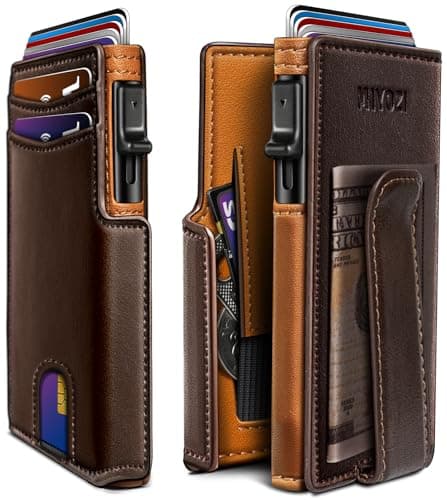
The capacity end of the format: a cage, up to thirteen cards, two ID windows and a fifteen-bill slot, in a body whose published thickness it is honest enough to print.

Most capacity
6.6
$29.99Amazon
03
LnxLtw Vertical Bifold

Marketed as vertical, but the numbers it publishes — 4.5 by 3.6 inches, with two full-length pockets for US bills — describe a conventional bifold with its card slots rotated.

Rotated slots in a standard footprint
5.6
Check price →
04
SCHLATUM SCHLATUM Vertical Bifold (15 slots)
SCHLATUM Vertical Bifold (15 slots)

Fifteen slots, two cash compartments and a flip-out ID in genuine cowhide at the bottom of the price range — the budget way into the high-capacity half of the format.

Budget high-capacity vertical bifold
6.4
$23.99Amazon
05
miyozi miyozi Pop-Up Wallet with Money Clip
miyozi Pop-Up Wallet with Money Clip

The slimmest way to have a card ejector and still carry notes, because the notes go on a leather-wrapped clip instead of into a fold — and it publishes its footprint.

Slimmest, and best value
6.8
$23.99Amazon

#ad · Live prices from the Amazon Product API, as of October 20, 2026. Where we have no verified live price, we show none — we would rather leave a gap than print a number that has rotted.

Side by side

The spec table

Every published spec that decides fit and function, side by side — with a dash wherever the maker does not publish the figure, never a guess.

ProductTypeLeatherCardsRFIDCash
Housmai Pop-Up BifoldBifold + pop-up cageLeather (grade not stated)9 (5 in cage + 4 slots)Yes (13.56 MHz stated)Cash slot, 15 bills
miyozi Pop-Up TrifoldTrifold + pop-up cageLeather (grade not stated)9-13 (5 in cage + 7 + 1 exterior)YesCash slot, 15 bills
LnxLtw Vertical BifoldBifold, vertical slots“Full-grain genuine” (claimed)7 slots + ID windowYes (13.56 MHz claimed)2 full-length pockets
SCHLATUM Vertical Bifold (15 slots)Vertical bifoldGenuine cowhide15 slots + flip-out IDYes (lining)2 compartments
miyozi Pop-Up Wallet with Money ClipPop-up cage + money clipLeather (grade not stated)9 (5 in cage + 4 slots)YesLeather-wrapped clip

In detail

The picks, in full

01
Housmai Housmai Pop-Up Bifold

Best overall

Housmai Pop-Up Bifold

Bifold + aluminum cage9 cards / 15 billsRFID at 13.56 MHzMagnetic flip
6.8/10

The pick that proves a card ejector and a real bill slot can coexist: five cards fan out of an aluminum cage, four more sit in leather, and the listing publishes a fifteen-bill cash slot alongside them.

Slimness
7
Leather
5
Capacity
7
Build
8
Value
7

Pros

  • The capacity bullet is itemized rather than summed: five cards in the cage, four in leather slots of which two are inner with an ID window and two outer with finger push holes, and fifteen bills in the cash slot. Every number is attributed to a specific place in the wallet
  • It is the only listing in our entire record that publishes an RFID FREQUENCY — 13.56 MHz, which is the band contactless payment cards actually use. Everything else in the category says "blocking technology" and stops
  • Two of the four leather slots have finger push holes on the outside, so the cards you use most do not need the wallet opened either — the cage is not the only quick-access route

Cons

  • "Premium leather" names no grade, and on a wallet where the aluminum alloy gets an aviation adjective the hide getting none is a telling order of priorities
  • No closed thickness is published anywhere in the bullets. A metal cage plus a leather fold plus fifteen bills has a real thickness and the listing does not say what it is
  • A magnetic flip and a sprung cage are two mechanisms that can fail, on a wallet whose leather is the part you can least verify

Skip this one if…

…you want the thinnest possible pop-up wallet. Keeping a bill slot is the whole point of this page and it costs you a fold the pure cardholders do not have.

$39.99· View on Amazon

Price as of October 20, 2026. Prices change — Amazon's is the one that counts.

#ad · we may earn a commission from this link to Housmai Pop-Up Bifold

02
miyozi miyozi Pop-Up Trifold

Most capacity

miyozi Pop-Up Trifold

Trifold + cage9-13 cards / 15 bills3.9 x 2.7 x 0.82 in published2 ID windows
6.6/10

The capacity end of the format: a cage, up to thirteen cards, two ID windows and a fifteen-bill slot, in a body whose published thickness it is honest enough to print.

Slimness
6
Leather
5
Capacity
9
Build
7
Value
6

Pros

  • The highest published card capacity of any ejector wallet in our record, itemized honestly: five in the cage, up to seven in the leather interior and one in an exterior daily slot, so you can see where every card goes
  • Two ID windows is a configuration almost nothing in this format offers, and it is the right one for anyone carrying a licence and a work or duty ID that both get shown
  • It publishes 3.9 by 2.7 by 0.82 inches in a feature bullet. That 0.82 figure is the only published thickness for a cash-carrying pop-up wallet we have found, and printing your own worst number is unusual

Cons

  • 0.82 inches is thick, and that is the EMPTY figure — thirteen payment cards add roughly another four tenths of an inch at the ISO card thickness. This is a bag or back-pocket wallet once loaded
  • The capacity is published as a range of 9 to 13, which is an implicit admission that reaching thirteen means doubling cards in slots, and doubling cards is what stretches leather permanently
  • No leather grade, and the bullet copy carries the same typo-level polish as the rest of this category

Skip this one if…

…slimness is any part of why a pop-up wallet appealed to you. The mechanism was invented to make a thin wallet; at thirteen cards and 0.82 inches this is using it to make a thick one.

$29.99· View on Amazon

$43.9932% off

Price as of October 20, 2026. Prices change — Amazon's is the one that counts.

#ad · we may earn a commission from this link to miyozi Pop-Up Trifold

03

Rotated slots in a standard footprint

LnxLtw Vertical Bifold

4.5 x 3.6 x 0.7 in7 slots + ID window2 full-length bill pocketsRFID 13.56 MHz
5.6/10

Marketed as vertical, but the numbers it publishes — 4.5 by 3.6 inches, with two full-length pockets for US bills — describe a conventional bifold with its card slots rotated.

Slimness
5
Leather
5
Capacity
6
Build
6
Value
6

Pros

  • It publishes a complete three-figure size including a thickness, which only one other pick on this page does — 4.5 by 3.6 by 0.7 inches, stated in the first bullet
  • Two full-length cash pockets take US notes flat rather than folded, which is a genuine advantage over every truly rotated wallet here and the reason the footprint is what it is
  • Seven slots and an ID window is a sensible everyday load, and the RFID claim names the frequency it blocks rather than leaving it at RFID technology

Cons

  • The size it publishes is the conventional bifold footprint, not a rotated one. Our standard bifold size guide derives about 4.5 by 3.5 inches for an ordinary billfold, and this is 4.5 by 3.6 — if you are buying a vertical wallet to get a narrower, taller object, this is not it
  • Full-grain genuine leather is a phrase that cannot mean anything: full grain and genuine are two different, mutually exclusive points on the grade ladder. A listing that uses both has told you nothing about the hide
  • Seven-tenths of an inch is thick for seven cards, which is what you pay for two full-width bill pockets and a lining in every slot

Skip this one if…

…the shape is the reason you are here. This is a standard bifold with vertically oriented slots — a real thing a lot of people search for under the same words, and a different wallet from the six above it.

Check price on Amazon →

We don't have a verified live price for this right now, so we aren't showing one.

#ad · we may earn a commission from this link to LnxLtw Vertical Bifold

04
SCHLATUM SCHLATUM Vertical Bifold (15 slots)

Budget high-capacity vertical bifold

SCHLATUM Vertical Bifold (15 slots)

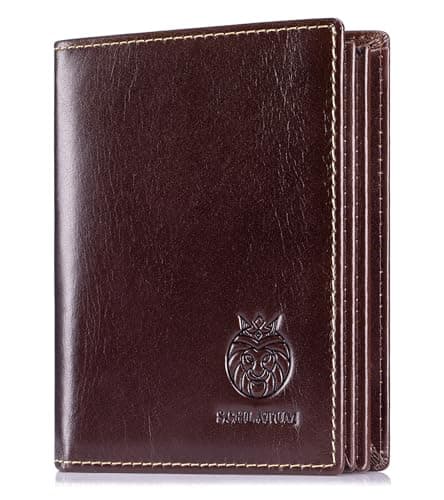
15 slotsFlip-out ID window2 cash compartmentsGenuine cowhide
6.4/10

Fifteen slots, two cash compartments and a flip-out ID in genuine cowhide at the bottom of the price range — the budget way into the high-capacity half of the format.

Slimness
4
Leather
5
Capacity
9
Build
6
Value
8

Pros

  • Fifteen slots, two cash compartments and a flip-out ID window, counted individually in the listing's own bullet rather than rolled into a marketing total
  • The leather claim is genuine cowhide and it stays genuine cowhide — no full-grain adjective smuggled in at a price that could not support one. That is the most honest material bullet on this page
  • A flip-out ID window is the right mechanism on a vertical wallet: the panel swings clear of the card stack instead of sitting under it, so showing a license does not mean unloading slots
  • It is the cheapest pick here by a clear margin, which makes it the sensible way to find out whether you actually like carrying a rotated wallet before spending on a full-grain one

Cons

  • No dimensions anywhere in the bullets — not a width, a height or a thickness. Fifteen slots in a fold has to go somewhere, and the listing never says how far
  • Genuine leather is the bottom of the real-leather ladder: a split hide with a finish applied on top. It will do several years of daily use and it will not develop the patina the crazy horse and full-grain picks above it will
  • Same brand name as the 21-slot accordion case we rank on our large-capacity cardholder page, and a completely different wallet. Check the model and the photograph, not the brand, before you buy

Skip this one if…

…you want the wallet to age into something. This is a functional, honestly-described genuine-leather wallet with a lot of pockets; if patina is the point, the Larkville and Bellicose picks are the ones that will develop it.

$23.99· View on Amazon

Price as of October 20, 2026. Prices change — Amazon's is the one that counts.

#ad · we may earn a commission from this link to SCHLATUM Vertical Bifold (15 slots)

05
miyozi miyozi Pop-Up Wallet with Money Clip

Slimmest, and best value

miyozi Pop-Up Wallet with Money Clip

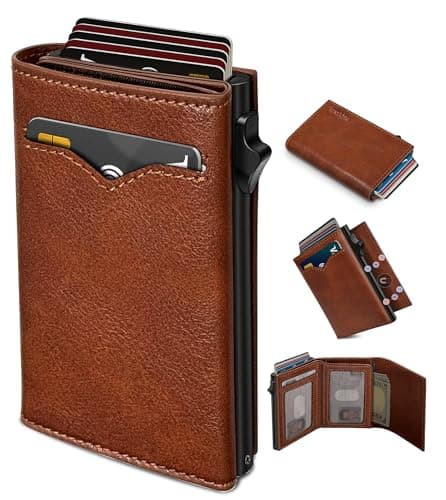
Cage + money clip9 cards / 10+ bills3.9 x 2.7 in publishedElastic small-item slot
6.8/10

The slimmest way to have a card ejector and still carry notes, because the notes go on a leather-wrapped clip instead of into a fold — and it publishes its footprint.

Slimness
8
Leather
5
Capacity
6
Build
7
Value
8

Pros

  • It publishes a compact 3.9 by 2.7 inch footprint in its own feature bullet, which most of this category declines to do, and a clip adds no thickness at all when there is no cash on it
  • The clip is leather-wrapped rather than bare metal, and the listing gives the reason: a bare clip scratches and tears notes. That is a real mechanism argument rather than a styling one
  • An elastic slot sized for two or three coins, a spare key or a SIM card is the only answer to loose change anywhere in this format, and it costs nothing when empty

Cons

  • A clip carries your notes on the OUTSIDE of the wallet, where they can be seen and where they will slide once the spring softens. A bill slot does not have that failure mode
  • No leather grade is stated, which is the pattern across every pop-up wallet we rank including the two VULKIT models
  • Nine cards means five in the cage and four in leather, and only the five in the cage actually fan out — read the split, not the headline

Skip this one if…

…you carry a working float in cash every day. A clip is right for a few notes and wrong for a thick fold; the Housmai and miyozi trifold both publish a fifteen-bill slot instead.

$23.99· View on Amazon

$39.9940% off

Price as of October 20, 2026. Prices change — Amazon's is the one that counts.

#ad · we may earn a commission from this link to miyozi Pop-Up Wallet with Money Clip

Four things to settle before you buy a cash wallet

1. Decide whether the notes fold

Everything follows from this. If the answer is no, you are buying a long wallet or a clip and you should accept that it will not go in a front trouser pocket. If the answer is yes, one fold is the most you should accept, which means a bifold or a vertical bifold and not a trifold.

2. Separate cash from coins

Notes and change in the same compartment is the single most common complaint in this part of the category, because coins crease notes and work their way between them. Two picks on this page keep them apart; the A|G bifold we rank on the coin-pocket page deliberately does not, and its own listing admits the wallet expands to 1.5 in when filled. If you carry both, the coin page is the one to read.

3. Check whether the compartment is one space or two

Two full-length pockets is not just more room. It is the ability to keep a working float apart from a reserve, or one currency apart from another, without a second wallet. Two of the five picks here publish two compartments. If you have ever hunted through a single billfold for the twenty you set aside, that is the feature you want.

4. Decide where the cash is visible from

A bill slot hides the stack inside the wallet. A clip carries it on the outside, where it is visible to anyone standing next to you and where it will start sliding once the spring softens. The miyozi clip is fifth on this page for exactly that reason, not because it is poorly made — it is the slimmest pick here and it publishes its footprint, which most of this category will not do.

The advice that earns us nothing

Carrying a lot of cash is a security decision before it is a wallet decision. No wallet on this page, or anywhere on this site, makes a large cash carry safer. A fatter wallet in a back pocket is more visible and easier to lift than a slim one in a front pocket, which is the argument the front-versus-back-pocket guide makes at length. If the amount you are carrying would genuinely hurt to lose, the honest advice is to carry less of it and keep the rest somewhere that is not on your body.

Most people asking this question carry less cash than they think. We wrote a whole guide on the amount and the arithmetic above is the useful half of it: if your float is twenty or thirty notes, your current wallet already handles it and the thing making it fat is cards, not money. Go and count the cards first.

If you are carrying notes for a specific reason, say so to yourself. Cash-envelope budgeting, a trade that gets paid in notes, and travel in a cash economy are three genuinely different briefs. The first wants a divided wallet, the second wants a clip, and the third wants a wallet sized for notes that are not US notes — which is a real and separate problem we cover in the guide on foreign notes in an American wallet.

Prices, and what we earn

Prices are read from the live price layer and stamped with the date they were read, which is why no dollar figure appears in this prose. Buy links are affiliate links. See the editorial policy.
How we picked

We do not run a testing lab

We compiled the published manufacturer specifications for every wallet here — format, leather grade, card capacity, RFID and how it carries cash — did the cost-to-own math, and scored each pick against a published rubric. The scores are judgments from documented research — they are not measurements we took or wallets we wore in, because we do not own every wallet here and we are not going to pretend we do. Where a spec could not be verified we wrote "data unavailable" rather than guessing.

Questions

Frequently asked

How many bills can a wallet hold?
Of the listings in our registry, the two that publish a figure both rate their cash slot at fifteen bills, and one money-clip model says ten or more. That is a retention limit rather than a thickness limit: fifteen US notes are only about 0.065 in thick lying flat, so what runs out is the slot's grip on the outer notes, not the space.
What is the best wallet for carrying a lot of cash?
Our top pick is the Housmai Pop-Up Bifold, whose listing rates the cash slot at fifteen bills and itemises nine card positions alongside it. For notes that never fold, the LnxLtw vertical bifold publishes two full-length bill pockets, and a long bifold — which is wider than a 6.14 in note — takes a flat stack better than anything that folds.
Does carrying a lot of cash make a wallet fat?
Far less than people expect. A US note is 0.0043 in thick, so a hundred notes is about 0.43 in lying flat — thinner than six payment cards. What makes a cash wallet fat is folding: one fold doubles the stack and two folds double it again. The format, not the money, is the problem.
Is a money clip better than a bill compartment for a lot of cash?
For a flat stack, mechanically yes — a clip holds notes without folding them and adds no thickness when empty. The trade is that the cash sits on the outside of the wallet, visible, and the spring softens over years. For a genuinely large float, a bare clip plus a separate card sleeve beats every combined clip wallet we rank.
Can a wallet hold cash and coins without ruining the notes?
Only if they are in separate compartments. Coins in a shared bill compartment crease notes and work between them, which is why we rank coin wallets by the pocket mechanism on a separate page. If you carry both daily, buy a wallet with a gusseted or zipped coin pocket rather than a bigger bill slot.

Keep reading

Receipts

Sources

We do not run a testing lab, and we do not pretend to. Every spec above traces to a manufacturer listing or a named standard; where we could not verify something, we say so on the page rather than quietly leaving it out. Read our full method.