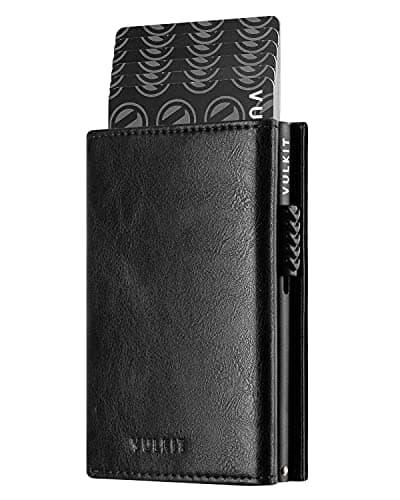
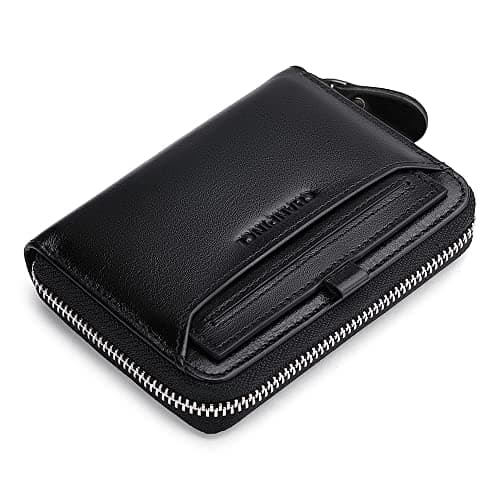
Partly. Every euro note is shorter than a US dollar, so length is never the problem — a bill compartment long enough for a dollar is long enough for any euro note ever issued. The problem is height: a US note is 66.3 mm tall and euro notes get taller as the denomination rises, so from €20 upwards they stand proud of a standard American bill compartment, and at €50 and above they stand about four tenths of an inch above the leather. Nothing is damaged; the notes are just exposed, creased along the top edge and easy to catch. If one wallet solves it, it is a zip-closing wallet— our pick below — because a zip does not care how tall the contents are.
The numbers, which nobody puts side by side
A US Federal Reserve note is 156 x 66.3 mm (6.14 x 2.61 in), and every denomination is the same size. Euro notes are deliberately not: each denomination is a different size so they can be told apart by touch and by eye. Here is the comparison, with the difference against a dollar worked out:
| Note | Size | vs US note length (156 mm) | vs US note height (66.3 mm) |
|---|
| US $1–$100 | 156 x 66.3 mm | — | — |
| €5 | 120 x 62 mm | 36 mm shorter | 4.3 mm shorter — sits below the edge |
| €10 | 127 x 67 mm | 29 mm shorter | 0.7 mm taller — effectively flush |
| €20 | 133 x 72 mm | 23 mm shorter | 5.7 mm taller (0.22 in) |
| €50 | 140 x 77 mm | 16 mm shorter | 10.7 mm taller (0.42 in) |
| €100 (Europa series) | 147 x 77 mm | 9 mm shorter | 10.7 mm taller (0.42 in) |
| €200 (Europa series) | 153 x 77 mm | 3 mm shorter | 10.7 mm taller (0.42 in) |
| €100 / €200 (first series) | 147 / 153 x 82 mm | 9 / 3 mm shorter | 15.7 mm taller (0.62 in) |
| €500 (first series, withdrawn from issue) | 160 x 82 mm | 4 mm longer | 15.7 mm taller (0.62 in) |
Two things in that table are genuinely worth knowing and we have not seen either stated anywhere. First, the €500 is the only euro note longer than a dollar, and it is no longer issued, so for practical purposes length is a solved problem. Second, the second-series redesign made this better: the Europa-series €100 and €200 were cut from 82 mm to 77 mm to match the €50, so the worst case in a modern euro wallet is 10.7 mm of overhang rather than 15.7 mm. If you have an older €100 in a drawer, it is the taller one.
Why overhang matters, and why it mostly does not
Let us be proportionate: four tenths of an inch of paper standing above a leather edge is not a disaster, and millions of people carry euros in American wallets without incident. Three real consequences, in order:
- The top edge creases and softens. Every time the wallet folds or goes into a pocket, the exposed strip bends. Over a two-week trip, notes come home looking older than they went in.
- They are visible and catchable. Notes standing above the wallet are visible when you open it and can snag on the way out of a pocket. For a €50 that is a real annoyance.
- The wallet stops closing flat. A bifold is designed around a note that disappears into its channel. Notes that do not disappear hold the fold slightly open, which is the thing that eventually marks the leather along the spine.
And the free fix, which we are putting before the shopping: fold them once. A €50 folded in half is 70 x 77 mm, which drops straight into any bill compartment with room to spare. You lose nothing except the ability to see the denominations at a glance. If your trip is a week, that is the whole answer and you can stop reading.
The other half of the problem: coins
The thing that catches American travellers out in the eurozone is not the notes. It is that the euro has €1 and €2 coins, so a significant amount of money arrives as metal. In the US, a wallet with no coin provision is a reasonable design; in Europe it means a pocket full of change worth real money.
This is why a coin pocket is on the requirement list for a euro-carrying wallet and not for a domestic one, and why one of our picks here is a wallet whose listing describes its note pocket for multiple currencies and adds a zipped coin compartment. Our full ranking of the mechanisms — gusseted pouch versus snap versus zip — is on the coin-pocket page.
What to look for in a wallet for foreign notes
A closure that does not depend on note height
A zip-around or a flap-and-magnet closure contains whatever is inside it regardless of whether the contents stand above the card panels. An open bifold does not. This is the single most useful specification for multi-currency carry and it is why the zip-around category exists.
Two compartments, not one
Carrying two currencies in one channel means counting through both every time you pay. Two full-length compartments is the feature that separates them, and several wallets publish it — see the cash-capacity page, where two of the five picks do.
A coin pocket with a real mechanism
A zip or a gusset, not a flat seam. Euro change is heavy and a flat pocket pushes it back out.
Somewhere for the documents
If the trip involves a passport, a passport cover and a wallet are two objects doing one job and it is worth asking whether one will do. The travel wallet roundup covers that properly; the short version is that a passport sleeve is 5.5 inches tall, so a wallet that takes one is a bag object rather than a pocket one.
Not RFID, particularly
Travel listings push shielding hard and it is the least important feature here. If you want the honest version of that argument we have it on the RFID guide and on the airport-security guide: it is a reasonable thing to want and a poor reason to pay a premium.
Which currencies this applies to beyond the euro
The underlying point is general: the United States is unusual in making every denomination the same size. Most currencies vary note size by denomination, usually by increasing both length and height as value rises. So if you are travelling with sterling, Swiss francs, Canadian dollars or Japanese yen, the same question applies and the same answer applies: check the tallest note you will carry against your wallet's bill channel, and if it stands proud, fold it once or carry a closing wallet.
One practical note for the other direction. If you are coming to the US with a European wallet, you have the easier problem: your wallet is cut for notes taller and shorter than a dollar, so dollars sit low in the channel and the only risk is them sliding around. That, and the thing our business-card page found: a European business card at 85 x 55 mm fits a payment-card slot almost exactly, while an American one at 88.9 x 50.8 mm is 3.3 mm too wide for it.
How to actually carry money abroad
None of this is the most important thing about carrying money in another country, so here is the part that is, none of which involves buying a wallet from us.
Split it. One card and a small amount of cash on your person, the rest somewhere else — a bag, a hotel safe. A single wallet holding everything is one pickpocket away from ruining a trip, and no leather good changes that arithmetic.
Carry the small notes on top. A €5 sits below the edge of a US bill channel and a €50 stands above it, which means the note you least want visible is the one that shows. Load the compartment with the big notes behind the small ones.
Front pocket, not back. Standard advice for a reason, and the same argument as the front-versus-back-pocket guide makes at home, only more so in a crowd.
Do not buy a dedicated travel wallet for one trip. If you travel once a year, folding the notes and carrying the wallet you own is the right call, and a travel wallet will spend eleven months in a drawer. Our travel roundup says the same thing in its own words.
Prices, and what we earn
Prices are read from the live price layer and stamped with the date they were read. Buy links are affiliate links — and the first recommendation on this page is to fold the notes, which earns us nothing. See the editorial policy.