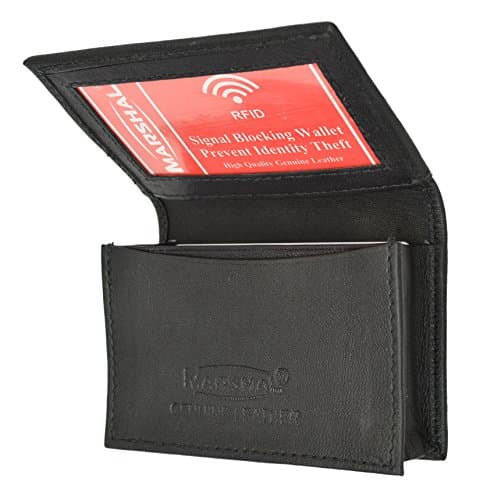
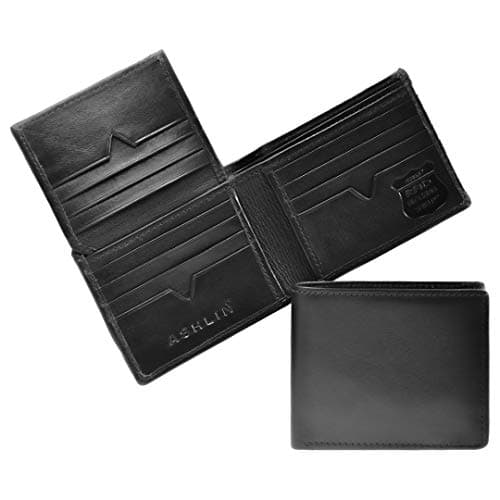
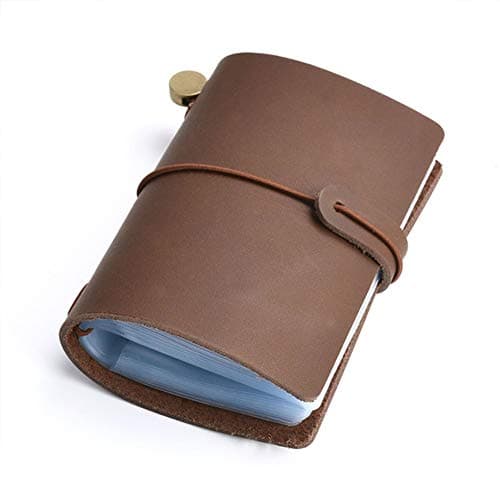
The pick for most people is the aolaso Crazy Horse Card Book — twenty side-loading sleeves at a published 0.31 in closed, and the only listing in our record that says out loud what the sleeves are cut for. If you need the capacity of a desk drawer, the boshiho 24-Slot Organizer is the one with two columns of slots and a published footprint. And if you are collecting other people's cards rather than handing out your own — which means the stack changes every day — the Marshal Expandable Card Case has no slots at all, which is the cleanest way around the problem this whole page is about.
The measurement that decides this and almost nobody mentions
A standard US business card is 88.9 x 50.8 mm, which is 3.5 x 2 inches. A payment card, a driver's licence and every other ID-1 card is 85.60 x 53.98 mm, which is 3.370 x 2.125 inches.
Put those side by side and the problem is obvious:
- a US business card is 3.3 mm wider than a credit card, and
- it is 3.2 mm shorter.
A leather slot cut for an ID-1 card is sized to 85.6 mm of width. Feed it an 88.9 mm paper card and you are forcing 3.3 mm of extra width into a pocket that has none — which either will not go in, or goes in bowed, or goes in and stretches the slot permanently so that it no longer holds a credit card properly either. The paper loses a corner, the leather loses its grip, and the listing never warned you because the listing was written about credit cards.
This is why the inclusion rule for this page is not a slot count. It is: either the listing states the sleeves are cut for business cards, or the case has no fixed-width slots at all. Two of the four picks satisfy the first condition or the second outright; the other two are here because their layouts give the paper somewhere to go, and we say exactly where below.
Why the aolaso is ranked first with a lower score
We rank pages by overall score and the array on this page breaks that rule once, on purpose. The aolaso card book scores 6.2 and sits above picks scoring 6.6 and 6.4.
The reason is that this page has exactly one inclusion rule and the aolaso is the only product in the registry that satisfies it directly: its listing leads with “business name cards”, so the sleeve cut is stated rather than inferred. Ranking it below two listings that never address the card shape would contradict the rule the page is built on. Note the honest cost of that choice, which we also print on the large-capacity cardholder page: the same listing never states the sleeves fit a payment card, so if you want one case for both, this is not it.
Giving cards out and taking cards in are two different products
Almost every search in this cluster collapses two jobs into one phrase, and they want opposite layouts.
Handing your own cards out
You carry twenty identical cards, you need them to come out clean and flat, and the stack shrinks over a week. That is a single deep pocket job, not a slot job — slots are for keeping different things apart and all your cards are the same thing. The Marshal case does this best of anything here because it publishes both its empty thickness and its full one (0.5 in expanding to 1 in) and collapses back down as the stack goes.
Keeping other people's cards
Now each card is different, you need to find one, and the collection only grows. That is genuinely a slot job, and it is where the aolaso's twenty side-loading sleeves and the boshiho's twenty-four earn their place. Side-loading matters more than it sounds: a card that loads from the side cannot work its way out of the top when the book is jostled in a bag.
Carrying two or three of your cards alongside a normal wallet
This is the most common real case and the answer is none of the above. Two business cards folded into the bill compartment of the wallet you already own costs nothing and works. A dedicated case for three cards is a second object to forget. If this is you, stop here — and if your wallet has no spare space, the honest fix is thinning the cards out of it.
If you travel, the problem changes shape
Business-card dimensions are regional, and the differences land exactly where they hurt. The published standards:
| Region | Card size | Versus an ID-1 payment card (85.60 x 53.98 mm) |
|---|
| United States / Canada | 88.9 x 50.8 mm | 3.3 mm wider, 3.2 mm shorter |
| Europe (FR, DE, IT, ES, UK and others) | 85 x 55 mm | 0.6 mm narrower, 1 mm taller — effectively the same card |
| Japan | 91 x 55 mm | 5.4 mm wider, 1 mm taller |
| China / Hong Kong / Singapore | 90 x 54 mm | 4.4 mm wider, same height |
| ISO 216 A8 | 74 x 52 mm | 11.6 mm narrower — loose in any payment-card slot |
Two things fall out of that table that we have not seen stated anywhere else. A European business card fits a payment-card slot — 85 x 55 mm against 85.60 x 53.98 mm is within a millimetre on both axes, so a standard leather cardholder genuinely works for European cards and an American one is the odd case out. And a Japanese card is the worst fit of all at 5.4 mm oversize, which matters because Japan is the business culture where you will be handed the most of them, formally, and where creasing one is a genuine discourtesy. If that is your trip, carry the slotless case.
What to check on the listing before you buy
Does it say business cards, or does it say credit cards?
This is the whole page in one question. Sellers in this category are usually describing a credit card organiser, because that is the bigger market, and the word “card” does the rest. One of our four picks addresses it. If you are shopping outside this page, that is the sentence to search the bullets for.
Are the slots leather or PVC?
Two of these publish PVC slots behind a leather cover, which the listings state rather than hide. PVC is the better material for a slot you intend to force a slightly oversize card into — it has some give and it does not take a permanent set the way leather does. It is the worse material for a case you want to own for a decade, because it clouds and eventually cracks. That trade is real and it is not obvious, so make it deliberately.
Does the published thickness describe the case empty?
It almost always does, and on a twenty-plus-slot case that gap is large. Twenty-six ID-1 cards are about 0.78 in of solid plastic at the ISO 7810 thickness; paper business cards are thinner than that, but a full case is still nothing like the figure on the box. The Marshal case is the only pick here that publishes a figure for full as well as empty, and that is the main reason it is on the page.
Does it need to go in a pocket?
If yes, the aolaso at a published 0.31 in and 3.07 x 4.13 in is the only one of the four that genuinely does. The boshiho is 1.18 in thick before a card goes in and is honest about it. That is a bag object, a desk object or a glovebox object, and it is a perfectly good one — just not a pocket one.
The advice that earns us nothing
Most people should not buy a business-card case. If you hand out two cards a month, the bill compartment of your existing wallet is the right answer and a second object is a thing to lose. The case starts earning its place at around the point where you are handing out a card most days, or where you are being handed cards you actually need to keep.
A twenty-four-slot case is a filing cabinet, not a wallet. We say this on the large-capacity page and it is worth repeating: if you have accumulated enough cards to need twenty-four slots, the useful move is to photograph them and keep the three you will actually call. A case does not make a dead contact list live.
Nothing here protects paper from a pocket. A leather sleeve keeps a card flat; it does not keep it dry, and a business card is uncoated stock on three of the four sides. If you are carrying cards somewhere wet, the honest answer is a hard case, which is not a leather product and not something we rank.
Prices, and what we earn
Prices are read from the live price layer and stamped with the date they were read. Buy links are affiliate links; the picks come from the same registry as every page on this site. See the editorial policy.