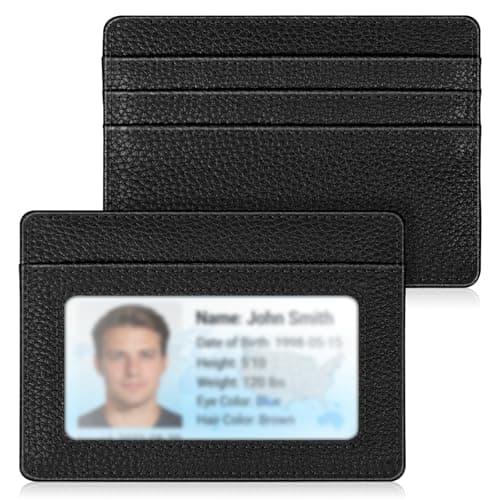
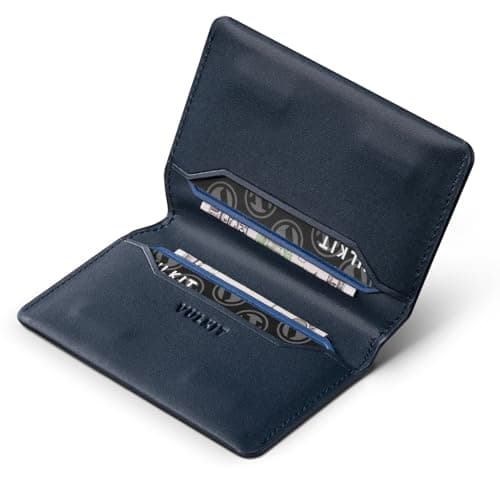
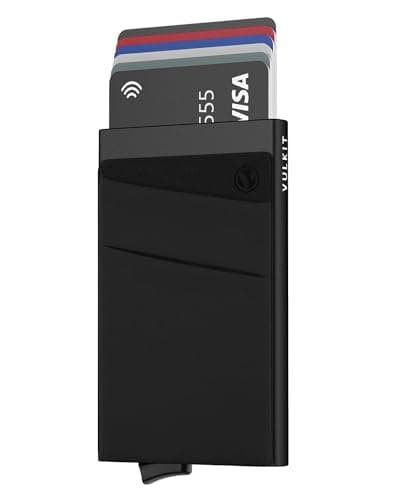
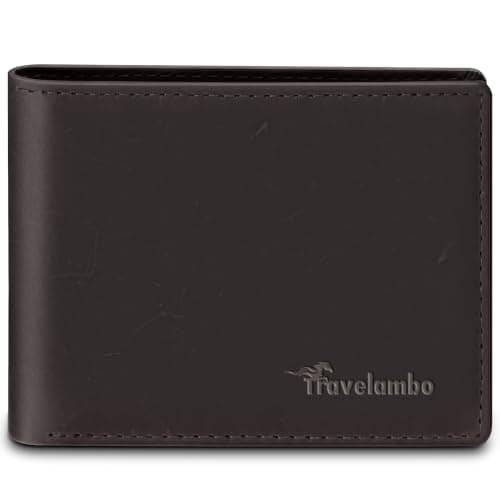
The short answer: a slim leather card holder comfortably takes four to six cards and can be squeezed to eight; a metal pop-up cage takes four to seven. But the number that actually catches people out is the other end of the range. A holder that retains cards by friction rather than by a flap or a zip has a minimum too — run it under that and it will quietly let a card go. One of the listings we rank publishes that minimum as three cards, and it is the most useful sentence in this entire category.
Start with the card, because that part is fixed
Every payment card, license, transit pass and hotel key in your wallet is the same object dimensionally. ISO/IEC 7810 defines the ID-1 format as 85.60 by 53.98 mm with a thickness of 760 ± 80 µm — 0.76 mm, or about 0.030 in. That is the only genuinely stable number in this question, and three things follow from it.
Stack height is strictly linear. Six cards is 4.6 mm of card. Ten is 7.6 mm. There is no clever packing to be done; cards do not compress.
A card holder cannot be smaller than a card plus a seam. Any sleeve that takes a card flat is at least about 90 by 60 mm externally. This is why card holders from completely different makers at completely different prices are all roughly the same size, and why a listing photograph tells you almost nothing.
The tolerance is wider than it looks. That ± 80 µm is a tenth of a card's thickness, so eight cards at the top of tolerance are measurably thicker than eight at the bottom. Add an embossed card and the local thickness at the raised numerals is higher again — which is why several listings in this category specify “flat” cards in their capacity bullets, and why an embossed card should be counted as two.
What to look for in a published capacity
Four things, and they separate the honest listings from the rest.
A range beats a single figure. “4–7 cards” is a seller telling you the truth: a holder genuinely has a comfortable load and a strained one. “Holds 8 cards” is almost always the strained figure with nothing else in the wallet.
A slot count beats a card count. A slot is a physical feature you can see in the photograph; a card count is a claim. Where a listing publishes both and they disagree — which happens constantly — the slot count is the one to believe.
Beware the sum. On pop-up holders the headline figure is the mechanism's capacity plus whatever the outer shell holds, and only the cards in the cage get the mechanism. A claimed ten can be five in the cage, four in slots and one in an ID window.
Look for a stated minimum. Almost nobody publishes one. The exception is worth quoting exactly, from VULKIT's metal case: “Daily Capacity: 4-7 cards (mixed flat and embossed)”, “At least 3 cards are needed for secure retention”, and a note that actual capacity depends on card thickness. That is three honest sentences where the rest of the category gives you one optimistic number.
The four holders below, and what each one publishes
These are not ranked as “the best card holders” — that is the hub's job. They are here because each one publishes a capacity figure of a different kind, so you can see what each kind is worth before you read any other listing.
What a slot costs you, and why the big numbers are a trap
An empty slot is not free. Across the ten wallets and card cases we rank that publish a closed thickness, the figures climb by roughly 0.035 to 0.040 in per slot the maker added, against a card thickness of 0.030 in. In other words an empty slot costs about as much thickness as a card does, so a twenty-slot organizer carrying eight cards is thicker than an eight-slot holder carrying eight cards. The published slot count is an argument against a product at least as often as for it. The full derivation, its counter-example and its honest limits are in the thickness guide.
The practical rule that falls out of this is fewer layers per card, not fewer cards. A holder with two deep slots that each take three cards will be slimmer at the same load than a holder with six single-card slots, because you are paying for leather once instead of three times.
Why a mechanical holder has a minimum
A pop-up cage, a metal case and an elastic sleeve all retain cards by pressure. The spring, the band or the sprung plate is sized for a stack, and with one or two cards in it there is not enough thickness for the pressure to act on. The card can slide, and in a bag or a loose jacket pocket it will eventually slide out. Leather slots sewn to a card's width do not have this problem, which is the quiet advantage of the plain sewn sleeve over the clever mechanism.
The corollary is the thing that breaks cards. A cage running at or above its maximum is tight, and a tight holder invites you to lever the card out over a hard rim — which concentrates a bending load on one line, exactly where a rigid chip module meets flexible PVC. That, not slot friction, is the main way cards get damaged in a wallet; the mechanics and the fix are in do card holders damage cards.
Fits is not the same question as should
This page is strictly about what physically fits and what a mechanism requires. How many cards you ought to be carrying is a different question with a different answer, and it is answered separately in how many cards should a wallet hold. If the honest answer for you is “more than eight”, a card holder is the wrong format and the large-capacity organizers — sixteen slots and up — are the page you want. If it is “four, plus a note”, look at the holders that carry cash instead.
A note on what we did not measure
We have not stacked cards into these wallets with a caliper, and we are not going to pretend otherwise. Every capacity figure on this page is either the ISO standard or a figure published by the seller in the listing's title or feature bullets, quoted as written. Where a listing contradicts itself we print the lower claim and say so. Nobody in this category publishes a tested retention force, so we do not report one.