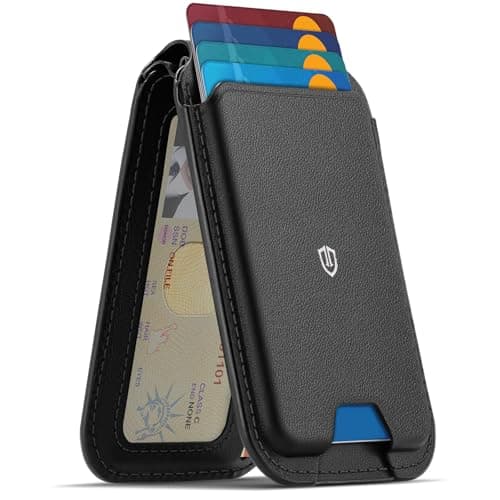
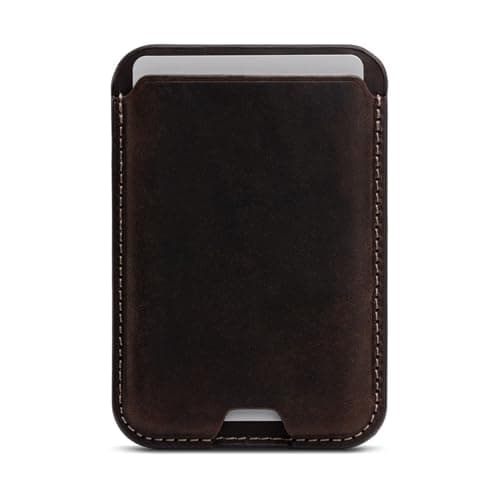
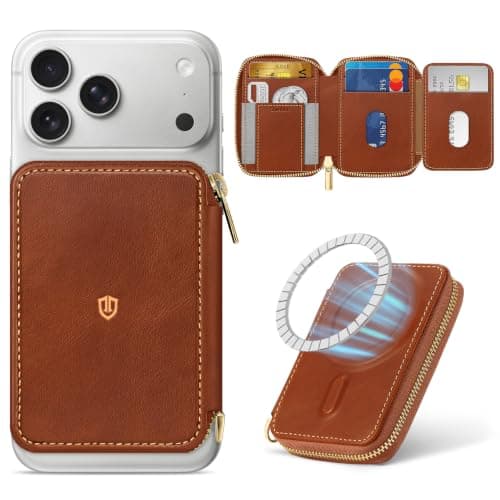
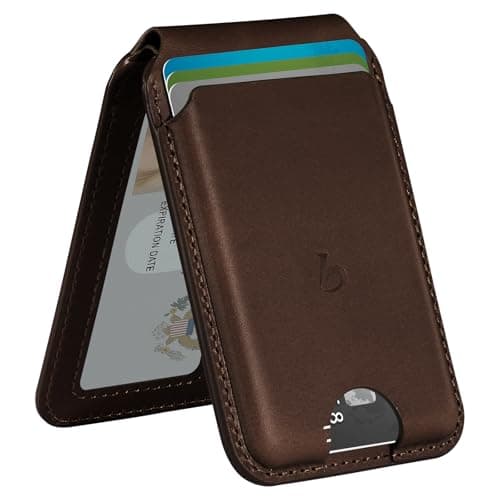
The published ceilings on the leather MagSafe wallets we rank run from two cards to twelve, and the figure is set by the mechanism rather than by the magnet. A plain magnetic sleeve tops out at two or three. A hinged stand reaches five or six. Only a zipped pouch gets to twelve, and it does it by being 0.69 inches thick, which is a different object from a card sleeve. If you are shopping, the number you want is in the listing's feature bullets, not the title — and the four picks below are the published ends and middle of that range.
The published numbers, from the listings themselves
Every figure here is the seller's own stated ceiling, taken from the feature bullets of a listing in our registry. We have not counted slots in photographs and we have not tested anything.
- Two cards — a side-opening sleeve with an internal spring, published at 0.26 inches. The thinnest figure in our whole record, and the ceiling is genuinely two.
- One to three cards — a plain full-grain sleeve. Note that this is published as a range starting at one, which matters: a sewn slot holds one card as securely as three.
- Up to five cards — a hinged stand design, which splits three quick-access cards outside from an ID and one card inside. Published thickness 0.47 inches.
- Six cards — four slots plus a transparent ID window, on the same kind of hinge. This is the practical ceiling for something that still behaves like a card holder.
- Up to twelve cards — a zipped pouch with six card pockets, an elastic pocket and an ID window, published at 0.69 inches. It detaches and works as a standalone wallet, which is the only reason the number is reachable.
Why the ceiling stops where it does
Not because the magnet gives up. Three separate limits bite before magnet strength does, and knowing which one you are hitting tells you which wallet to buy.
The lever arm, which is the real limit
A MagSafe wallet is held by a flat magnetic ring against the back of the phone. The force that defeats it is almost never a straight pull — it is a peel, where one edge lifts and the rest follows. Every card you add moves the wallet's outer face further from the magnet, which lengthens the lever any snag or pocket seam gets to work with. That is why the capacity ladder above tracks thickness so closely: at some point the stack stops being a sleeve on a phone and starts being a handle. What that means in practice, and what to do about it, is in why a MagSafe wallet falls off.
The arithmetic of the stack
A payment card at the ISO/IEC 7810 specification is about 0.03 inches thick. So six cards is roughly 0.18 inches of card, before the leather. A sleeve published at 0.26 inches empty and holding two cards is carrying about 0.06 inches of card inside 0.2 inches of leather — the leather is most of it. By the time you reach the twelve-card pouch at 0.69 inches, the cards are about 0.36 inches and the construction is the rest. This is also why doubling cards into a slot is the wrong move: it does not change the arithmetic, it just moves the thickness into one place and stretches the slot permanently.
The retention mechanism, which has a floor as well as a ceiling
Two of these designs use a spring clip on the quick-access slot specifically so that a single card does not work its way out, which is the failure this format is worst at. That is a design response to a real problem: an open slot sized for three cards does not grip one card well. It is the same mechanism problem that the metal cages have, and the published version of it — “at least 3 cards are needed for secure retention” — is on a VULKIT listing we quote in how many cards fit in a card holder. If your MagSafe carry is one card, buy a design with a clip or a closure rather than an open sleeve.
Cash, and the honest limit of the format
Four of the five MagSafe wallets we rank have no cash provision at all, and that is the defining limitation of the category rather than an oversight. A Federal Reserve note is 6.14 inches long and a phone is about 6 inches tall, so a note has to fold twice to live on the back of a phone, and a folded note in a card slot competes with the cards for the same friction. The one pick here with an answer is the zipped pouch, whose elastic pocket the listing says takes folded cash, coins, keys or receipts. If cash is part of the daily carry, a MagSafe sleeve is a supplement rather than a wallet, and the cash-and-cards roundup is the page you actually want.
How many cards should you put on a phone?
Three, in our view, and the reason is not capacity. A phone that falls lands on whatever the heaviest face is, and a six-card stack on the back changes how a phone sits in a hand, in a pocket and on a table. Three cards — one payment, one ID, one access card — is the load where the phone still behaves like a phone. The broader argument about thinning the deck rather than buying capacity is in how many cards a wallet should hold, and the two-and-three card roundup ranks the wallets built for exactly that carry.
What the listings do not publish
Three gaps, worth naming because they are consistent across the category.
Holding force. Two of the four picks publish a magnet grade (N52 and N52H). None publishes a holding force in newtons or pounds, so there is no number that lets you compare a five-card stand against a two-card sleeve on retention. We have printed the grades and refused to convert them into a strength claim.
Real thickness. Several listings in this category publish dimensions that are clearly the package rather than the wallet — a 4 by 3 by 1 inch figure on a card sleeve is a box. Where the figure is obviously packaging we have said so rather than quoting it as a spec, which is why the spec table below has fewer numbers in it than you might expect.
What happens with a case on. One listing states outright that it is not compatible with a non-magnetic case or with an iPhone mini; the others are silent. A case between the magnet and the phone adds distance, and distance is the one variable that reliably reduces holding force.
If you need more than six cards
Stop trying to put them on the phone. The twelve-card zipped pouch is a real product and it works, and it is also 0.69 inches of wallet magneted to the back of a device you hold to your face. At that point a separate slim wallet is thinner in the pocket and better at being a wallet. The honest ladder is: one to three cards on the phone, four to eight in a slim wallet, ten or more in a ten-slot wallet.
Prices, and what we earn
Every price here is read live from the Amazon Product Advertising API and stamped with the date it was read, which is why no dollar figure appears in this prose. Buy links are affiliate links; the picks are score-ordered from the same registry as every other page on the site. See the editorial policy.