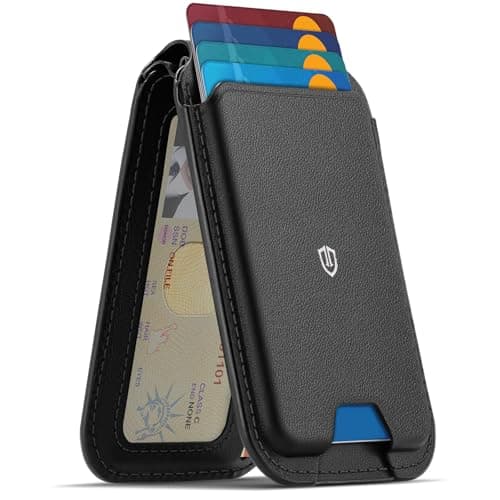
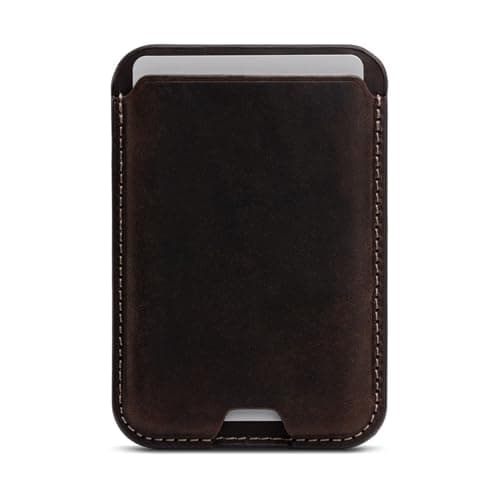
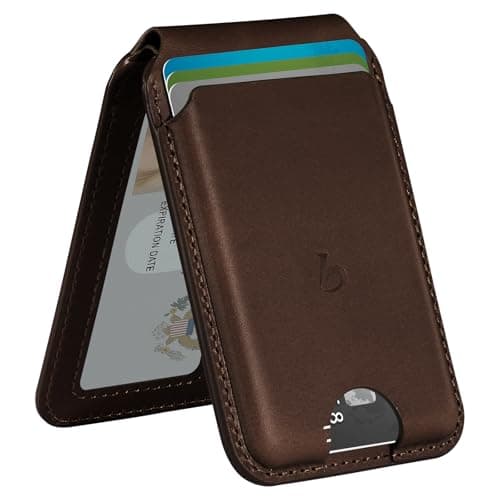
The short answer is no, not in normal use— and the useful answer is that you are worried about the wrong object. Apple's own support documentation warns against putting cards between an iPhone and a MagSafe Charger, in those words, while selling a MagSafe wallet designed to hold cards on the back of the phone. Both of those things are true at once, and understanding why is what makes the warning usable rather than frightening. If you want one pick, the Belemay Vegetable-Tanned MagSafe Wallet is ours: it publishes the highest magnet grade of any leather model we rank and states an anti-magnetic lining, which is the only answer in the category aimed directly at this question.
Only one thing on your card is magnetic
A modern payment card carries up to four ways of being read, and three of them cannot be affected by a magnet at all.
| Feature | How it stores or moves data | Can a magnet erase it? |
|---|
| Magnetic stripe | Magnetised particles in a stripe, per ISO/IEC 7811 | Yes, in principle. This is the only one |
| EMV chip (the gold contact pad) | A silicon integrated circuit read through electrical contacts | No — there is nothing magnetic to erase |
| Contactless antenna (tap to pay) | A radio coil at 13.56 MHz, per ISO/IEC 14443 | No — a static magnet is not a radio signal |
| Embossed or printed number | Physical relief and ink | No |
That table is the whole topic. If you tap to pay, or insert the chip, a magnet is irrelevant to you — the only part of a card a magnet can damage is the part most of the developed world has stopped using. If your card gets swiped, the stripe still matters, and the honest nuance is in the next section.
Stripes are not all equally tough, and you cannot tell by looking
The magnetic stripe standard comes in more than one flavour. ISO/IEC 7811 part 2 specifies a low coercivity stripe; part 6 specifies a high coercivity one. Coercivity is, loosely, how hard the material resists having its magnetisation changed — so a high-coercivity stripe is harder to erase, and a low-coercivity one is easier.
Which one is on the card in your hand? Your issuer chose, and there is no way to tell by inspection. That is the honest state of the question and it is why blanket reassurance is wrong and so is blanket alarm. What we can say from the standard is the ranking: the cards most likely to suffer are the cheap ones — hotel key cards, gym and transit passes, paper-thin loyalty cards — and the cards least likely to are bank cards, which is the opposite of the way people worry about it.
The charger, not the wallet. Apple says so
Here is Apple's published guidance, verbatim: “Don’t place credit cards, security badges, passports, or key fobs between your iPhone and MagSafe Charger, because this might damage magnetic strips or RFID chips in those items.”
Read that carefully, because it is precise about two things most of the internet blurs. The warning is about a charger, and it is about putting cards between the charger and the phone. A charger is not a magnet sitting still; it is a coil moving energy, and a card sandwiched in that gap is in a genuinely different situation from a card in a leather sleeve on the back of a phone in your pocket. Apple sells a MagSafe wallet and tells you to take it off before charging, and both halves of that are consistent.
Note also the second half of Apple's sentence: “or RFID chips”. That is the charger's electromagnetic field, not its magnets, and it is why key fobs and access badges — which have no magnetic stripe at all — are on the same list. It is also a cost that matters on a duty wallet, which is the point the badge-wallet page makes about shielded linings and proximity badges sharing the 13.56 MHz band.
What to look for in a MagSafe wallet, if this is your worry
A published magnet grade, not an adjective
Three listings in our record publish a neodymium N-grade— two at N52H and one at N52. Everything else says “strong” or “ultra-strong”, and one claims “up to 6 times stronger” with no reference point, which is not a specification. We print grades and ignore multipliers, the same rule as on the retention guide.
One honest wrinkle: a higher grade is better for holding the wallet on and, all else equal, is the thing you would worry about for a stripe. So this spec cuts both ways, and the listings that publish it are being more useful than the ones that do not regardless of which direction you read it in.
A stated shielding layer between the magnet and the cards
This is the feature that actually addresses the question. One pick below states an anti-magnetic lining; the listing puts a percentage on it which we are not going to repeat as a fact, because there is no test behind it. The existence of a stated barrier layer is checkable and the number is not, so we rank on the first and ignore the second.
A format that keeps the card off the magnet
A hinged stand design puts leather and a mechanism between the magnet plate and the card stack; a flat sleeve puts less. That is a real structural difference and it is also why stand models are thicker. If you want the flattest option, you are accepting the shortest distance.
Nothing, if you only tap
Said plainly because it saves money: if every card you carry is contactless or chip-only, none of the above applies to you and you should buy a MagSafe wallet on leather, capacity and published card ceiling instead.
What nobody in this category publishes
Three gaps worth knowing before you read any review of these products, including ours.
No holding force, anywhere. Not one listing in our record states a pull strength in newtons or grams. The N-grade is a property of the magnet material, not of the assembled wallet, and it tells you nothing about how many magnets there are or where they sit.
No field strength at the card. Which is the number that would actually answer this page's question. Nobody publishes it, we cannot measure it, and any site that gives you a figure is either citing a manufacturer or inventing one.
Published dimensions that are clearly the box. Two of our picks publish figures like “4 x 3 x 1 in” for a wallet that is obviously a few millimetres thick. That is packaging, and we say so in the spec notes rather than passing it on.
The other magnets in your life
Magnetic closures are everywhere in leather goods and this question applies to all of them, not just phone wallets. Several wallets we rank use a magnetic flap, including pop-up card holders and the nappa holder in the Ekster versus VULKIT comparison. Fossil makes a magnetic card case with a clip. None of those publishes a magnet grade either.
The same reasoning applies throughout: the chip and the contactless antenna cannot be affected, the stripe can in principle, and the practical casualties are hotel keys and transit cards rather than bank cards. If you have ever had a hotel key stop working after a day in your pocket, that is the mechanism and it is the best everyday evidence that the effect is real but narrow.
If a card does stop working
A demagnetised stripe cannot be re-magnetised at home and there is no trick that fixes it. The card has to be replaced by the issuer, which is free and usually fast. Before assuming the magnet did it, check two things that are more common: a scratched stripe, which is physical wear from being pulled through readers and in and out of tight slots, and a worn chip pad. Our guide on whether card holders damage cards covers the abrasion side, which in our view is the far more likely culprit for a card that has quietly stopped reading.
Prices, and what we earn
Prices are read from the live price layer and stamped with the date they were read. Buy links are affiliate links; the picks are score-ordered from the same registry as every page on this site. See the editorial policy.