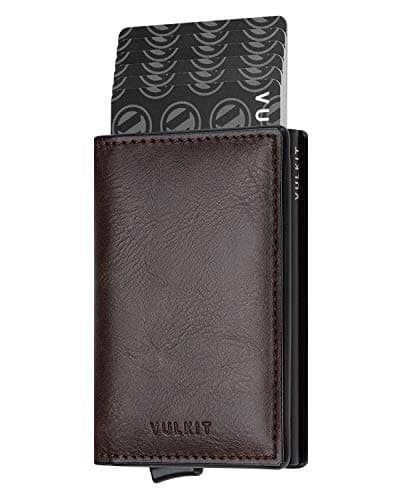
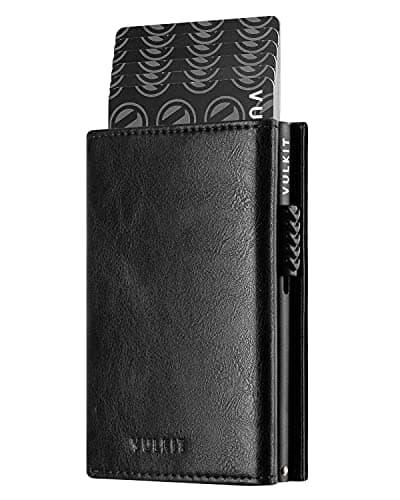
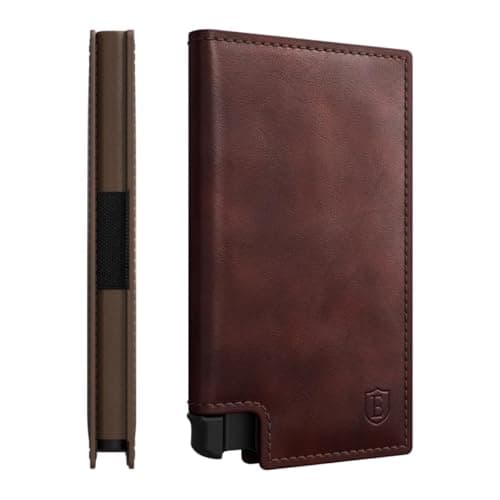
If the mechanism is why you are here and you only want it once, buy the Ekster Parliament — it is the only one of the four whose listing names a leather grade (top-grain over an aluminum cage), the only one with a published twelve-card ceiling, and the only one with a tracker card you can add later. If you want to find out whether you actually like a pop-up wallet before committing, buy the VULKIT Pop-Up Card Holder, which delivers a functionally identical thumb lever for a fraction of the price and is honest enough to publish seven cards in its bullets while its own title says eight. The brand you should not choose on brand is either: the deciding question is what you need the wallet to do about cash.
The mechanism is not the difference
Both brands build the same object: a stack of cards held in a sprung aluminum cage, fanned into a staircase by a thumb lever, wrapped in leather or left bare. That is the party trick people buy these for, and across the four picks here it works the same way and has the same limits. We cover those limits in full on the card-holder capacity guide and on the pop-up roundup, and the important one is a floor rather than a ceiling: a friction cage needs a minimum stack to retain anything, and one listing in this category publishes that minimum as three cards. A single card in a cage is not secure in any of these.
So choosing between Ekster and VULKIT is not choosing between mechanisms. It is choosing between two different sets of published claims around an identical idea, and they differ in three specific ways.
Difference one: Ekster names the leather. VULKIT mostly does not
The Ekster Parliament listing says top-grain leather over an RFID-blocking aluminum cage. That is a grade, it sits one rung below full-grain on the ladder our grade explainer walks through, and it is checkable.
Across VULKIT's range, the material language is “leather”, “supple leather” and “PREMIUM LEATHER CASE”. None of those is a grade. The single exception is worth knowing because it inverts what you would expect: the one VULKIT whose bullets name a leather is the cheapest model in the line, a four-slot nappa card holder with no cage at all. The most expensive wallet the brand sells names no grade; the least expensive one does.
We have printed that exactly as the listings have it, including on the VULKIT brand review. It is not a claim that VULKIT's hide is bad — we have no way to know, which is the point. It is a claim about what you are able to verify before you pay.
Difference two: VULKIT solves cash and coins. Ekster solves tracking
This is the difference that should actually decide your purchase, and it is the one neither brand frames as a choice.
Ekster carries cash on the outside. Both Ekster picks here use an expandable back or an elastic strap. A US note is 6.14 inches long, so getting it behind a card-sized wallet means folding it twice and then holding it against the wallet's back. It works, it is visible, and it is the thing our Ekster review flags as the format's weak point. What Ekster has instead is an ecosystem: a solar-powered tracker card sized for the wallet, which makes the whole thing findable. No VULKIT model offers that.
VULKIT builds the cash in. The brand's range includes a trifold with a genuine full-length bill compartment — notes lie in it the way they lie in a billfold, one fold rather than two — and a top-of-range model with a note pocket and a zipped coin pocket behind a magnetic flap. That coin zip is the only answer to loose change anywhere in this entire format, from either brand. Its listing also describes the note pocket for multiple currencies rather than just US bills, which is a more specific design statement than it looks: euro notes above €20 are up to 11 mm taller than a US note, so a pocket cut to a dollar is not automatically cut to a fifty-euro note. We go into that on the foreign-notes guide.
Difference three: the price gap, and what it is actually for
The Ekster models cost multiples of the VULKIT ones — read the live prices above rather than a figure in this prose, because that is the only honest way to publish it. What the gap buys, as far as the listings will support:
| What you are deciding | Ekster | VULKIT |
|---|
| Leather grade stated in the bullets | Yes — top-grain (Parliament) | Only on the nappa holder, which has no cage |
| Published card ceiling | Up to 12 | 7 to 10 depending on model, cage holds 5 in all of them |
| How cash is carried | Outside, on a strap or expandable back | Inside — a full bill compartment or a note pocket, model depending |
| Coins | Not addressed by any model | A zipped coin pocket on the top model |
| Tracker | A solar tracker card sized for the wallet | Not offered — one model is sized to take an AirTag |
| An all-metal option | Yes, aluminum, same mechanism, no leather | Yes, a metal card case publishing 0.31 in |
| Published closed thickness | Not published in the bullets | Not published on any leather model; 0.31 in on the metal case |
The last row is the one both brands fail, and it is the specification a front-pocket buyer most wants. Not one leather pop-up wallet from either brand publishes how thick it is closed. That is a category-wide gap rather than a brand failure, and it is the reason our thickness guide works from the ISO card figure instead: a payment card is 0.03 inches, so five cards in a cage is 0.15 inches of plastic before any leather, aluminum or lever is counted.
Which one to buy
Buy Ekster if the wallet is the purchase rather than the experiment: you want a named leather grade, you carry cards and little cash, and the tracker is genuinely appealing. It is also the right choice if you have already owned a cheap pop-up and know you like the format.
Buy VULKIT if you carry notes, or coins, or you are not yet sure that a mechanical cardholder is for you. The cheap pop-up is the lowest-risk way to find out whether you will still enjoy the lever in month three, and if the answer is no you have lost very little. If the answer is yes, you will know exactly which features you missed.
Buy neither if you carry one or two cards, because a cage needs a stack to grip — our two-and-three-card page exists for exactly that carry and recommends sewn slots and clips instead. And buy neither if the real problem is bulk from cards you do not use; half an hour of sorting is free and solves more of this than a mechanism does.
What about Ridge?
“Ridge wallet vs VULKIT” shows up in the same autocomplete block, and it is a different comparison because Ridge is a plate-and-elastic design rather than a lever-and-cage one. We cover it on Ekster vs Ridge, leather vs metal and the Ridge alternatives roundup, which sorts the options by which Ridge weakness you are trying to fix.
Three things to check on either brand before you buy
Read the bullets, not the title
Both brands publish titles that disagree with their own feature lists. The cheap VULKIT pop-up advertises up to eight cards in the title and seven in the bullets; one of its models is called a card holder in the title and a trifold wallet in the bullets. Those are different formats with different pocket behaviour. Buy on the bullets every time — it is the same rule the slot-count page had to apply across its whole category.
Work out which number is the cage and which is the shell
Every headline capacity in this format is an addition. “Ten cards” on a VULKIT means five in the aluminum cage plus four in leather slots plus an ID window. Only the cage cards actually fan. If quick access to eight cards is what you wanted, no wallet from either brand does that — you get quick access to five and ordinary access to the rest.
Decide about RFID honestly
Both brands claim RFID blocking, and in the caged models the claim has an obvious physical basis: the cards sit inside an aluminum box. The weakest claim in either range is the VULKIT nappa holder's “advanced RFID blocking materials”, with no cage and nothing named. Whether any of it matters is a separate question and we answer it without hedging on the RFID guide: contactless fraud at a distance is rare, and shielding is a reasonable thing to want and a poor reason to pay a premium.
Prices, and what we earn
Both brands' prices are read from the live price layer and stamped with the date they were read, which is why no dollar figure appears anywhere in this prose — a comparison page that hard-codes a price gap is wrong the week after it publishes. Buy links are affiliate links and we earn on either brand, which is exactly why this page ranks them on what their listings publish rather than on which pays better. See the editorial policy.