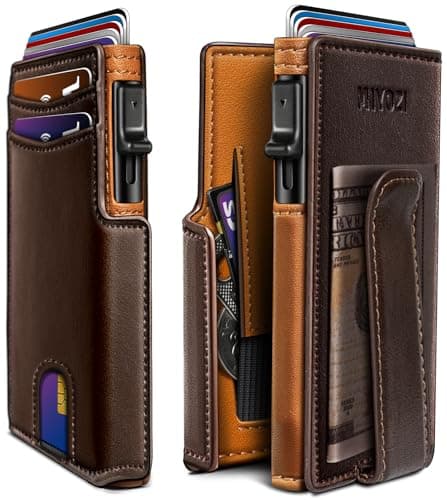
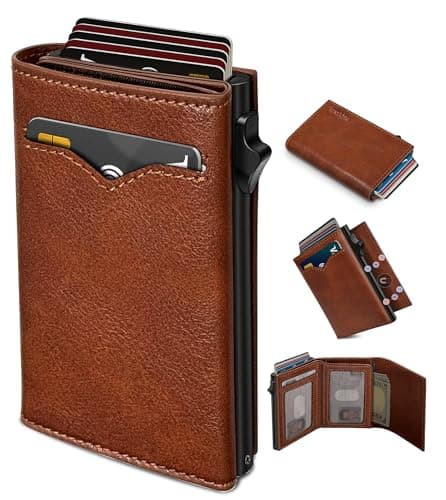
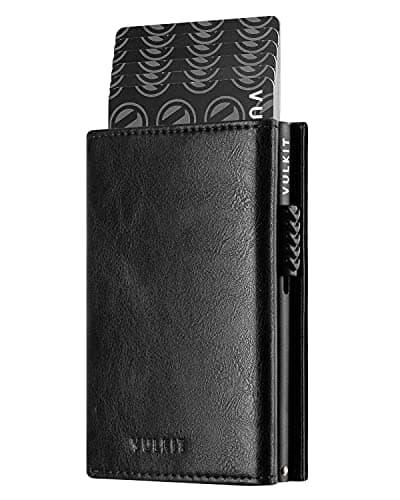
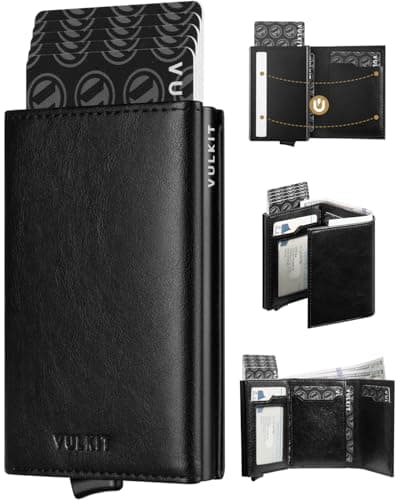
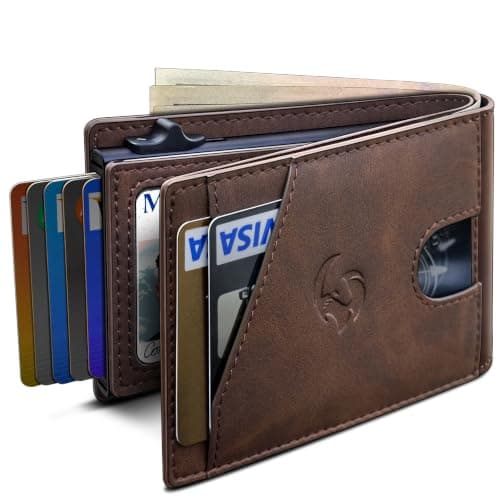
The pick for most people is the Housmai Pop-Up Bifold — five cards fan out of an aluminum cage, four more sit in leather slots, and the listing publishes a fifteen-bill cash slot alongside them, which is the combination this entire search is looking for. If you want the mechanism with the least bulk, the miyozi with the leather-wrapped money clip publishes a 3.9 by 2.7 inch footprint and puts the notes on a clip instead of in a fold. And if coins are in your carry at all, the VULKIT with the zipped coin pocket is the only pick here that takes them.
The rule for getting on this page
Two mechanical conditions, and the second one is what makes this page exist. The wallet needs a mechanical card ejector — a thumb lever or side button that fans cards out of a cage without the wallet being opened — and it needs a published cash provision: a bill slot, a note pocket or a clip, stated in the listing's own feature bullets.
That second rule excludes almost every pop-up product sold, and it excludes the page we rank them on. The mechanism is overwhelmingly fitted to cardholders, which have no cash channel by definition — those are ranked on the pop-up card holder roundup, which is the better page if you have stopped carrying notes. This one is for the reader who wants the thumb lever and has not. The split is the whole distinction and we would rather state it than let you find out on arrival.
How a card ejector actually works, and what it costs
A cage of sprung aluminum holds a stack of cards under pressure. A lever or button lifts them in a staggered fan so you can read the one you want and pull it without touching the others. It is a genuinely good mechanism — faster than a slot, and it keeps cards from being levered over a leather edge, which is what actually cracks them.
It costs three things, and no listing on this page mentions any of them.
A minimum card count
A cage grips the stack, not the card, so an under-filled cage lets cards go. VULKIT publishes the figure on a sibling product — “At least 3 cards are needed for secure retention” — and it is the most useful sentence anyone in this category has written. If your carry is one or two cards, a mechanism is the wrong object and the two-and-three card roundup explains why a plain sewn slot beats it.
A headline number that is a sum
Every capacity figure in this category adds the cage to the leather, and only the cage cards actually pop up. The listings here are better than most because they itemize it: Housmai publishes five in the cage plus four in leather; the miyozi trifold publishes five in the cage, up to seven in the leather interior and one exterior slot. Read the split rather than the headline. Where a listing gives a range — the miyozi trifold's “9-13 cards” — the top of the range means doubling cards into slots, which works and permanently stretches the leather.
Two more things that can break
A sprung cage and a magnetic closure are both moving parts on an object that previously had none. Four of the five picks here use a magnetic flip to hold the leather shut over the metal. We have no failure data and will not invent any; what we will say is that a plain sewn bifold has no mechanism to fail, which is a real argument for the ordinary format.
Where the cash goes, and it is the real decision
Three mechanisms appear across these five picks and they are not interchangeable.
A bill slot is the full answer: Housmai and the miyozi trifold both publish fifteen bills, enclosed and flat. A leather-wrapped clip — the slimmest miyozi — costs no thickness when empty and carries ten or more notes on the outside of the wallet, where they can be seen and where they will slide once the spring softens. The listing gives the reason the clip is wrapped rather than bare: a bare metal clip scratches and tears notes. A note pocket is the VULKIT approach, and the coin-pocket model's zipped compartment is the only place on this page that loose change can go.
Worth knowing before you choose: cash is almost never what makes a wallet fat. A US Federal Reserve note is 0.0043 inches thick, so fifteen of them folded add less than five payment cards do at the ISO card thickness of about 0.03 inches. The mechanism is what you are choosing, not the capacity — the cash guide does that arithmetic properly.
The one spec in this category nobody else publishes
Housmai states that its RFID lining blocks 13.56 MHz. That is the only RFID frequency published on any listing in our entire record, and it is worth something: 13.56 MHz is the band contactless payment cards and most access badges actually use, so the claim is specific and checkable rather than the usual “advanced blocking technology”. Every other pick here claims RFID blocking without naming a band. It does not make Housmai's lining better than theirs — we have no way to know — but it is the only one that told us anything at all.
Leather grade across this whole category: not one listing names it
All five picks say “leather” or “premium leather” and stop. None says full grain, top grain or genuine, which means none of them is claiming a rung on the ladder the grade guide describes. The pattern is consistent enough to be a category fact rather than an oversight, and the reason is visible in the copy: on the Housmai listing the aluminum gets an adjective (“airplane-grade”) and the hide does not. These are sold as gadgets with leather on them.
That is worth being clear-eyed about rather than annoyed by. If what you want is a mechanism, buy the mechanism and treat the leather as trim. If what you want is a hide that will look better in five years, nothing on this page is it, and the full-grain roundup is where those live — none of them has a cage.
Thickness, and the only published figure
One pick publishes a closed thickness in its own bullets: the miyozi trifold, at 3.9 by 2.7 by 0.82 inches. We print it because it is published and because printing your own worst number is unusual — 0.82 inches is thick, and that is the empty figure. Thirteen cards add roughly four tenths of an inch more. The other four publish no thickness at all, and a metal cage plus a leather fold plus notes has a real one.
If thinness is the goal, the honest ranking inverts: the clip-only miyozi has no bill fold and is the slimmest thing here, and below that you are into slim wallets with no mechanism at all. The slot-by-slot arithmetic is in the thickness guide.
What we left off, and why
Every pure pop-up cardholder, however good — no cash provision means it fails this page's inclusion rule and belongs on the cardholder page or, if it has a clip or a cash slot, the cash-provision page. Every all-metal case, because this page is about wallets with a cage in them rather than cages with a wallet attached — those are on the RFID roundup and the Ridge alternatives page. And every listing whose leather claim was contradicted by its own bullets.
Prices, and what we earn
Prices are read live from the Amazon Product Advertising API and stamped with the date, which is why no dollar figure appears in this prose. Buy links are affiliate links and the ranking is score-ordered regardless — see the editorial policy.