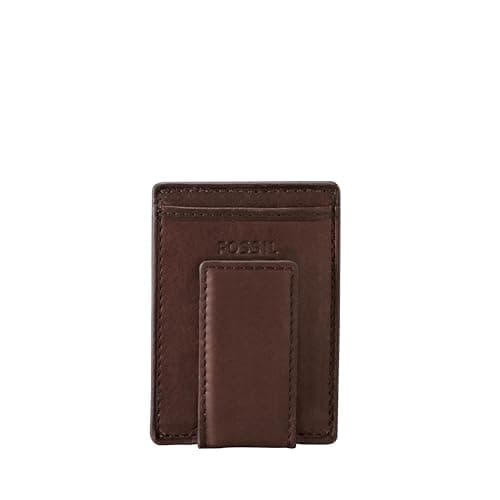
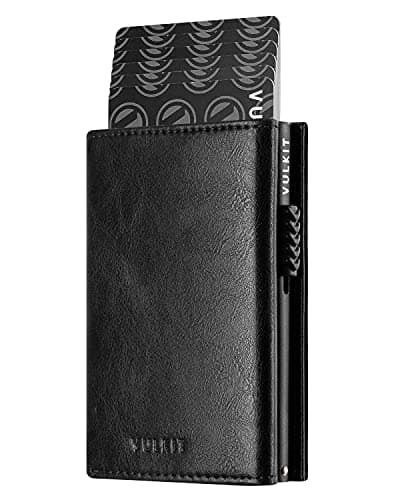
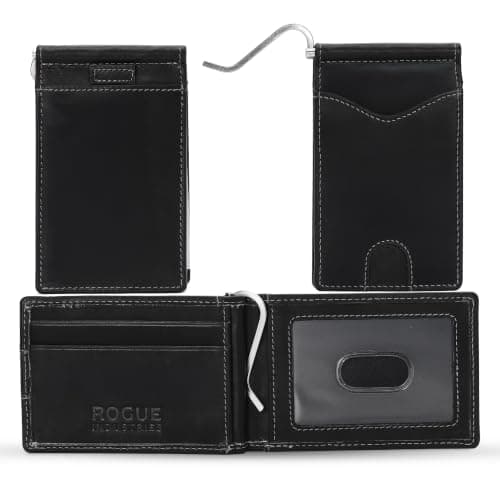
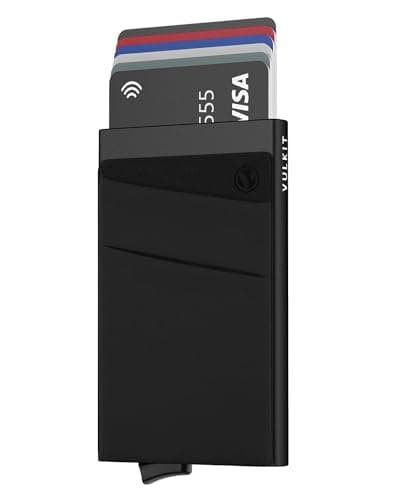
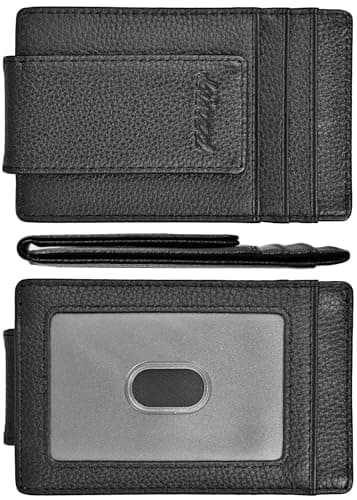
The pick for most people is the kinzd Money Clip Wallet — it is the only one here that gives you a full bank of card slots and a clip strong enough to trust, which is exactly what someone who went looking for a card holder that holds cash is actually after. If you want the cash to disappear rather than advertise itself, the Fossil Ingram hides a magnetic clip behind the leather. If you carry coins too — the one thing a clip cannot do — the VULKIT pop-up with the zipped coin pocket is the answer and nothing else on this page is.
The rule for getting on this page
Two conditions, both mechanical, both checked against each listing's own published title and feature bullets. First, the product has to be a card holder — a slim card-first carry with no full-length billfold channel. The moment a wallet has a conventional bill compartment running the width of the leather it is a bifold, it belongs on the bifold hub, and it is not what this search is looking for. Second, the listing has to publish a specific cash provision: a clip, a dedicated cash slot, or a note pocket. “You could fold a bill and wedge it somewhere” is not a feature and does not count.
That rule is narrow on purpose, and it is why this page is five picks rather than twenty-five. It excludes almost every card holder we rank, including the ones we rank highest: the general card holder picks and the large-capacity organizers are mostly pure card carriers, and the slim sleeves on the slim wallet roundup are pure card carriers by design. Those are better products for someone who has stopped carrying cash. This page is for the person who has not.
Three mechanisms, and they are not interchangeable
Every pick here solves the same problem a different way, and the differences matter more than the price does.
A sprung or magnetic clip
The clip is the only mechanism that costs you no thickness at all when there is no cash in it. An empty bill compartment still has two faces of leather; an empty clip is flat. The trade is that a clip holds folded notes on the outside of the wallet, where they can be seen and where they will slide if the clip has gone soft. kinzd and Rogue use a sprung metal clip; Fossil uses a magnet. A magnet is quieter and kinder to the leather, and it is also the one that worries people about their cards — a worry that is mostly misplaced, and we go through exactly why in the magnetic-damage guide.
A cash slot
A slot takes a note folded once or twice and keeps it enclosed. It is the quietest option and the least capable: VULKIT's all-metal case publishes a “money pocket” that is realistically two or three folded bills, and the slot on a slim holder is usually shared with cards — a point worth repeating because the listings never make it. VULKIT's own bullets on the pop-up card holder describe its extra slot as taking “2 credit/business cards or little cash”. Two cards or cash. Not both.
A note pocket, sometimes with a zip
The most capable and the bulkiest. The VULKIT coin-pocket model is the only pick here that takes notes, cards and coins, because it is the only one with a zipped compartment. If coins are in your carry at all, this is a short list of one and the extra millimeters are the price.
What the capacity numbers in this category are worth
Less than you would hope, and the pattern is consistent enough to plan around. Headline card counts on pop-up holders are sums: the mechanism holds five, the shell holds the rest, and only the five in the cage actually pop up. The VULKIT coin-pocket model's claimed ten is five in the cage plus four slots plus an ID window. Worse, two listings in this range round their own sums upward in the title while the feature bullets underneath give the lower, correct figure — which is why every number in the table below comes from the bullets rather than the title.
The one genuinely honest capacity bullet we have found in this entire category belongs to the metal VULKIT, and it is honest in the direction that costs the seller money: it publishes a minimum as well as a maximum — “At least 3 cards are needed for secure retention” — because a friction-retained cage with one card in it will let that card go. If you are buying any mechanical holder, read how many cards actually fit in a card holder before you decide, because the minimum is the figure that surprises people.
How much cash are you actually carrying?
This is the whole decision and almost nobody asks it before buying. A US Federal Reserve note is 6.14 by 2.61 inches and 0.0043 inches thick. Folded in half twice it is a touch over an inch wide and about 0.017 inches thick — so ten notes folded that way add roughly 0.09 inches, which is less than three payment cards. Cash is almost never what makes a wallet fat.
So the honest advice runs against the grain of this page: if you carry two or three notes for emergencies, a clip is plenty and you should buy on the leather and the card layout instead. If you carry a working float in cash every day, you want the note pocket, and you should probably be looking at a slim wallet built around cash and cards rather than a card holder with cash bolted on.
What we left off, and why
Two exclusions are worth naming. We left off every bifold with a money clip inside it, because a bifold with a clip is still a bifold — those are ranked on the money-clip roundup and on the front-pocket clip page, where they belong. And we left off the standalone money clip: a bare clip plus a pure card sleeve is often slimmer and cheaper than any combined product here, it is the carry we would personally pick, and it earns us nothing to say so.
Prices, and what we earn
Every price on this page is pulled live from the Amazon Product Advertising API and stamped with the date it was read. We do not type prices into our copy, which is why you will not find a dollar figure anywhere in this prose — it would be wrong within a week. Buy links are affiliate links; the ranking above is the same ranking we would publish if they paid nothing, and the editorial policy explains how that is enforced.