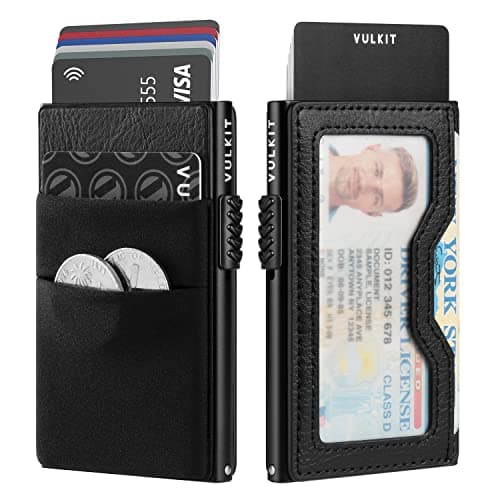
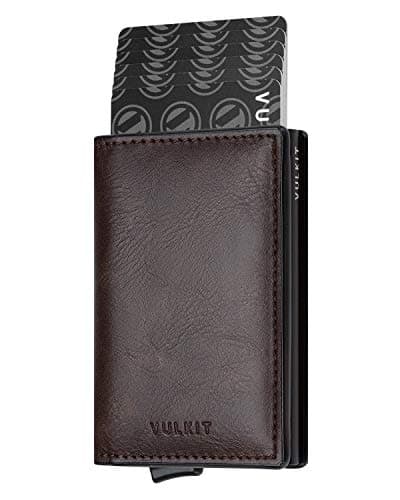
VULKIT sells the pop-up card wallet at roughly a third of what Ekster charges for the same idea, and that single fact is why the brand turns up everywhere on this site. The mechanism is real: slide a lever and your cards fan out in a staircase, which is genuinely the fastest way to get a specific card out of a slim wallet. But the lineup looks baffling — six wallets, overlapping names, card counts from four to ten — and once you read the listings side by side, it stops being baffling and becomes one decision.
Here is the thing nobody tells you: VULKIT makes one wallet.Every pop-up model in the range contains the identical component, and every listing describes it in almost the same words — five cards in an aluminum case. What differs is the shell wrapped around that cage. Nothing at all, and you have the bare metal case. A leather shell with a bill compartment, and you have the trifold. Add a coin zip and you have the top of the range. Swap the leather for stretch fabric and you have the AirTag model. Delete the cage entirely and you have the slotted nappa holder.
That structure is useful, and it also explains the brand's one systematic problem.
Every card count in the range is an addition
When a VULKIT listing says it holds 7, 8 or 10 cards, it has added the cage's five to whatever the shell holds. The mechanism still only ever fans five. That matters, because the pop-up is the reason to buy the brand, and the cards in the outer slots do not get it — they come out the way cards come out of any sleeve.
- 10 cards (coin-pocket model) = 5 in the cage + 4 inner slots + the ID window
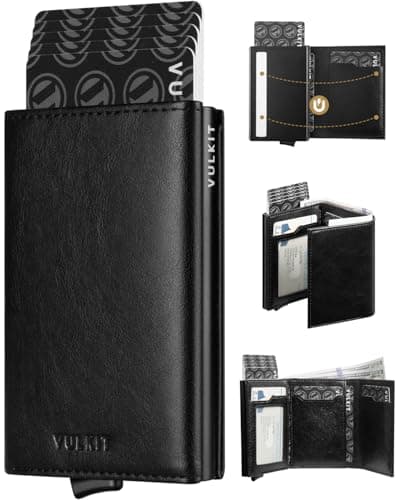
- 8 cards (trifold) = 5 in the cage + 3 slots, plus an ID window and a cash compartment
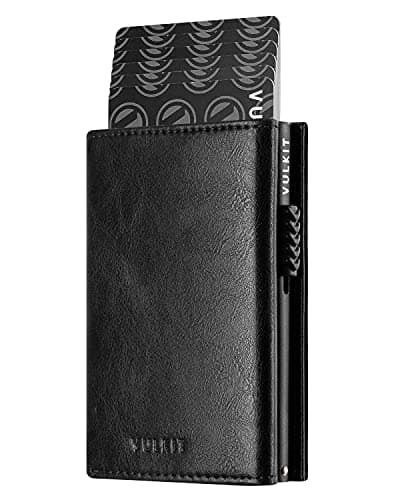
- 7 cards (the original pop-up) = 5 in the cage + 2 in one outer slot
- 7 cards (EDC/AirTag model) = 5 in the cage + whatever the stretch pockets take
And on two models the title rounds the sum up. The original pop-up card holder is titled “Up to 8 Credit Cards”. Its own feature bullets say “QUICK ACCESS 5 CARDS” and “HOLD 7 CREDIT CARDS AND CASH: 5 cards in Aluminum case, 2 credit/business cards or little cash in extra slot”. That is seven, not eight — and read the last clause again, because the extra slot takes two cards or a little cash. Seven cards and a folded bill is not a configuration this wallet has.
We are not pointing that out from a position of innocence. This site had carried “up to 8 cards” on that wallet since launch, taken from the title rather than the bullets, and it was wrong on every page it appeared on. It is corrected in the same change that published this review. The metal case has the same problem in the other direction: its title says “Holds 5 Cards and Notes” while its bullets say 4 to 7. Buy on the bullets.
VULKIT states a leather grade on exactly one model
This is the finding that should set your expectations for the brand. Across the whole range, the material claims read: “PREMIUM LEATHER CASE”, “Supple leather with exquisite hand-stitch”, and on the original pop-up, simply “Leather” in the title with no material bullet at all. No grade. No origin. No tannery. No tannage.
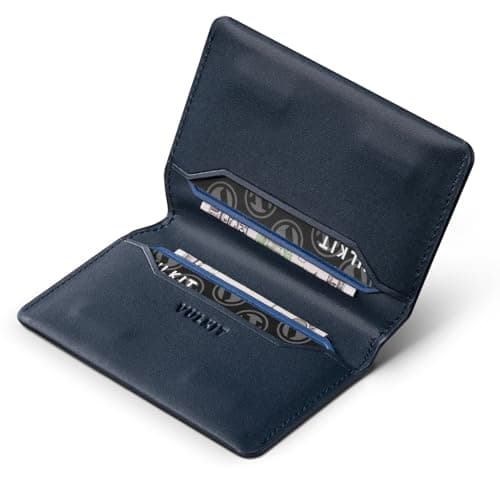
The one exception is the cheapest leather model in the lineup, the slim card holder, whose bullet says it is “made of soft and textured nappa leatherwith delicate and detailed stitching”. Nappa is a real, specific thing — a soft chrome-tanned hide — and naming it is more information than the brand's top-of-range wallet offers. It is still a finish rather than a grade, so it does not tell you whether the hide is full grain, top grain or genuine; our full grain vs top grain vs genuine explainer covers that ladder, and how to spot fake leather covers what to check when it arrives.
Treat “premium leather” on any listing as marketing rather than a specification. It is not a lie — these wallets do have leather on them — but it tells you nothing about which part of the hide you are getting, and that is the thing that decides whether a wallet patinas or peels. If a stated grade is what you want at this price, the brands with real material claims are in our best leather wallet brands roundup.
One model in the leather lineup is not leather
The EDC/AirTag wallet is marketed inside the same range as the rest, but its own second bullet says the “magic pocket is made of elastic Lycra fabric & environment-friendly vegan leather”. Vegan leather is a polyurethane coating on a fabric backing. It does not patina, it does not soften with handling, and it fails by peeling rather than by wearing in. We have recorded it as what it is in the spec table, and it is the reason that model finishes last here despite being perfectly good at the specific job it is built for.
That is not a knock on buying it — if you want an AirTag, keys and a pop-up cage in one object, it is the only thing in the range that does it. It is a knock on finding it in a leather lineup with no label change.
The most honest capacity bullet in the category is on the metal case
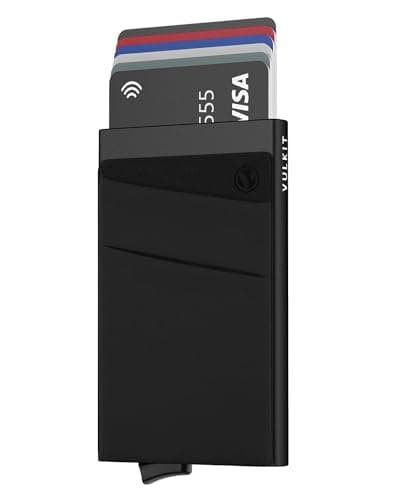
Credit where it is due, and it is genuinely unusual. VULKIT's all-aluminum money-pocket case publishes this:
“Daily Capacity: 4-7 cards (mixed flat and embossed). Minimum Recommendation,At least 3 cards are needed for secure retention. (The actual capacity depends on the thickness of the card).”
That is four true things most sellers omit entirely. It gives a range rather than a maximum. It acknowledges that embossed cards eat more room than flat ones. It states a minimum— which is the single most useful fact about any friction-retained cage, because under-filling one leaves cards loose against metal edges. And it admits the figure depends on the cards you own. We have not found a better capacity bullet anywhere in this category, and we went looking; it is cited as a source on our do card holders damage cards guide for exactly that reason.
The same listing is also the only one in the range that publishes a size: 4.25 by 2.55 by 0.31 inches. Not one leather model states a closed thickness, which is a shame, because thickness is the entire proposition of a slim wallet. For the record, we do not take dimensions from the marketplace item-dimension table on these listings — it returns figures like 4.02 by 2.64 by 0.71 inches, which is the gift box.
So how good is the mechanism, really?
Genuinely good, and the comparison people actually want is against Ekster. The lever action is the same concept and VULKIT's version works: cards fan in a staircase, you take the one you want, you push the stack back. What you give up is refinement — the cage is plainer, the action is less damped, and the leather around it is unspecified where Ekster's is top grain over aluminum with a cash strap and an optional tracker card. Our pop-up card holder roundup ranks both against each other directly.
The mechanism also carries the one maintenance point worth knowing: a friction cage has a floor as well as a ceiling. Carry three to seven cards, count an embossed card as two, and use the lever rather than levering a card out over the aluminum rim — that last habit is what actually cracks cards, and it is the subject of our card damage guide.
On RFID, every model in the range claims blocking, and on the pop-up models the claim at least points at something physical: an aluminum body around the cards. The nappa holder is the exception — its claim is “made with advanced RFID blocking materials” with no cage and no band named, which is the weakest version of the claim. Whether any of it is worth paying for is a separate argument we take on honestly in are RFID wallets worth it.
Who actually sells you a VULKIT
Worth a line, because it sets the right expectation on returns and warranty. When we resolved these six listings, not one buy box was held by VULKIT itself— they belonged to third-party merchants trading as TAIHAOHK and TH Interstellar. That is normal for a budget Amazon brand and it is not a reason to avoid them, but it does mean your counterparty is a reseller rather than the manufacturer. Treat these as marketplace purchases with marketplace recourse, and do not expect a brand warranty process of the kind Fossil or Bellroy run.
What we would buy
Start with the original pop-up card holder. It is the cheapest honest route to the mechanism that makes the brand worth considering, it is the slimmest leather model, and seven cards covers most people who have already pared down. Buy it knowing the extra slot is cards or cash, not both.
If you carry coins, the coin-pocket model is the only answer in the range — nothing else here attempts change, and a card holder cannot fudge it. You are paying the brand's top price for a coin zip and a note pocket, so buy it only if you want both.
If you want notes to lie flat, take the trifold, and accept that a trifold with an aluminum cage inside it is the thickest thing VULKIT makes. If slimness is the point, this is the wrong direction — a money-clip wallet keeps cash fast without the third panel.
If slimness is the whole point, the metal case is the brand's best wallet and our rubric cannot say so. It publishes 0.31 inches, it has the most honest bullets in the lineup, and it finishes fifth here purely because this is a leather-wallet site scoring it on a leather axis it never entered. If that is what you want, read the metal side of the argument in leather vs metal wallet and consider the Ridge too.
Skip the EDC/AirTag model unless the AirTag is the reason you came, because it is the one wallet here that is not leather. If tracking is what you want, the dedicated AirTag wallet roundup has leather options built for it.
And if you do not want a mechanism at all, the nappa holder is the quiet pick — the only VULKIT that names its leather, with nothing in it that can break.
Two models we did not rank
For completeness, since both are currently purchasable and will turn up in a search for the brand. The VULKIT passport wallet is a travel document holder rather than an everyday wallet, and it belongs with the picks on our travel wallet roundup rather than in a card-holder comparison. The small zip wallet with a keychain and lanyardis a different format again — a zip coin pouch with an ID window, aimed at lanyard carry — and it has no card cage, no fold and nothing in common with the six above. Neither is a bad product; both would be judged against a different rubric, and we would rather leave them out than score them on the wrong one.