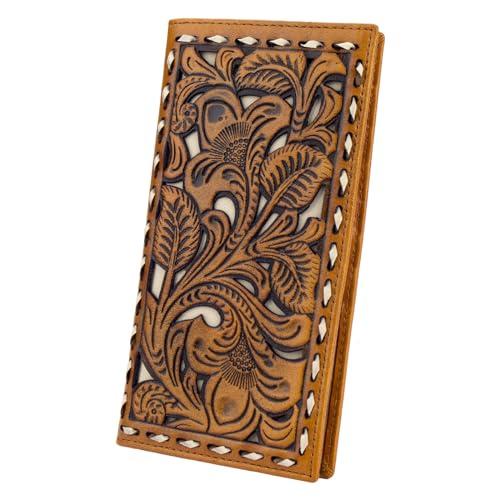
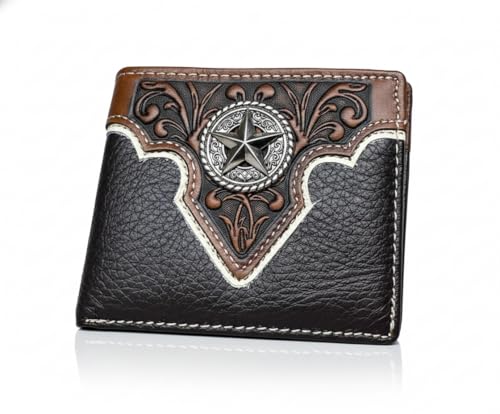
The short version: buy the Western Stakes hand-tooled floral bifold. It is the only wallet in this aisle whose listing names the tooling technique, the motif and the hardware, and it sits in the same price bracket as the plainest wallets we rank. If you want the long rodeo silhouette instead of a decorated short bifold, the MUXILING rodeo long bifoldis the cheapest wallet on this page and the only one claiming RFID blocking — it is also our budget pick.
Western wallets are the one corner of this category sold almost entirely on how they look, and the listings know it. Every one of the five below describes its decoration in some fashion — floral tooling, a concho, buckstitch, an inlay, an ostrich quill pattern. That is the opposite of how the rest of the leather-wallet aisle reads, where the pictures are generic and the title is a feature list. So ranking them on “features” would miss the point of the purchase entirely.
The finding: nobody in this aisle will tell you what the leather is
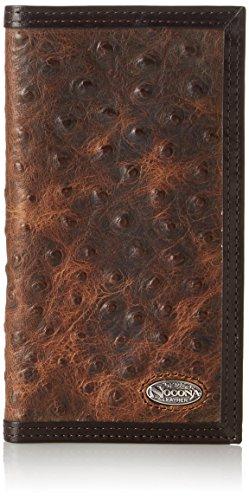
Here is what we did not expect. Across every western wallet we resolved on 16 November 2026 — tooled bifolds, rodeo longs, trifolds, basket-weave panels, concho wallets from boot brands and from marketplace workshops — not onestated a tannery grade. Not full grain, not top grain, not vegetable tanned. Four of the five picks below say “leather” and stop. The fifth says “Ostrich” without saying whether that means ostrich hide or an ostrich pattern pressed into cowhide, which is a difference of several hundred dollars in the raw material.
We did find exactly one listing in the western aisle that names a grade. It states full grain, an 11-slot card count and an RFID claim, at under the price of our budget pick. And we excluded it, because its only western credential is the phrase “Western Cowboy Gifts for Men” sitting in the title as a gift category. It describes no tooling, no concho, no stitch work and no rodeo body. It is a plain brown bifold being marketed into this search.
That exclusion is the most useful thing on this page, so we are printing it rather than burying it: in this category you can have the decoration or you can have the leather claim, and today you cannot have both. If the grade is what you are actually shopping for, close this page and read best full-grain leather wallets, where every pick states one. If you want a wallet that looks like it came off a tack-shop wall, read on — but buy knowing that the hide is unspecified on all five.
Tooled, embossed, laser-cut and inlaid are four different things
The vocabulary in this aisle is used loosely, and the differences are worth twenty minutes before you spend money.
- Hand tooled is a process claim: the pattern is cut and pushed into damp leather with stamps and a swivel knife. It leaves burnished edges and slight irregularity, and it needs the grain layer to be intact to hold a crisp line. Two of our picks state it.
- Embossed is a pattern pressed in under heat and pressure, usually by machine, and it is part of standard corrected-grain finishing. It can look almost identical when new and tends to flatten with wear.
- Laser cut is a pattern burned through or into the surface. It is crisp, cheap and repeatable, and the cut edges can look slightly scorched up close.
- Inlay and buckstitch are construction rather than surface work: a contrasting panel set into the face, and a lace stitched around the edge. Our rodeo pick states both.
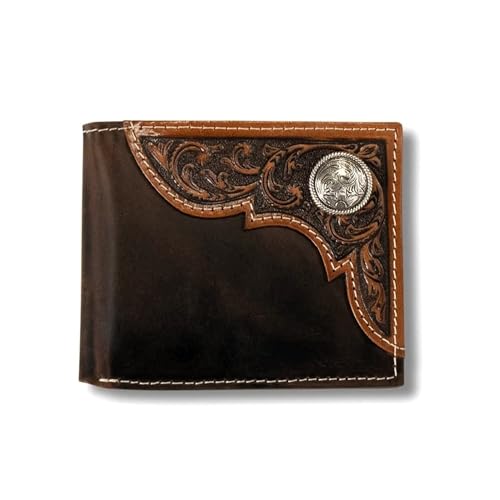
One of our picks illustrates exactly how slippery this is. The ARIAT bifold's title says “Tooled Overlay” and its own feature line says “embossed corner overlay”. Both are published, they are not the same claim, and we have recorded both rather than quietly choosing the flattering one. If the distinction matters to you, ask the seller before you buy.
Short bifold, trifold, or rodeo: the format is the real decision
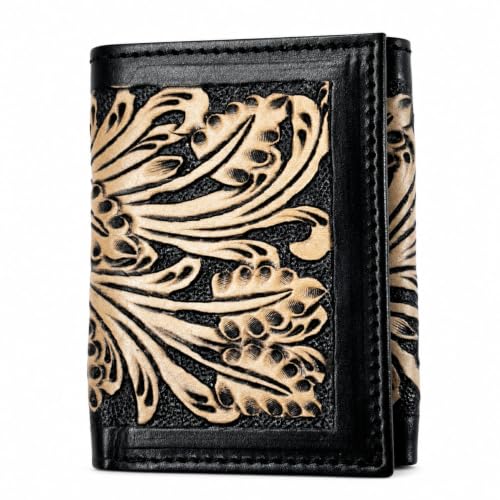
Western wallets come in three bodies and they are not interchangeable. A short bifold is a normal wallet with decoration on it: it fits a back pocket, holds folded notes, and is what most people searching this category actually want. A trifoldadds a third panel and stacks more card slots vertically — more capacity, noticeably more thickness. A rodeo or long wallet is a different object: long enough to take US notes unfolded (a Federal Reserve note is 6.14 x 2.61 in, 156 x 66.3 mm), deep enough for a checkbook, and far too long for a back pocket on most people. It rides in a coat pocket, a truck console, or on a chain.
That is why two of the five picks here are rodeo-length and we have ranked them second and fifth rather than first: the format is right for a minority of buyers and wrong for the rest. If the long body is what you are after, our long leather wallets page ranks the format on its own terms, and chain wallets covers the version that attaches to a belt loop. If a rodeo wallet is tempting you mainly because you carry a checkbook, leather checkbook covers is the cheaper answer.
What a concho actually costs you
A concho is a raised metal disc on the outside face of a wallet you may well sit on. Two picks here have one, and neither listing states how it is attached — screwed, riveted or glued. It is the part most likely to mark a wooden desk, scratch a phone screen sharing the same pocket, or wear a shiny patch into denim. None of that makes it a bad feature; it is the look, and the look is the purchase. It is just worth knowing that the decoration on these wallets is mechanical, not just visual.
Advice that earns us nothing
If you already own a plain brown bifold you like, a western wallet is a second wallet for occasions, not a replacement — and the honest version of this purchase is the cheapest tooled wallet that looks right to you, because none of them will tell you anything about the hide anyway. Spending $65 instead of $32 in this aisle buys you a better-known name and, on the evidence of these five listings, strictly less published information. And if what you actually want is leather that will outlive you, the money is better spent on a made-in-USA full-grain wallet with no decoration at all.
Buying notes
Assume corrected grain and plan the care accordingly
When a listing says only “leather”, the likeliest answer at these prices is a corrected-grain hide with a finish sprayed over it. That is not a disaster — it is most of the wallet market — but it changes how you look after it: a finished surface takes conditioner more slowly and will not develop the patina people associate with veg-tanned leather. Our full grain vs top grain vs genuine explains what each word commits the seller to, and how to care for a leather wallet is the maintenance routine that suits a finished hide.
Tooling is a wear surface
A tooled face has high and low points, and the high points take the abrasion. On a wallet that lives in a back pocket the raised pattern is what polishes first, which looks great on good leather and goes blotchy on a thin finish. This is the single best argument for the short bifold format if you intend to carry it daily: less surface area in contact with denim.
Count the card slots yourself
Not one of these five publishes a card count. A payment card is 85.60 x 53.98 mm and about 0.76 mm thick (ISO/IEC 7810 ID-1), so every card you add to a tooled bifold pushes the decorated face further out of shape. If your carry is more than about six cards, buy the trifold here or read wallets with 10+ card slots instead of hoping a two-panel western wallet will cope.
“Ostrich” needs a straight answer before you pay for it
Genuine ostrich leather and ostrich-embossed cowhide look similar in a thumbnail and are not remotely the same purchase. Our most expensive pick uses the word and does not resolve it, so we have not resolved it either. If you are buying for the hide rather than the pattern, buy from a seller who states it in writing — and if the pattern is all you want, the cheaper picks on this page give you a more clearly described object.
Advice that earns us nothing
A tooled wallet is a gift that lands well, and it is one of the few leather goods where the cheap version does the job the expensive version does, because the thing being bought is the pattern. Our personalized wallets page is the other half of that thought if the point is the gesture rather than the carry.