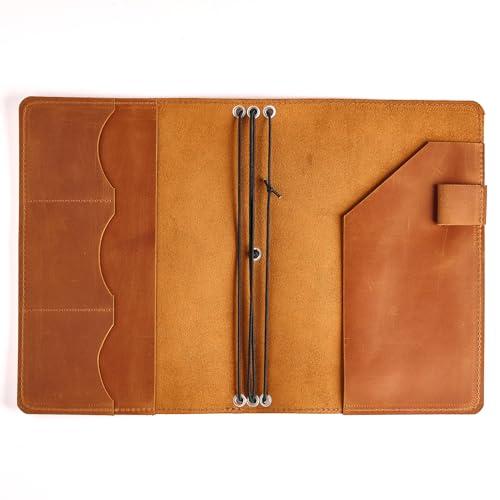
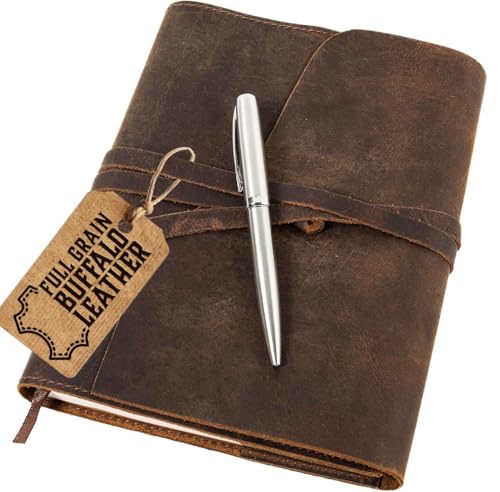
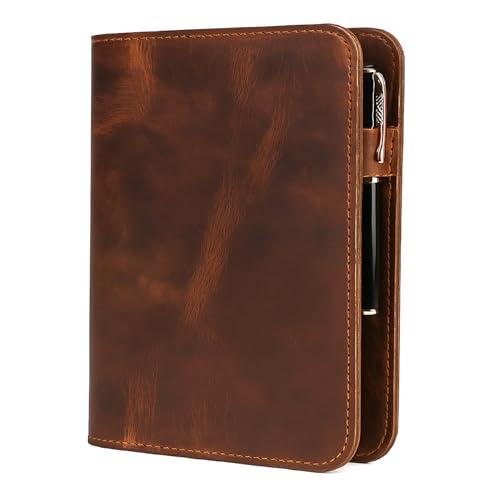
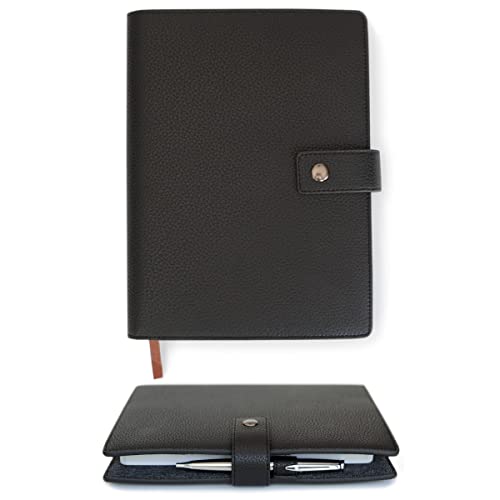
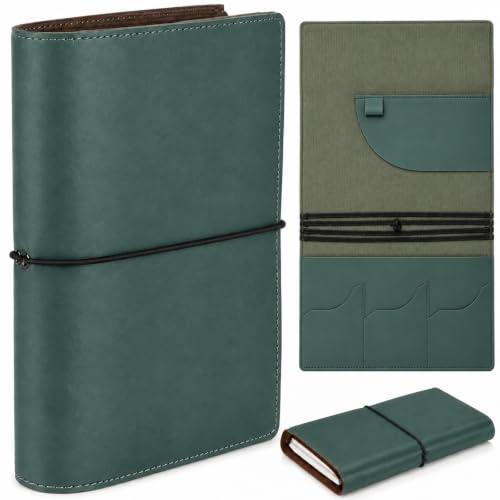
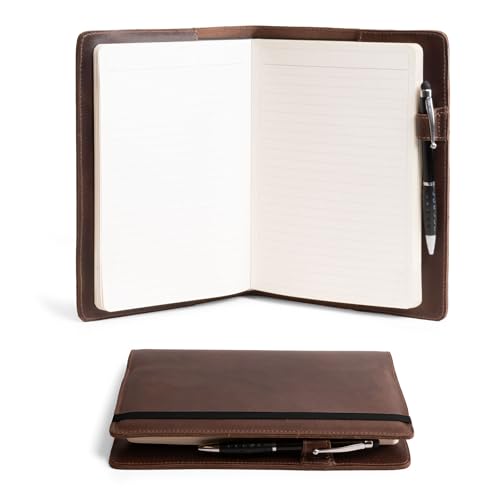
The short version:if your notebook is a hardcover — a Leuchtturm1917 A5 or a Moleskine Large — buy the Hide & Drink case for the hardcover Leuchtturm A5. It is the only cover we found that names the specific notebook it was cut for, prints the measurement, and states full grain. If your notebook is an ordinary A5 pad or softcover, buy the TORAKIP A5 journal cover instead, which states the ISO size and adds a pen holder, card slots and three elastic bands. The VANJUJOJO at well under twenty dollars is the budget pick, and it is an honest one as long as you accept that it specifies almost nothing.
Why the size is the whole review
Every other leather good on this site can be a disappointment. A notebook cover can be useless, because it either closes around your notebook or it does not. That makes the fitted dimension the only spec worth ranking on first, and it is the spec this category handles worst.
Here is the measurement that matters. ISO 216 fixes A5 at 148 x 210 mm, which the standard itself renders as 5.8 x 8.3 in. Three of the six listings below state exactly that: 5.8 x 8.3 in. Three others state 5.75 x 8.25 in, which is 146.05 x 209.55 mm. The height difference is trivial. The width is not: 5.75 in is about 1.95 mm narrower than ISO A5, and ISO 216's own stated tolerance for a dimension under 150 mm is ±1.5 mm. So a cover cut to 5.75 in is cut to something that is notISO A5 inside the standard's own margin.
That is not a mistake by the sellers. It is the hardcover notebook body — the size a Leuchtturm1917 A5 or a Moleskine Large actually measures, which is slightly under the paper standard because the covers are trimmed flush. Exactly one listing in this category says so out loud by naming the notebook, and that is why it is our top pick: it converts a guess into a statement.
The practical rule, then: 5.8 x 8.3 in for loose A5 pads and softcovers; 5.75 x 8.25 in for hardcover brand notebooks. Two millimetres sounds like nothing until a hardboard cover will not sit flat under an elastic band.
The spec nobody in this category publishes
Not one of these six states a spine capacity or a closed thickness. They will tell you the two flat dimensions and go quiet about the third, and the third is the one that decides whether a 240-page hardcover fits or whether the cover gapes around a single thin insert.
We found exactly one listing anywhere in the category that publishes a capacity — it states that it takes three inserts — and we excluded it from our picks because it names no brand at all, and every product in this registry has to be something a reader can hold someone to. So the honest position is: the thickness is unmeasured across this entire category, ours included. If you run a thick hardcover, favour a cover with elastic bands or a wrap closure over one cut to a fixed body.
Covers, journals and the refill question
Two of our picks arrive with paper in them and four do not, and the distinction is worth getting right before you buy:
- A coveris leather and nothing else. You supply the notebook, you replace it when it is full, and the leather outlives an indefinite number of inserts. Four picks here are this, and two of them say “Paper Not Included” or “Cover Only” in their own titles — which sounds trivial and is the single most common complaint in the category.
- A refillable journalis a cover with its first insert already in it. It works from the day it arrives, and the refills are usually sized to that maker's insert. Our full-grain buffalo pick is this, and it is the one product on the page that states a page count (320) and a paper weight (70gsm) — which is the information fountain-pen users actually need and which no cover-only listing can give you.
What the leather claims are worth here
The grade vocabulary on this page is better than on most of the wallet aisle, which was a surprise. Two listings state full grainand one of those also names the species (buffalo) and a country of manufacture — the only provenance statement anywhere in the batch. Two state “genuine leather”, which is a floor rather than a grade. One states “leather” and stops. And one names a proprietary material and“full-grain premium leather” in the same title, which we have recorded as unresolved rather than resolving it in the seller's favour.
A cover is a good place to care about this, because unlike a wallet it is handled rather than sat on: it opens, folds back and gets gripped at the same spot thousands of times. A grain layer that is intact creases into a patina; a sprayed finish over corrected grain eventually cracks along that fold. Our full grain vs top grain vs genuine has the full vocabulary, and leather wallet patina describes the ageing you are buying when the grade claim is real.
Advice that earns us nothing
If you are not already writing in a notebook every day, buy the cheapest cover on this page or none at all. The $75 cover does not make the habit, and a leather cover around an empty notebook is a desk ornament. The honest sequence is: fill one notebook first, discover whether you want to carry it, and then spend money on protecting the next one. And if the notebook you want to protect is a planner that gets replaced annually, a cover is the wrong purchase outright — the paper outlasts nothing and the cover has no second life.
One more: if the reason you are shopping is that a notebook is getting battered in a bag alongside keys, the cheaper fix is to move the keys. Our leather key holders page ranks the covers that stop a keyring behaving like a cheese grater, and it costs a third of the top pick here.
Buying notes
Measure your notebook, not your notebook's label
Take a ruler to the closed notebook you own and write down the width. If it is about 148 mm (5.8 in) you have a true A5 and should buy a cover stating 5.8 x 8.3 in. If it is about 146 mm (5.75 in) you have a hardcover brand body and should buy a cover stating 5.75 x 8.25 in. If it is 105 mm wide you have an A6 — ISO 216 puts A6 at 105 x 148 mm (4.1 x 5.8 in) — and none of the picks on this page will fit it; buy a cover that states A6 in its own title.
Elastic bands are a wear item, like a wallet's elastic
Three picks here hold their inserts with elastic, and elastic is the part of a leather good that dies first — the same thing we say about band wallets on our minimalist wallets page. It is not a reason to avoid them: it is a reason to prefer a cover where the band is replaceable or where the leather still works without it.
A pen loop decides whether you carry it
This sounds like a small thing and it is the difference between a cover that lives in a bag and one that lives on a desk. Four of the six state a pen loop or pen holder; our top pick does not. If you are replacing a loose notebook-plus-pen-plus-two-cards arrangement, buy for the loop and the card slots, not for the grade.
Card slots make it a one-object carry
A payment card is 85.60 x 53.98 mm (ISO/IEC 7810 ID-1) and about 0.76 mm thick, so two or three cards add almost nothing to a cover's thickness and remove a wallet from a bag that already holds a notebook. Four picks here state card slots. It is the most undersold feature in the category, and it is why a notebook cover belongs on a site about what you carry rather than about stationery.
Condition it like a wallet, because it is one
A cover sees more flexing than a billfold does. The care routine is identical — a small amount of conditioner, worked in, twice a year — and the products are the same: best leather conditioners for wallets ranks the ones that are safe on small smooth-leather goods, and how to care for a leather wallet is the method.
Advice that earns us nothing
The cheapest meaningful upgrade to a notebook is not leather at all — it is better paper. If your complaint is bleed-through rather than a battered cover, buy a heavier-gsm insert and keep the cover you have.