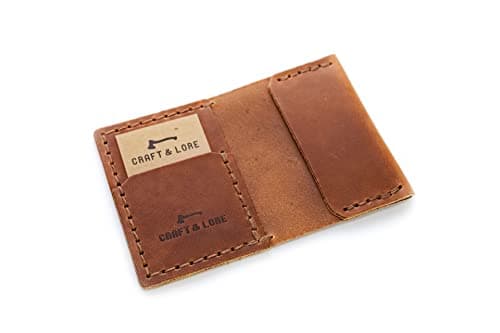
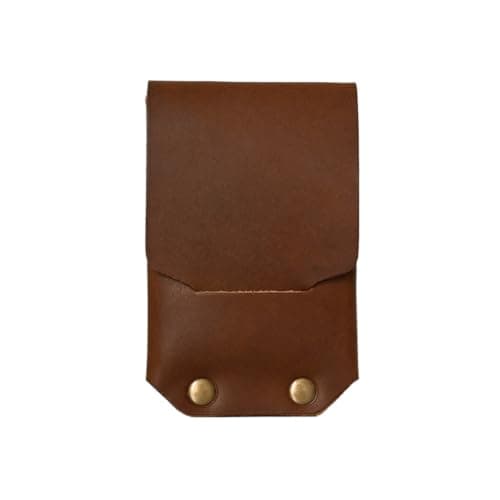
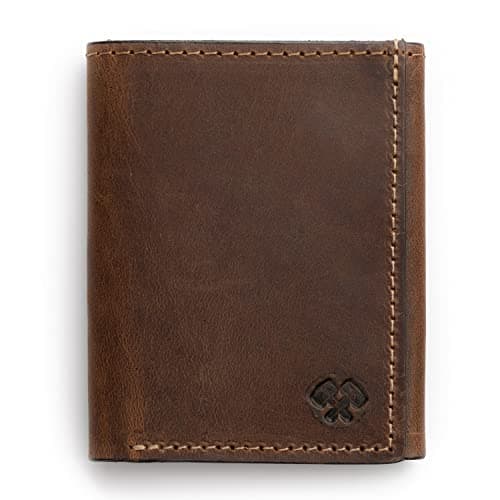
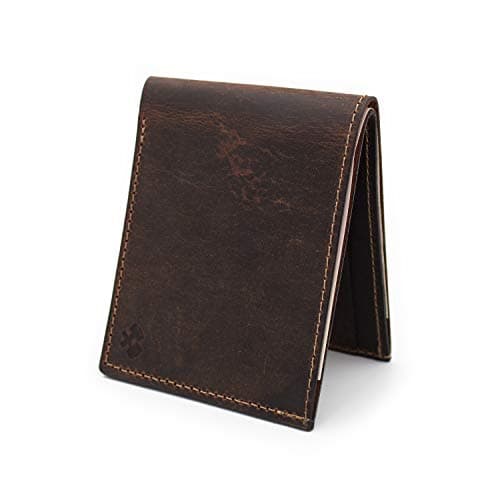
The pick for most people is the Main Street Forge Bifold — full-grain hide, a normal six-pocket billfold layout, and a lifetime warranty provided by the maker rather than by the marketplace, which is the only kind you can actually claim against. If you want the coverage spelled out instead of implied, the American Bench Craft Revere is the one whose listing says what the guarantee covers — craftsmanship failure, repaired or replaced. And if you would rather have a finite term you can read than an unbounded word you cannot, the Bellroy Note Sleeve publishes three years and means it.
Why this page ranks the warranty and not the leather
Every other durability page on the internet ranks hides. We already have those pages — the full-grain roundup ranks grade, the made-in-USA roundup ranks where it was assembled, and the grade explainer covers what those words mean. None of them answers the question people are actually typing, which is some version of “which one of these will I still have in ten years”.
Grade is a poor proxy for that, for a reason that is easy to miss: a full-grain wallet and a genuine-leather wallet almost never fail at the leather. They fail at the stitching, at an edge coating that flakes, at a lining that tears away from the panel, or at a moving part — a snap, a zip, an elastic band, a spring cage. Leather grade tells you how the surface will age. It tells you nothing about any of those four.
A warranty does. It is the only durability claim on a listing that costs the seller money if it is wrong, which makes it the only one worth ranking. So the single rule for getting on this page is mechanical and we are stating it out loud: the listing has to publish warranty or guarantee coverage in its own title or feature bullets. Not a review that mentions one. Not the brand's website. The listing.
What the six listings actually publish
This is the comparison the category does not print anywhere, and it is less uniform than the word “lifetime” makes it sound.
| Wallet | Published coverage | Who backs it | What it names |
|---|
| Main Street Forge Bifold | Lifetime warranty | The maker, directly | Term only — no covered-failure list in the bullets |
| Craft & Lore Insider | Stitching guaranteed for life | The maker, directly | A specific component, not the whole wallet |
| Bellroy Note Sleeve | Three-year warranty | The brand | A finite term, stated as a number |
| American Bench Craft Revere | Lifetime guarantee | The maker, directly | Craftsmanship failure — repaired or replaced |
| Main Street Forge Trifold | Lifetime warranty | The maker, directly | Term only |
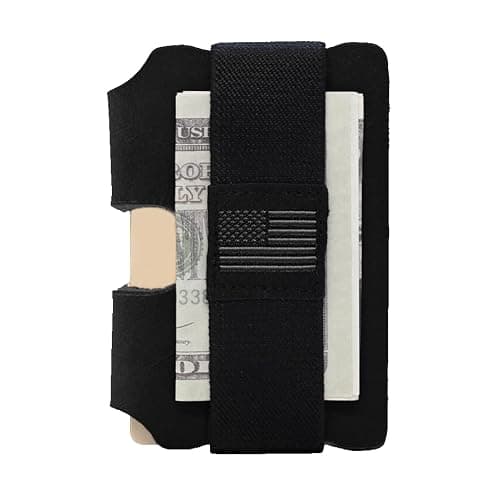
| American Bench Craft EDC | Lifetime guarantee | The maker, directly | Craftsmanship — and the wear item sits outside it (see below) |
Read that table twice, because the interesting column is the last one. Four of these wallets say “lifetime”. Only two say what a lifetime covers, and one of those two is narrower than it first appears: Craft & Lore guarantees the stitching for life, which is a specific and genuinely useful promise about the component that fails most often, and is not a promise about the wallet.
The one pick with a finite warranty is third, deliberately
The Bellroy Note Sleeve publishes three years and sits above two lifetime claims on this page. That is not an error and it is worth explaining, because it is the honest reading of what these documents are.
An unbounded warranty with no covered-failure list is a marketing word until you try to use it. A three-year warranty from a brand with a support function, a returns path and a product line it still sells is a claim with edges — you know when it ends and you know who answers the email. If you want the maximum theoretical coverage, the Main Street Forge bifold is first on this page and it deserves to be. If you want the claim most likely to be honoured without an argument, read the two that name a failure mode.
No warranty covers the thing that will actually wear out
The American Bench Craft EDC is last on this page and it is the most instructive pick on it. It is full-grain leather from the same US workshop as the Revere, it carries the same lifetime guarantee, and it holds its cards with an elastic band. Elastic is a consumable. It relaxes, and the rate it relaxes at depends on how many cards you load against it, not on how well it was made — which means it is wear, and wear is what every craftsmanship guarantee in existence excludes.
That pattern generalises, and it is the single most useful thing on this page: a lifetime warranty protects you against the maker's mistakes, never against your own use. So the durability question is not only “who covers it” but “how many things can go wrong”. Count the mechanisms before you buy. A plain stitched billfold has one failure surface, which is thread. A wallet with a snap has two. A zip wallet has three, and we say the same thing on the zip page: the leather will outlive the hardware.
Two things we excluded, and why
The Main Street Forge Slim is not on this page, and it is the same brand as the first and fifth picks. Its listing describes the coverage as “manufacturer-backed” rather than lifetime, where the bifold and trifold listings both say lifetime. We rank what the listing publishes, so a weaker published promise from the same maker does not inherit the stronger one. The wallet is a good wallet and it is ranked on the made-in-USA page.
Every wallet whose durability rests on a brand's reputation rather than on its listing is also out, including some we rank highly elsewhere. That rules out most of the registry. It is a narrow page on purpose — six wallets out of a hundred and twenty-seven is roughly the share of this market that commits to anything in writing, and that is itself the finding.
What actually makes a leather wallet last
Warranties decide what happens when a wallet fails. These four things decide whether it does.
1. The number of moving parts, which should be zero
Thread, leather and a fold have no mechanism. Snaps unseat, zips strip, elastic relaxes and a sprung aluminum cage has a spring in it. None of those is a reason not to buy a wallet — our pop-up cardholder roundup exists because the mechanism is genuinely useful — but if the question you are asking is specifically “which will last longest”, the answer trends towards the simplest object on the shelf.
2. Edge finishing, which is the tell
There are two ways to finish the cut edge of a leather panel. You can paint it, which looks immaculate in a photograph and chips, or you can skive the leather thinner, fold it over and sew through the fold — a turned edge. A turned edge has no exposed cut face, so there is nothing to flake. Almost no listing in this category mentions which it used; the Ashlin card wallet is the one in our record that does, and it says turned edges in its own bullets. When a seller bothers to name the finishing, pay attention.
3. The tannage, not the grade
Grade describes which layer of the hide you got. Tannage describes what was done to it, and it is the better predictor of how a wallet handles a decade of pockets. Oil-tanned and wax-stuffed hides carry their conditioner inside the fibre, which is why they scuff and rub back instead of cracking — see the oil-tanned explainer and crazy horse. Vegetable-tanned hide ages into the best patina on the site and is the most sensitive to water, which is why the work-wallet page argues against it despite it being our favourite tannage elsewhere.
4. How full you keep it
This is the factor you control and the only one that is free. Leather stretches permanently when it is loaded past the shape it was cut to, which is why the stretch guide exists and why doubling cards in a single slot is the fastest way to ruin a good wallet. A $25 wallet carried at its designed capacity will outlast a $95 wallet carried at twice it.
The honest version of “buy it for life”
Three things worth saying plainly, none of which earns us anything.
A ten-year wallet is not automatically the cheap option. Run it out: a $20 wallet replaced every three years and a $90 wallet kept for fifteen are within a couple of dollars a year of each other. We did that arithmetic properly on the cost-to-own page. Buy the durable one because you would rather own one wallet, not because it is cheaper — often it is not.
Nothing here needs replacing on a schedule. “How often should you replace your wallet” is one of the most-searched questions in this category and it has no answer, because a wallet is not a consumable. You replace it when the stitching opens, the lining tears, the fold cracks through or your carry changed. Until one of those happens, the right move is five minutes of conditioner.
If your current wallet is only three years old, keep it. Most people who search for the most durable wallet on the market are holding a perfectly sound wallet that has gone dry, or one that has become uncomfortable because it is overloaded. A tin of balm fixes the first and half an hour of sorting fixes the second. Neither of those is a purchase.
Prices, and what we earn
Every price on this page is read from the live price layer and stamped with the date it was read, which is why no dollar figure appears in this prose. Buy links are affiliate links; the picks are score-ordered from the same registry as every other page on the site. See the editorial policy.