The short version: “pebbled” describes how a leather looks and feels— a surface of small raised bumps — and nothing else. It is not a grade, not a tannage, and not even a defined technical term: the standard reference vocabulary for leather does not contain the word. It can be a genuine property of the hide, and it can equally be stamped on, because embossing is one of the routine finishing operations — and specifically part of the process that produces corrected-grain leather, where flaws are removed, the leather is dyed, and a surface is embossed to create a more uniform appearance. So on a corrected hide, the pebble can be doing the job of covering up what the sanding took off. That does not make pebbled leather bad. It makes the word uninformative, which matters because it is one of the most reassuring-sounding words in the aisle.
The three listings that make the argument for us
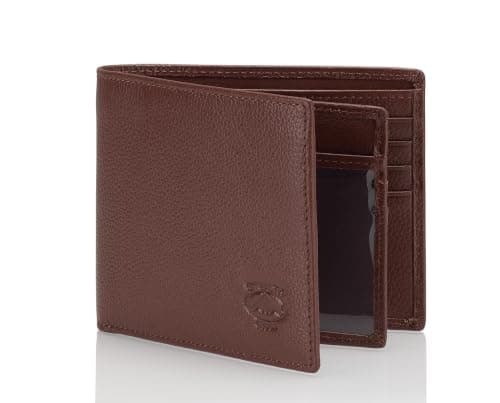
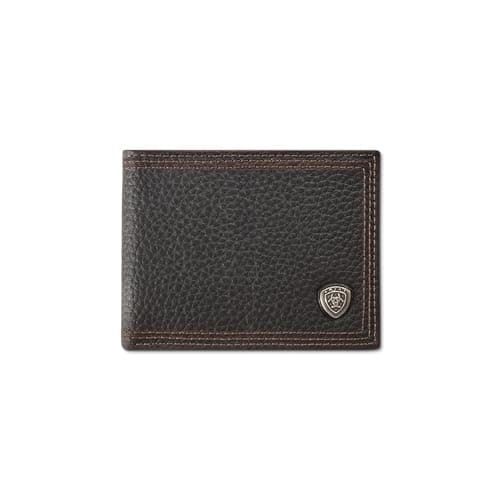
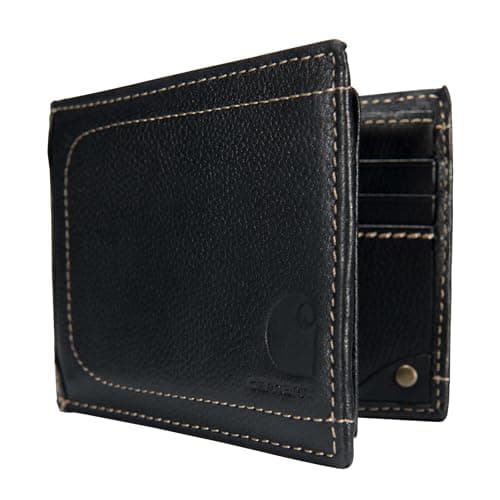
We did not set out to prove this with products, but the catalog did it cleanly. The three wallets below all describe themselves with the same texture word, and the grade claim underneath it is different in every single one:
- One says pebble leather and full grain leather— the top of the ladder.
- One says pebble top grain napa leather— a rung down, plus a softness finish, three different leather words stacked into one phrase.
- One says Pebbled Leather and no grade at all— and it is the most expensive of the three.
Same surface, three different materials underneath. That is the practical conclusion of this page in one line: the pebble tells you nothing about the leather, so you have to read for the grade separately — and if the grade is missing, you have been told about the surface and nothing about the hide.
Where the texture comes from — two completely different routes
Route one: it was always there
A hide's outer skin has its own natural grain pattern, and on some hides and some parts of some hides that pattern is distinctly bumpy. The clearest confirmation of this comes from an unexpected direction: the literature on shell cordovan explains that because that material is connective tissue rather than skin, it lacks the pebbled effect of leather derived from the outer skin. In other words, pebbling is a property of the grain. Remove the grain and you remove the pebble.
That is the good version of pebbled leather: the texture is the hide's own, it sits on an intact grain layer, and the wallet will wear and darken the way good leather does. Bison and buffalo hides are commonly described this way, which is why they look the way they look.
Route two: it was pressed in
The other route is embossing, a standard finishing operation in which a pattern is pressed into the surface under heat and pressure. This is exactly what happens on the Saffiano finish — we have a whole page on that cross-hatch — and it is also part of the corrected-grain process, where the sequence is: remove the surface flaws, dye the leather, emboss it. The purpose of that sequence is a uniform appearance, and uniformity is precisely what you get when a machine applies the same pattern to every square inch.
So there is a genuine and unflattering possibility behind a pebbled wallet with no stated grade: the hide had marks, the marks were sanded off, and a pebble pattern was pressed on in their place. We cannot tell you that is what happened on any particular listing. Neither can the listing, which is the problem.
The route to actually avoid
There is a third case and it is the one worth knowing about. Bicast leather is a split coated with polyurethane or vinyl and given an embossed texture which, in the reference literature's own words, “gives it the appearance of a grain.” Read that carefully: the most convincing-looking grain can be the one furthest from being a grain at all. The same logic applies to the “pebbled vegan leather” listings the search data turns up — a polymer surface embossed to imitate a texture that is itself often an imitation. Our guide to spotting fake leather covers the physical checks, and the peeling guide covers how that construction fails.
Is pebbled leather good? Three things it genuinely does well
We are not here to talk you out of it. The texture has real, practical advantages and they explain why it is so common on wallets:
It hides scuffs. This is the big one and it is not marketing. A surface with raised bumps distributes contact across high points, so a scrape marks the tops rather than drawing one clean line across a smooth face. A pebbled wallet looks better after two years of pocket abrasion than a smooth one does, which is why workwear and western brands use it.
It grips. A textured wallet is slightly less likely to slide out of a pocket or off a car seat than a glassy one. A small effect, but a real one.
It disguises the flaws it was often applied to disguise. Worth stating without snark: a corrected hide with a pressed pebble gives you an evenly attractive wallet at a lower price, and if you want a wallet that stays looking tidy rather than one that develops character, that is a feature rather than a con. It is the same trade-off we set out on the Saffiano page.
What it costs you
One thing, and it is the thing this site cares most about: a heavily corrected, embossed surface will not develop a patina. The darkening and sheen a good wallet earns from your hands comes from an intact grain taking up oils; a pressed, sealed surface is a barrier to exactly that process. Our patina guide explains the mechanism. So if the reason you are buying leather is that you want the wallet to look like yours in five years, a pebbled finish with no stated grade is working against you.
The exception is the top pick below, and it is why it tops the page: a pebble texture on a listing that states full grain is the combination that gives you the scuff-hiding surface and the aging, because full grain by definition keeps the entire grain layer with no removal of the surface.
The modifiers people search, answered plainly
“Pebble grain” vs “pebbled”. The same thing. Pebble grain is the older trade phrasing and is more common in footwear; pebbled is more common on wallets and bags. Neither is a specification.
“Refined pebbled leather”.A brand phrase, not a technical term. “Refined” is not defined anywhere and typically signals a finer, more regular pebble — which, if anything, points at embossing, because a machine makes a more regular pattern than an animal does.
“Italian pebbled leather”. Two unverifiable adjectives joined together: a texture that is not a grade and a country that is not a grade either. We took that second word apart in our page on Italian leather. Together they still tell you nothing about the layer.
“What is pebbled leather made of?” Whatever is under the pebble, which is the question the word is unhelpfully standing in front of. It may be full-grain cowhide; it may be a corrected split; it may be a polymer coating on a textile. Read for the grade.
How to read a pebbled listing in thirty seconds
- Find the grade word.Full grain, top grain, genuine, bonded. If none of those appears, you have not been told what the leather is — only what it looks like. That is the single check this whole page exists to teach.
- Check whether the pattern is suspiciously regularin the photographs. An animal's grain varies across a panel; a press does not. Perfect uniformity is a hint, not proof.
- Look for “vegan”, “PU”, “bicast” or “bonded”. Any of those plus a convincing pebble means the texture is doing imitation work.
- Decide which wallet you actually want. Stays-tidy or ages-well. A pebbled corrected hide is genuinely good at the first and cannot do the second.
How the three picks are ranked, and the tie we broke
The ranking rule on this page is the page's own argument: what the listing says is under the pebble. Grade stated and high beats grade stated and lower, which beats no grade at all.
The top two score identically on our rubric, and we placed the full-grain passcase first because this page is about the grade beneath the texture and it is the only pick here that names the top of the ladder. The runner-up publishes far more layout— twelve card slots, an ID window, an RFID claim, all as numbers — so if capacity is your decision rather than the hide, buy that one and we would not argue. The pick ranked last is the most expensive of the three and the only one that states no grade, which on this page is the position that rule has to produce.
One honest note on all three: none of them publishes a closed thickness, and two publish no card count. The specs below are compiled from the sellers' own listing titles, because the feature-bullet blocks on these listings could not be retrieved — so a dash in the table means the seller has not said, not that we forgot to look.
What we are not going to tell you
That any of these three is embossed. We have explained that embossing is a standard finishing operation and part of the corrected-grain process, and that a pebbled surface with no stated grade is the configuration where that is most likely. We have not inspected these wallets, no listing states whether its texture is natural or pressed, and we are not going to convert a general mechanism into a specific accusation.
That pebbled leather is worse than smooth leather. It is a different trade-off, and on an intact full grain it is arguably the better choice for a wallet that lives in a pocket.
Any durability figure. Nobody publishes abrasion testing in this category, including for textures, so the scuff-hiding advantage is described as a mechanism and not as a measurement.
Care, which is slightly different for a textured surface
One practical difference worth knowing: the valleys between the bumps collect dust, lint and conditioner. Two consequences. First, if you use a cream or wax, use less of it and work it in rather than leaving it to sit, because the low points are where excess product dries pale and visible. Second, a soft dry brush does more for a pebbled wallet than a cloth does, because a cloth only touches the high points. Everything else is the same as for any wallet, and our care guide plus the conditioners we rank for wallets cover the rest.
Prices, and what we earn
Prices here come from the retailer and are timestamped; where one cannot be verified you will see “check current price” rather than a figure we are guessing at. We earn a commission if you buy through our links — and this page ranks the most expensive of its three picks last, on the grounds that it is the one that will not tell you what the leather is.