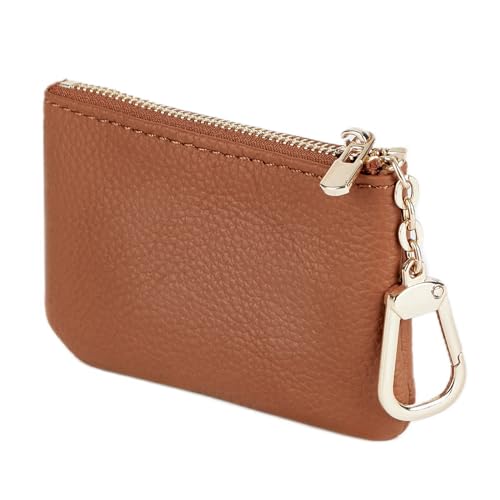
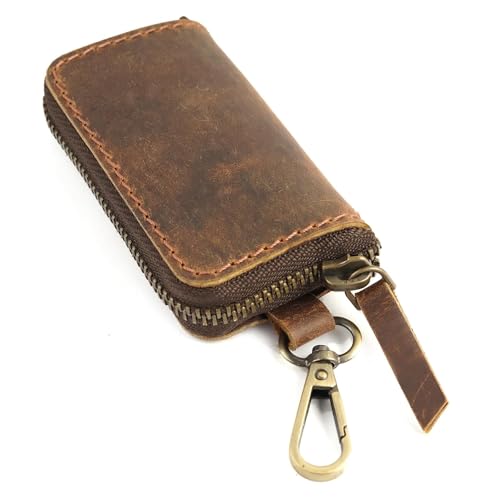
The short version:a coin purse has one job, and the part that does the job is the closure. There are exactly two mechanisms in this category — a sprung squeeze frame that opens one-handed into a tray, and a zipperthat needs two hands and lets nothing escape — and they fail in opposite directions. Everything else is leather wrapped around that decision. So the ranking below is closure first, then whether the purse attaches to anything, then whether the listing states a leather grade, then whether it publishes a size. That last one sounds trivial and it is the rarest fact in the whole aisle: of the twenty-five distinct listings our searches returned, three publish a dimension and one of those three names no brand.
Squeeze frame or zipper — the whole decision
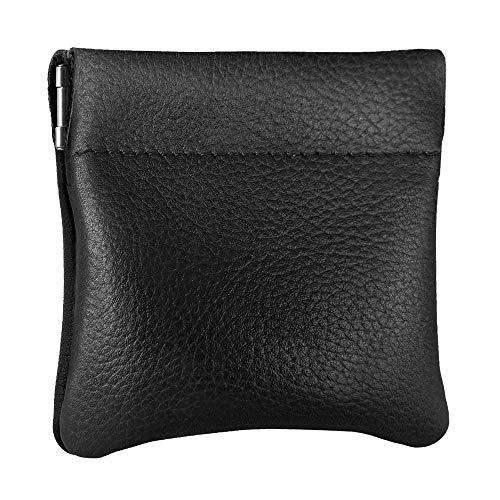
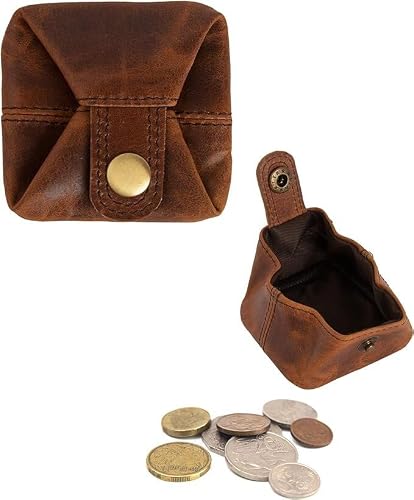
The squeeze frameis the old design: two sprung metal strips in a leather envelope. Pinch the ends and the mouth gapes open into a shallow tray you can tip coins out of, or pick through with a thumb, while your other hand is holding a coffee. That is its entire advantage and it is a real one — it is the reason the format outlived the coin pocket sewn into a bifold wallet. Its weakness is equally absolute: a squeeze frame cannot be locked shut. Loaded heavily and turned upside down in a bag, it can open. Three picks here use one.
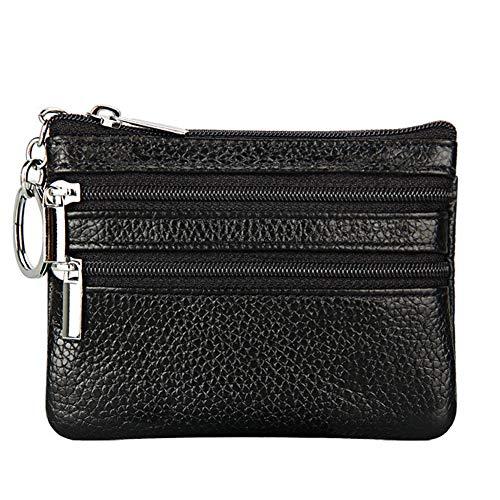
The zippergives up the one-handed trick and solves the spill. A closed zip is a closed box: coins, a folded note, a spare key, an AirTag, earbuds. It is also the only closure you can trust in a bag rather than a pocket. The cost is speed — a zip at a till with your hands full is genuinely annoying, which is the complaint this format earns most. Two picks here use one, and one of those uses three.
If you cannot decide, the honest tiebreaker is where the purse will live. In a front pocket, buy the squeeze frame. It will be in your hand and open before a zip has started. In a bag, a coat pocket or clipped to keys, buy the zip, because the failure mode of a squeeze frame in a bag is thirty cents in the lining.
The thing nobody states, and the thing almost nobody states
Two gaps define this category, and both are worth knowing before you spend ten dollars:
- Half the listings never name the closure.Three of the six products ranked below state a mechanism in the listing; three do not — including our best-made pick, from an established leather brand, whose title names the grade, the colorway and the fact that it is handmade, and never says how it shuts. We have recorded that as “not stated” and ranked it accordingly. On the central specification of the product, that is a remarkable silence.
- Almost nobody publishes a size.Three of twenty-five listings state a dimension. Two of those three are ranked below — a 3.5 by 3.5 inch squeeze purse and a 4.33 by 3.54 inch three-pocket zip — and the gap between them is the difference between a pocket afterthought and a small flat wallet. A coin purse's only brief is to be small, so a listing that will not say how small is withholding the one number that matters.
The inclusion rule, and what it cut
Four searches on 23 November 2026 returned twenty-five distinct listings. The rule for getting onto this page has three parts, and the cuts are instructive:
- It has to be standalone.A wallet with a coin pocket is a different purchase, and it already has a page — wallets with a coin pocket ranks six of those, sorted by the pocket mechanism. If what you actually want is one object instead of two, start there and skip this page entirely.
- It has to be leather, claimed by the seller.Four of the twenty-five are PU or explicitly vegan — and three of those four lead with the word “leather” in the title before qualifying it. At these prices that is the category's defining hazard, and our how to spot fake leather guide is the test to run if you shop outside this page. If a coated-fabric pouch is genuinely what you want, vegan leather explains what you are buying.
- One object, one nameable brand.Four listings are multipacks — “4 Pcs”, “2 Pack”, “Pack of 2” — and a bundle is not a product we can rank. Another four name no brand at all, including a well-priced made-in-USA leather pouch and the only other listing in the category that publishes a size. Our standing rule is that we do not rank a product we cannot attribute, so we would rather tell you those exist than stake a ranking on them.
Who actually needs one in 2026
Worth being blunt, because this is a nine-dollar product and we would rather you buy nothing than the wrong thing. If you tap your phone for everything and see a coin twice a year, you do not need this; you need a card holder. There are four cases where a standalone coin purse is genuinely the right object:
- Cash-heavy travel. The strongest demand signal in this category is travel: searches for a coin purse spike around destinations where change is unavoidable and denominations run high, and a pocketful of foreign coins is exactly what a dedicated pouch is for. Our note on whether euros fit an American wallet covers the adjacent problem of banknote size, and travel wallets ranks the document side of the trip.
- You have gone minimalist and miss the coin slot. The slim-wallet trade is to drop the coin pocket, and a separate pouch gives it back without re-adding bulk to the wallet you just downsized.
- You want a small-things pouch, not a coin purse. Earbuds, a spare key, a SIM, a USB stick, medication. Several of these are sold for exactly that, and a zipped leather box is a better object for it than a plastic case.
- Laundry, parking, vending, tips. A quarter pouch in a car or a coat is a sensible five-minute problem solved for about seven dollars.
If none of those is you, the honest advice is to buy nothing. If one of them is, this is a category where the cheapest honest option is genuinely fine, and the budget pick below costs less than a coffee.
How to choose, in four decisions
1. Pick the closure for where it will live
Front pocket, in hand, paying at a counter: squeeze frame. Bag, coat, backpack, or anything that gets turned over: zip. This is not a quality ranking — the cheapest squeeze frame here beats the most expensive zip for the use it is designed for. What it is, is the one decision you cannot change after it arrives.
2. Decide whether it should attach to something
A small pouch is the easiest thing in your carry to lose, and the fix is to tie it to something you do not lose. Three of these six state an attachment: two a keyring, one a belt loop. The belt loop is the most interesting of the three because it works when you have no usable pocket at all — the same reasoning behind our leather key holders and the belt-loop key keepers ranked there. A loose pouch in a trouser pocket, by contrast, is one more thing competing for the space a front-pocket wallet already wants.
3. Read the grade word, and discount it slightly at this price
Four of these six state full grain— a much higher hit rate than the wallet aisle manages — and one states split leather, which is the lower layer of the hide and the most honest grade statement in the batch precisely because nobody is required to make it. One says only “genuine leather”, which is a floor rather than a grade. Our grade explainer sets out what each word is worth. At six to eleven dollars, treat a full-grain claim as a signal rather than a guarantee: a small object can be cut from the offcuts of a good hide, which is both how these prices are possible and why the claim is plausible.
4. Buy small, and buy once
The failure mode of this category is buying a pouch big enough to fill. A coin purse that takes twenty coins will contain twenty coins, and then you are carrying half a pound of metal in a trouser pocket. The two picks here that publish a size are 3.5 by 3.5 inches and 4.33 by 3.54 inches, and for most people the smaller one is the better buy. If you want the bigger one, you probably want a zip-around wallet that holds cards and cash as well.
Care, which takes about a minute a year
A coin purse is the hardest-worked leather in a carry: it gets opened more often than a wallet and it holds the only thing in your pocket with sharp edges. The inside will scuff and that is invisible. The outside wants what any small leather good wants — a fingertip of conditioner about twice a year, buffed off. Our leather conditioner roundup covers which products darken leather and which state that they do not, which matters if you bought a light tan one. Full instructions, which apply unchanged to a pouch, are in how to care for a leather wallet.
What a coin purse is not
- It is not a wallet. None of these holds cards properly except the two that state a card slot, and neither of those takes a flat banknote without folding it. If you want one object, buy a wallet with a coin pocket.
- It is not a key organizer. Two of these clip to keys; none of them organizes keys. If the keys are the problem, that is leather key holders.
- It is not an AirTag wallet. A zipped pouch will hold an AirTag happily, but if the point is finding the wallet rather than the change, AirTag wallets is the page that ranks for it.
How we picked
We do not run a testing lab
We searched this category live on the Amazon catalog API on 23 November 2026 and then re-verified every surviving candidate with a direct item lookup — title, stock status and live offer price — before any of them was written about. Each one is scored against the five-metric rubric printed above the picks: closure, leather, attachment, size stated and value. That is a different rubric from the one on our methodology page, which scores wallets on slimness, leather, capacity, build and value, and it is published here because scoring a coin pouch on “card capacity” would be nonsense. The scores are judgments from documented research — they are notmeasurements, and we have not handled these purses. Where a listing does not state something — and on this page that is most often the closure and the size — the table says “not stated” rather than guessing in either direction.