Almost every version of this comparison is adjectives against adjectives: nylon is tough and modern, leather is classic and ages well, pick your personality. That is not a comparison, it is a mood board. This page can do better than that for one specific reason: Rogue Industries sells the same curved front-pocket silhouette in ballistic nylon and in top-grain leather, from the same storefront, with the same RFID-lining claim. Same brand, same shape, same design intent, one variable changed. Reading those two listings against each other produced three findings, and two of them contradict what the category says about synthetic wallets.
Finding one: the nylon model publishes the lower capacity
The intuition almost everyone brings to this is that a synthetic wallet should hold more in the same space, because fabric is thinner per layer than a hide. Inside this brand's own range, the published numbers go the other way.
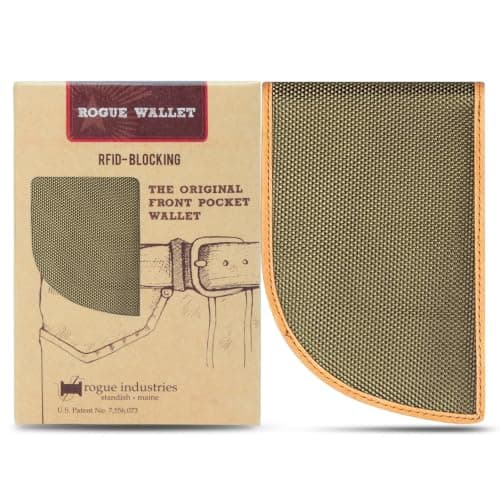
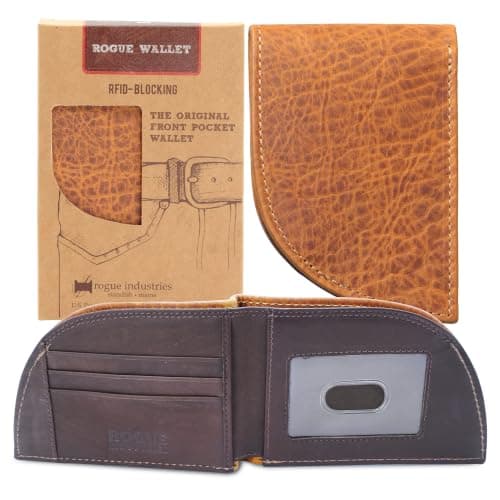
The ballistic-nylon model's bullets publish three card slots and an ID pocket, plus a full-size banknote section. The leather model in the same curved shape publishes six to eight credit cards across three slots, an ID window, a stash pocket and a full-length bill section. Same brand, same silhouette, same storefront, and the leather one is rated for roughly twice the cards.
We are not going to tell you why, because neither listing says and we will not invent a mechanism. What we can say is that the assumption is unsupported here, and that it matters: if you were choosing nylon to fit more in a front pocket, this particular pair of listings does not support the plan. The capacity question has its own page in how many cards a wallet should hold, and the honest answer there is that most people need fewer slots than they shop for.
Finding two: no nylon wallet in our registry publishes a thickness
The second claim the category makes for synthetics is thinness, and we went looking for a published number to support it. Across all 127 products we hold, not one nylon or fabric wallet publishes a closed thickness. The ballistic-nylon model's bullets give no wallet dimensions at all.
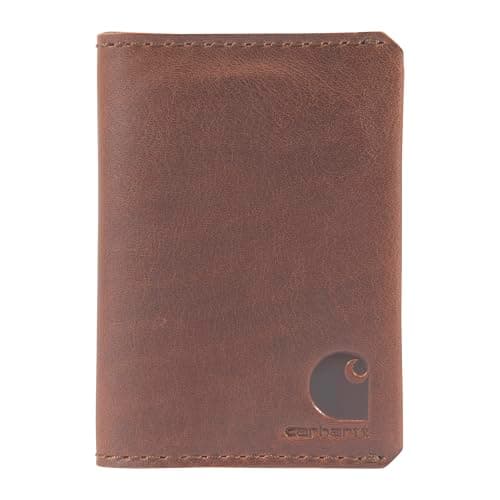
Meanwhile the thinnest published figure on this page belongs to a leather wallet: the Carhartt is published at a quarter of an inch closed, and the construction explains it rather than asserting it — one piece of vegetable-tanned top-grain leather, two pockets, no lining and no window. A single leather layer with nothing behind it beats a woven panel with a bound edge and a lining, at least where anybody has been willing to publish the number.
That does not prove nylon is thicker. It proves that the thinness claim for nylon is made in prose and never in a specification, while the leather version of the claim is occasionally made in a number. On this site a published number beats an adjective every time, which is the same rule we apply in our guide to bifold thickness and the reason we keep saying to check whether a published dimension describes the wallet or the shipping box.
Finding three: in this range, choosing the material also chooses the country
This one is specific to the brand that made the controlled comparison possible, and it is the kind of thing you only see when you read the fine print on four listings from one maker.
The ballistic-nylon model's listing states it is imported from India. The model in this lineup whose listing states it is handcrafted in Maineis a leather one — the bison wallet. The brand's own FAQ says only its Made in Maine Collection is US-made, and the mid-priced leather model states no origin at all.
So inside this range the cheaper synthetic is also the imported one, and US manufacture is available only in hide. If origin is part of your decision, the material question and the provenance question are not independent here, and the broader version of that ranking is made-in-USA leather wallets.
Where nylon genuinely wins, said plainly
We sell leather. That is the whole site, and it is exactly why this section needs to be specific instead of grudging. There are three situations where the synthetic wallet is the correct purchase and we will lose money telling you so.
It is going to get wet, repeatedly.This is the real one. Nylon is a synthetic polyamide fiber and it does not take up water the way a hide does; a soaking is a drying-off rather than an event. Leather that gets wet and dries unevenly stiffens, can water-stain, and loses some of its finish — the failure mode we describe in are leather wallets waterproof. If you work outdoors in weather, fish, kayak, or sweat through a pocket all summer, buy the nylon one.
You do not want to care about it. A hide rewards attention and punishes neglect; the whole conditioner category exists because of that. A woven synthetic asks for nothing and looks the same in year three as in week one. For some people that is the entire specification.
Abrasion against grit, all day. Ballistic nylon is a thick, tightly woven fabric originally developed as flak-jacket material, and dragging it in and out of a pocket full of concrete dust is a job it handles without recording the history. Leather records everything, which is a feature right up until the day it is not. The jobsite version of this decision is wallets for work, and the gym version — where the real variable is sweat rather than grit — is wallets for the gym.
Where leather wins, and the honest shape of the argument
The one real advantage is not durability and we should stop pretending it is. A well-made wallet in either material will outlast most people's interest in it, and wallets almost never fail at the material anyway — they fail at stitching, an edge coating, a lining or a moving part, which is the argument behind our durability ranking.
The advantage is that leather changes and nylon does not. A full-grain or vegetable-tanned hide darkens, softens and takes on a patina from your hands and your pocket, so a three-year-old wallet is visibly yours. A woven synthetic is a manufactured surface: it will not improve, and when it does finally show wear it looks worn rather than aged. Everything people describe as leather's quality advantage is downstream of that one property.
Which makes this a preference question rather than a performance question, and we would rather say so than dress a taste up as a test. Two things follow. First, if you want the aging, the grade is what delivers it — a heavily coated or corrected leather will not patina either, so buying leather without reading the grade can get you the price of leather with the aging of nylon. A country adjective will not tell you, which is the point of our page on Italian leather. Second, leather is more repairable by a cobbler than a bound fabric panel, although in practice almost nobody repairs a wallet of either kind.
Canvas, polyester and “vegan leather” are three different questions
The searches that land here use the words interchangeably and they should not, so briefly:
Canvasis usually cotton, which means it is an absorbent natural fiber. It has the look people want from a fabric wallet and it does not have nylon's water advantage — a wet canvas wallet is wet in the way a wet shirt is wet. Coated or waxed canvas is a different and better-behaved material.
Polyester and ripstopare, for a wallet, in the same family as nylon: synthetic, non-absorbent, dimensionally stable, and they do not age. Ripstop's reinforcing grid is about tear propagation in a sail or a jacket, which is not a load case a wallet sees.
“Vegan leather”is not a fabric wallet at all. It is almost always a polyurethane coating on a textile backing, built to look like a hide, and its characteristic failure is that the coating delaminates and peels — a different and usually faster failure than either real leather or woven nylon. We cover what that looks like in why is my leather wallet peeling and how to spot fake leather. If you are choosing a synthetic for performance, a woven nylon is the honest version of that choice and a coated imitation hide is not.
The decision, in five rows
Each row below is a question we can answer from something a listing publishes, rather than from a feeling about materials.
Will it get wet regularly? If yes, nylon, and stop reading. This is the one row that settles the question on its own, because it is the one physical difference with no leather workaround beyond care you will not keep up.
Do you want it to look better in three years?Then leather, and the grade matters more than the material does — a corrected, coated hide ages about as much as a woven panel.
How many cards? Read the published count on the exact listing, not the material. In the one controlled pair we have, the leather model publishes six to eight and the nylon one publishes three slots plus an ID pocket.
Does thickness decide it? Then you are shopping for a published number, and on this page only leather models publish one. The quarter-inch Carhartt gets there by removing things: one piece of leather, two pockets, no lining, no window.
Does origin matter?In this brand's range, the nylon model states imported from India and the model stating Maine manufacture is leather. Elsewhere the coupling may differ — read for a stated country rather than an implied one.
How the picks are ranked, including one tie we broke on purpose
Two things to disclose, because a page comparing materials on a leather site has an obvious conflict and the honest move is to name it.
Our rubric has a leather column. The five metrics behind every score on this site include the leather grade, so a ballistic-nylon wallet structurally cannot top the ranking here no matter how good it is. That is a limitation of the scoring and not a verdict on the material. We are telling you rather than hiding behind the number, and it is why the sections above are built on published specs instead of on our own scores.
The tie.The Carhartt and the ballistic-nylon Rogue score identically. We placed the Carhartt above it because this page's most useful finding is a published thickness and the Carhartt is the only pick that has one; the nylon pick is third of four rather than last because it is the only non-leather wallet here and the page is about that choice. Neither position is a claim that one outlasts the other.
What we are not going to tell you
That one material lasts longer than the other.We have no wear testing, no abrasion figures and no returns data, and nobody in this category publishes any. Both materials outlive a typical wallet's moving parts.
What “ballistic” guarantees. It is a fabric name from a flak-jacket application, not a civilian performance rating, and no denier, weave or test standard appears on the listing. Treat it as a description of a kind of cloth.
A water-resistance rating for either.Nylon's advantage here is a property of the fiber and it is real, but no listing on this page publishes a rating and we are not going to supply one.
Anything about the environmental comparison. It is genuinely contested, the honest answer depends on inputs neither listing discloses, and a wallet retailer is the wrong source for it.
If you came here for a one-line answer
Buy nylon if the wallet is going to get soaked, battered or ignored. Buy leather if you want a wallet that looks like yours in five years, and read the grade when you do, because that is the property you are paying for. Everything else people argue about in this comparison is either a preference or a claim nobody publishes a number for.
Prices, and what we earn
Prices here come from the retailer and are timestamped; where one cannot be verified you will see “check current price” rather than a figure we are guessing at. We earn a commission if you buy through our links, and the nylon pick on this page is cheaper than two of the three leather ones — so the paragraph telling you to buy it when the wallet will get wet costs us money. It is still the right advice.