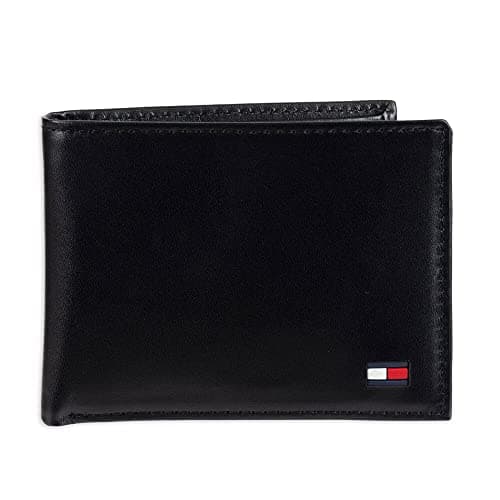
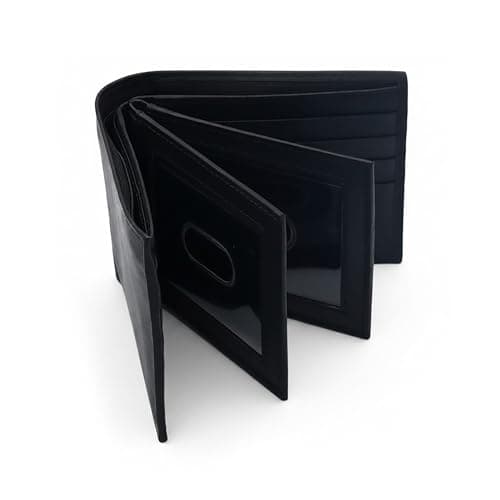
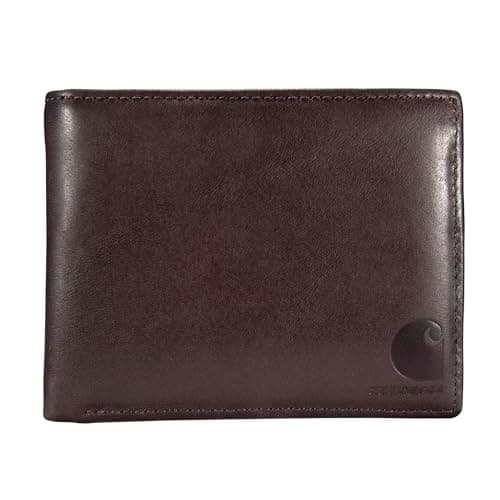
The pick for most people is the Carhartt Oil-Tan Leather Wallet — a plain bifold with a removable passcase, which means a card can be handed over or shown without the wallet being emptied, and no snap, zip, cage or band to operate. The Tommy Hilfiger Passcase Bifold does the same job in a dressier, giftable form. If three documents have to be visible at once — a licence, a health card and one more — the A|G Wallets 1225 has three windows, and we will tell you plainly below why it is fourth-ranked anyway. And if loose change is the daily frustration, the Fossil Derrick has the only gusseted coin pouch we rank.
This page deliberately ignores the spec this site usually leads on
Six of our highest-traffic pages rank wallets on how thin they are. That is the right axis for most buyers and it is the wrong axis here, for two reasons that have nothing to do with taste.
The first is grip. A slim wallet gets thin by making its slots tight, so the card is held by friction and extracted by pinching an edge and pulling. That is a fine-motor task. So is operating a sprung aluminum cage, unseating a stiff snap, or working a small zip pull. Any of those can go from trivial to genuinely annoying with arthritis, reduced sensation, or just dry skin — and none of it appears on any listing anywhere, because sellers describe capacity, not the force required.
The second is what has to be shown. The number of documents a person is asked to produce tends to go up, not down: a driver's licence, a health or insurance card at a pharmacy counter, a supplementary plan card, sometimes a membership card at a desk. A cardholder that holds eight payment cards and has no window is the wrong object for that, however good the leather is.
So the inclusion rule on this page is: the listing has to publish an ID window or a removable passcase, and the wallet must have no mechanism that requires a precise or sustained grip. That excludes a lot of wallets we rank highly elsewhere, by name, below.
What a removable passcase actually solves
Two of the four picks publish one and it is the most underrated feature in this category. A passcase is a small separate leather sleeve, usually holding two or three cards behind a clear window, that lifts out of the bifold entirely.
That matters because of what happens at a counter. With a fixed window you hand over the whole wallet, or you pick the card out of a plastic sleeve with a fingernail. With a passcase you hand over a thin sleeve with the licence facing out, the rest of the wallet stays in your hand, and nothing has to be extracted at all. It is also the answer to the most common complaint about ID windows generally, which is that getting a card out from behind the film is harder than getting it out of a slot.
Three documents versus one wallet you can sit on
The A|G 1225 has twelve slots, three ID windows and a zip pocket, and it is the fourth pick rather than the first. The reason is in its own listing, which is unusually candid: it “expands up to 1.5 in when filled”.
An inch and a half of wallet in a back pocket is the exact object that causes the problem covered in our guide on sitting on a wallet — a pelvis tilted by a wedge under one side, for every hour spent in a car or a chair. That is a real and well-documented mechanism, and recommending a brick to someone whose back is already the reason they are being bought a gift would be irresponsible. So the honest framing is: buy the A|G only if three visible documents is a genuine daily requirement and it will be carried in a jacket or a front pocket. Otherwise take two windows and a thinner wallet.
What we excluded, by name
This page is short because the rule removes most of the registry, and the exclusions are more useful than the inclusions.
- Every pop-up cardholder. We rank these highly on the pop-up page and they are the wrong gift here. A sprung cage needs a deliberate thumb push, and one listing in the category publishes a minimum card count for the cage to retain anything at all — a mechanism with a floor is a mechanism that can fail in the hand.
- Every MagSafe wallet. A magnetic sleeve on the back of a phone is held by a magnet against a peel, and we have written about why that fails. A wallet that detaches when it is brushed is not the right object for someone who would rather not be picking cards up off a car park.
- Every card sleeve with an elastic band. Stretching a band and threading cards under it with two hands is more dexterity than a slot, not less, despite looking simpler.
- Every engraved and monogrammed wallet. Not on grounds of taste — on grounds of returns. Engraving usually makes a gift non-returnable, and the one thing this gift most often needs is to be exchangeable. We make the same point on the personalised page and on the groomsmen page.
If you are buying this as a gift, read this part first
The great majority of people searching for a wallet for an older man are buying it for someone else, and that changes the brief completely. A wallet is a replacement, not an addition: he already owns one, uses it every day and has opinions about it he has never said out loud. We wrote a whole guide to that trap and the short version has three parts.
Match the format he already carries
This is the rule people break. A man who has carried a bifold for forty years does not want a card sleeve, and a card sleeve given to a bifold carrier is a project rather than a present — he has to re-decide his entire carry to use it. Look at what is in his back pocket and buy that shape, one grade better.
Count the windows he actually uses
Open the old wallet if you can. If there is a licence behind a clear panel and a health card tucked behind it, you want two windows or a passcase. If there is a wallet-sized photograph in there, that is a window too, and a wallet with none of them will feel like a downgrade however nice the leather is.
Keep the receipt and skip the engraving
A plain wallet with a receipt beats an engraved wallet without one, on a gift whose whole risk is that it is the wrong shape. If you want it to feel personal, write the note by hand — the same advice we give on the groomsmen page, for the same reason.
Leather, briefly
Three of the four picks here state genuine leather, which is the lowest rung of real leather and the correct trade on this page. Our top pick is the exception: Carhartt publishes oil-tan leather, which is the one genuinely useful material note here. An oil-tanned hide carries its conditioner inside the fibre, so it scuffs and rubs back rather than cracking, and it does not need a maintenance routine to stay serviceable. That is worth more on a wallet that will be carried without ceremony for a decade than full-grain veg-tan would be — the oil-tanned explainer covers the mechanism, and it is the same argument we make about wallets for a jobsite.
If the leather is the point of the gift, do not buy from this page. Buy from the full-grain roundup or the warranty-ranked durability page and accept a tighter set of slots — just make sure the format matches what he carries now.
The advice that earns us nothing
If the old wallet still works, buy a tin of conditioner instead. A dry, stiff, tired-looking wallet is almost always a wallet that has gone five years without being fed, not a wallet that has failed. Twenty minutes and a balm from the conditioner roundup will make it look dramatically better, it costs a fraction of any wallet on this page, and it does not ask anyone to change a forty-year habit.
If the complaint is back or hip pain, the fix is free before it is a purchase. Moving the wallet out of the back pocket resolves the mechanism entirely and costs nothing. A thinner wallet helps; taking the wallet out from under you helps more. That is the first section of the guide on sitting on a wallet and it is the honest order of operations.
If the complaint is losing it, buy a tracker, not a wallet. We rank wallets built around a tracker on the AirTag page, and the cheaper move is a tracker card slipped into the wallet he already owns.
Prices, and what we earn
Prices are read from the live price layer and stamped with the date they were read. Buy links are affiliate links. See the editorial policy.