Skip to content
Hide Thread

Leather Guide · Leather Guide

Why leather wallets cost what they do

Four things separate a $15 wallet from a $150 one, and only two of them are the leather. Here is where the money goes, measured against our own catalog rather than asserted.

By Stephen V.Updated How we research
#ad

We earn a commission when you buy through our Amazon links, at no extra cost to you. It never affects our picks, and we say so when the cheaper wallet is the better buy. How this works.

The short version: a wallet is a small object with very little material in it, so the price gap in this category is not mostly about how much leather you get. It is about which layer of the hide the leather came from, how long it sat in a tanning vat, how it was put together, and whose name is on it. The first three are real and you can check two of them before you buy. The fourth is the one that moves the price most and tells you least. This page is about where the money goes. Whether spending it pays back is a different calculation, and we do it on the cost-to-own page.

1. The grade: which layer of the hide you bought

A hide is layered, and the price of leather tracks almost perfectly with how much of the top layer survived. Full-grain leather “contains the entire grain layer, without any removal of the surface”. Corrected grain has “the surface subjected to finishing treatments to create a more uniform appearance”— the flaws are sanded off, then the leather is dyed and embossed with a grain pattern to replace the one that was removed. Below that, the layers underneath get coated: bicast leather is split leather coated with polyurethane or vinyl, which, in the reference's own words, “gives it the appearance of a grain”.

That is the whole ladder, and it is why two wallets that look identical in a photograph can differ fourfold in price. The expensive one is made from the part of the hide that is in shortest supply, sold in the condition nature left it; the cheap one is made from the parts underneath, resurfaced to look like the part on top. Our grade guide walks the ladder in full, and pebbled leather explains the embossing step, which is where most of the visual deception in this category happens.

Here is the part worth knowing before you shop, and we measured it rather than guessed it. Across the 106 wallets in our own catalog whose listing makes a leather claim, only 31 say full grain. Seventy name a rung on the ladder at all — 31 full-grain, 14 top-grain, 25 genuine — and 36 name a leather word with no rung behind it: a tannage, a finish, a hide, or simply “leather.” That is a count of what we rank, not of the market, but we rank what the market sells at these prices, and the shape is clear. The grade is the single biggest input to price and roughly a third of listings decline to state it.

2. The tanning: weeks in a vat, or under a day

This is the cost driver nobody in the aisle explains, and it is the most concrete one available. Turning a raw hide into leather means tanning it, and there are two routes.

Chrome tanning uses chromium(III) sulfate and its tanning stage takes “less than a day for this part of the process.” It is “responsible for 85–90% of modern leather making”, which is to say: almost all leather, almost all wallets, almost certainly yours.

Vegetable tanning uses tannins that “occur naturally in the bark and leaves of many plants,” and it “takes longer than mineral tanning” — the hides are “immersed for several weeks in vats of increasing concentrations of tannin.”

Weeks against less than a day. That is working capital sitting in a tannery, floor space occupied, and a slower turn on every hide, and it lands in the price of the finished wallet before anybody has cut a panel. It is the honest answer to “why does the vegetable-tanned one cost so much more” — not mystique, calendar. We cover the resulting material on vegetable-tanned leather and rank the wallets made from it at vegetable-tanned leather wallets.

What we are not going to tell you is how many weeks, or what either tannage costs per hide. Those figures circulate widely and we could not verify them, so they are not on this page.

3. The construction: stitching, edges and where it was made

Two wallets can use the same hide and still differ in price because of how they were assembled. The things that cost money here are labor-shaped:

  • Hand-stitching versus machine-stitching.A saddle-stitched seam is made one pass at a time by a person. It is slower by an order of magnitude and it is the single clearest labor line in a wallet's cost.
  • Edge finishing.A cut leather edge can be left raw, painted, or burnished — sanded and rubbed until the fibers compress and seal. Burnishing is hand work and it is also the part of a wallet that fails first, so paying for it is not vanity.
  • Lining and layer count.A fully-lined wallet uses roughly twice the leather and has to be built in stages. An unlined one is cheaper and often thinner, which is sometimes the better wallet — see bifold wallet thickness.
  • Country of manufacture. This is a labor-cost line and nothing more mysterious. It is also the spec most likely to be missing: our made-in-USA roundup exists partly because so few listings state a country at all.

4. The brand: the part that moves the price most

The uncomfortable answer to “are designer wallets worth it” is that above a certain point you stop buying hide and start buying a logo, and the transition is not gradual. A fashion house and a small leather workshop can charge similar money for wildly different objects, because one is pricing a brand and the other is pricing a week of someone's labor. Our brand guide is organized around exactly that distinction, and our brand reviews go listing by listing rather than reputation by reputation.

The useful test: ask what the price buys that the listing will state.A full-grain claim, a named tannery, a published country, a warranty, a stated card count — those are things a seller commits to. “Luxury,” “premium” and “genuine Italian craftsmanship” are not. We wrote a whole page on why the last of those three is a provenance adjective and not a specification.

Three things a higher price does not buy

This is the part that earns us nothing, so we will be blunt about it.

  • RFID blocking is not an expensive feature. It is a shielding layer that appears on wallets at every price point, including the cheapest ones we rank. If a listing presents it as a premium upgrade, that is marketing. Our read on whether you need it at all is at are RFID wallets worth it.
  • More card slots is not better leather. Slot count is a cutting-and-sewing decision, and each one adds thickness. A high slot count is an argument against a wallet as often as for it.
  • Texture words are not grades.Pebbled, tumbled, milled, Saffiano, crazy-horse — all of these describe a finish applied to leather of some grade, and a listing that gives you the texture and withholds the rung has told you about the surface and nothing about the hide.

So how much should a leather wallet cost?

We will not print a number, because any number we print is wrong somewhere — prices on this site are pulled live from the retailer for exactly that reason. What we will give you is the shape of the market in brackets, and what each bracket reliably publishes about itself. That is in the buyer's guide below, and the three picks under it are one wallet from each bracket so you can see the difference in writing rather than in adjectives.

The short answer

Quick picks

#ProductBest forScorePrice
01
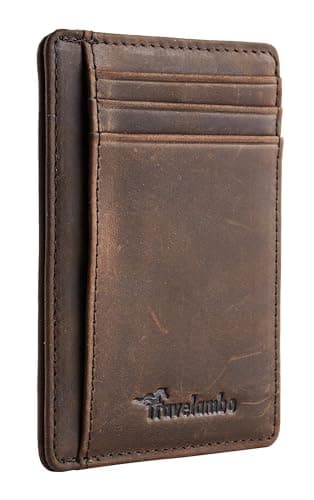
Travelambo Travelambo Front Pocket Wallet
Travelambo Front Pocket Wallet

The ten-dollar RFID front-pocket wallet that outsells almost everything — the honest answer when budget is the whole brief.

Best budget slim
7.4
$8.48Amazon
02
Main Street Forge Main Street Forge Slim Wallet
Main Street Forge Slim Wallet

The smallest wallet the brand makes, and the only one whose listing publishes an exact slot count: five slots rated for up to eight cards.

Best Main Street Forge for a minimal carry
7.6
$39.99Amazon
03
Craft & Lore Craft & Lore Insider Bifold
Craft & Lore Insider Bifold

A hand-stitched cash-and-card bifold from a North Idaho workshop, offered in Horween Chromexcel or Horween Dublin — the tannery's hide in a wallet you can actually order today.

Best made-in-USA Horween
8.0
$70.00Amazon

#ad · Live prices from the Amazon Product API, as of November 2, 2026. Where we have no verified live price, we show none — we would rather leave a gap than print a number that has rotted.

Side by side

The spec table

Every published spec that decides fit and function, side by side — with a dash wherever the maker does not publish the figure, never a guess.

ProductTypeLeatherCardsRFIDCash
Travelambo Front Pocket WalletFront-pocket bifoldGenuine leather8–11YesYes
Main Street Forge Slim WalletSlim walletFull-grain5 slots (up to 8)—Yes
Craft & Lore Insider BifoldBifoldHorween Chromexcel or Dublin (option)12—Yes

In detail

The picks, in full

01
Travelambo Travelambo Front Pocket Wallet

Best budget slim

Travelambo Front Pocket Wallet

Front-pocketLeather8–11 cardsRFID
7.4/10

The ten-dollar RFID front-pocket wallet that outsells almost everything — the honest answer when budget is the whole brief.

Slimness
8
Leather
5
Capacity
8
Build
6
Value
10

Pros

  • Costs about as much as lunch and still blocks RFID and holds a real stack of cards
  • A huge range of colors, so it's the easy first slim wallet to try the format
  • Enormous review count for a wallet this cheap — the fit-and-finish is a known quantity

Cons

  • The leather is thin and won't last or age like a wallet several times the price
  • It's a commodity product — there's no warranty story or brand to stand behind it

Skip this one if…

…you want something to keep for a decade. At this price it's a two-to-three-year wallet — buy it to test the slim format, then upgrade if you love it.

$8.48· View on Amazon

$12.9935% off

Price as of November 2, 2026. Prices change — Amazon's is the one that counts.

#ad · we may earn a commission from this link to Travelambo Front Pocket Wallet

02
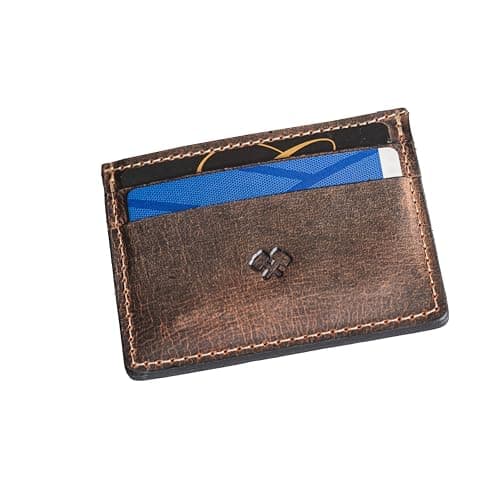
Main Street Forge Main Street Forge Slim Wallet

Best Main Street Forge for a minimal carry

Main Street Forge Slim Wallet

Slim walletFull-grain5 slots / up to 8 cardsMade in USA
7.6/10

The smallest wallet the brand makes, and the only one whose listing publishes an exact slot count: five slots rated for up to eight cards.

Slimness
9
Leather
9
Capacity
4
Build
8
Value
8

Pros

  • Five slots rated for up to eight cards is a published, specific number — most of this brand's listings never give one at all
  • The thinnest body in the line, which is the whole reason to buy a minimalist wallet rather than a bifold
  • Full-grain leather and US small-batch assembly, same as the more expensive wallets above it

Cons

  • The warranty bullet says "manufacturer-backed" rather than lifetime, unlike the classic bifold and trifold listings, so the coverage on this specific model is not spelled out
  • Five slots is a genuine ceiling — this is a wallet you have to edit your carry down to, not one you grow into
  • No RFID and no ID window are claimed on the listing

Skip this one if…

…you carry an ID you show often or more than a handful of cards. The front-pocket slim bifold above holds more for the same money.

$39.99· View on Amazon

Price as of November 2, 2026. Prices change — Amazon's is the one that counts.

#ad · we may earn a commission from this link to Main Street Forge Slim Wallet

03
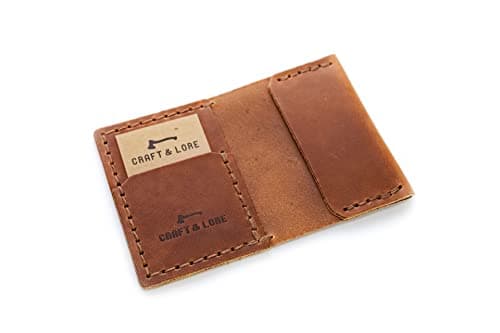
Craft & Lore Craft & Lore Insider Bifold

Best made-in-USA Horween

Craft & Lore Insider Bifold

BifoldHorween optionHolds 12 cardsMade in USA
8.0/10

A hand-stitched cash-and-card bifold from a North Idaho workshop, offered in Horween Chromexcel or Horween Dublin — the tannery's hide in a wallet you can actually order today.

Slimness
6
Leather
9
Capacity
8
Build
9
Value
8

Pros

  • Two of the six leather choices are named Horween hides — Chromexcel Natural and Dublin English Tan — rather than a finish that merely gestures at the look
  • Cut and saddle-stitched by hand in North Idaho from US steer hide, with the stitching guaranteed for life
  • Holds twelve cards comfortably in a 3in x 4.25in body, so the Horween hide arrives in a wallet you can carry everything in

Cons

  • Horween is a colorway you have to select, not the default — order Natural Veg Tan or Buck Brown and you get a different hide entirely
  • Nothing on the listing or the maker's page claims RFID blocking, so we have not claimed it either
  • At 3–4oz this is thick leather for a bifold, and it starts stiff before the fold breaks in

Skip this one if…

…you need RFID shielding or an ID window. This is a plain hand-stitched billfold with neither — a Serman Brands or RUNBOX gives you both for less money.

$70.00· View on Amazon

Price as of November 2, 2026. Prices change — Amazon's is the one that counts.

#ad · we may earn a commission from this link to Craft & Lore Insider Bifold

The three price brackets, and what each one tells you

The entry bracket

At the bottom of the market you are buying a finished look. Expect “genuine leather” or no grade at all, RFID included as standard, a generous published card count, and no country of manufacture. The leather will be real at this price more often than people assume — “genuine” is a real rung on the ladder, just the lowest one — but it is also where synthetic leather is most likely to be sitting next to it on the shelf at the same price, so read the material line. These wallets are ranked at budget leather wallets.

The middle bracket

This is where the grade claim appears and where the sentence “worth it” starts to mean something. Full-grain shows up here, so do named tanneries, stated countries and real warranties. It is also the bracket with the widest quality spread, because it contains both small workshops pricing labor and fashion labels pricing a logo. Our under-$100 roundup is the honest middle of the market.

The upper bracket

Above the middle you are paying for labor and for scarcity of the specific hide: hand stitching, burnished edges, a named tannery's run, small-batch assembly. The honest thing to say is that the leather stops improving long before the price stops rising, because there is no rung above full-grain — what you buy above that point is construction and provenance. If a wallet in this bracket does not state its tannery, its country and its construction, you are in the logo part of the market. Full-grain wallets and Horween wallets are where we rank these.

How to decide what to spend, in three questions

  1. How long do you want it to last? Not how long it couldlast — how long you want to own it. If the honest answer is a few years, the entry bracket is the right call and the rest of this page is interesting rather than useful. How long leather wallets last has the realistic ranges by grade.
  2. Do you want it to age or stay the same? Patina is a full-grain property. If you want a wallet that looks the way it did when you bought it, you are not shopping for the upper bracket and should not pay for it. See leather wallet patina.
  3. Then run the division. Price divided by realistic lifespan is the only comparison across brackets that holds up, and it regularly flips the ranking. That is the cost-to-own method, and it is the page to read next if this one has convinced you that the middle bracket exists for a reason.

One caveat about the picks below

They are one wallet per bracket, chosen because each one publishes enough about itself to illustrate the bracket honestly — not because they are the best wallet at their price. For that, use the roundups linked above. The prices on this page are pulled live from the retailer, so the brackets will shift under us and the argument will not.
How we picked

We do not run a testing lab

We compiled the published manufacturer specifications for every wallet here — format, leather grade, card capacity, RFID and how it carries cash — did the cost-to-own math, and scored each pick against a published rubric. The scores are judgments from documented research — they are not measurements we took or wallets we wore in, because we do not own every wallet here and we are not going to pretend we do. Where a spec could not be verified we wrote "data unavailable" rather than guessing.

Questions

Frequently asked

Why are leather wallets so expensive?
Four inputs, in descending order of how much they actually explain: the grade of leather (which layer of the hide it came from), the tanning method (vegetable tanning keeps hides in vats for several weeks against under a day for the chrome stage), the construction (hand stitching, burnished edges, lining, country of manufacture), and the brand. Only the first three are things you are buying; the fourth is the one that moves the sticker most.
How much should a leather wallet cost?
We deliberately do not publish a figure, because every price on this site is pulled live from the retailer rather than typed in. What we can tell you is what each bracket reliably states about itself: the entry bracket gives you RFID and a card count and usually no grade; the middle bracket is where a full-grain claim, a named tannery and a warranty appear; above that you are paying for labor and provenance, because there is no rung above full grain.
Are expensive wallets worth it?
It depends entirely on one number you already know and we do not: how long you want to own it. Divide price by realistic lifespan and a mid-bracket full-grain wallet often works out cheaper per year than an entry-bracket one you replace repeatedly. That calculation is the whole of our cost-to-own page. If you replace wallets because you get bored rather than because they fail, the arithmetic says buy cheap.
Are designer wallets worth it?
As leather, usually not in proportion to the price — above a certain point the hide stops improving because full grain is the top rung, and the additional money goes to the name and the shop. As objects people want, that is a real thing to buy and we are not going to pretend otherwise. The test is simply whether the listing states a grade, a tannery, a country and a construction method. Fashion listings frequently state none of the four.
Does a higher price mean better leather?
Up to the middle of the market, broadly yes — that is where grade claims start appearing. Above it, no: price keeps climbing after the grade has topped out, and what it buys is stitching, edge work, provenance and brand. Within the entry bracket price tells you almost nothing, which is why we rank on what each listing publishes rather than on what it costs.
Is RFID blocking worth paying extra for?
You should not have to. RFID shielding appears on wallets at every price point including the cheapest we rank, so a listing presenting it as a premium feature is pricing marketing. Whether you want it at all is a separate and more interesting question, and our answer is more skeptical than most of the internet's.
Why do two wallets that look identical cost four times as much?
Because the photograph cannot show you which layer of the hide you are looking at. The cheap one is very often a lower split that has been sanded smooth, dyed and embossed with a grain pattern to replace the one that was removed; the expensive one is the intact top layer. The embossing step is specifically designed to close the visual gap, which is why the grade claim in the text matters more than the image.

Keep reading

Receipts

Sources

We do not run a testing lab, and we do not pretend to. Every spec above traces to a manufacturer listing or a named standard; where we could not verify something, we say so on the page rather than quietly leaving it out. Read our full method.