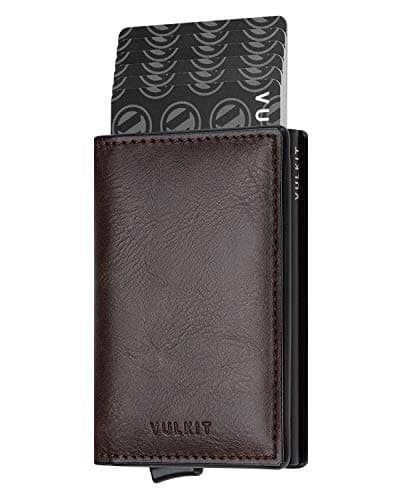
The short version: buy the VULKIT Pop-Up Card Holder— it is the single best value in this whole aisle, because it puts the thumb-lever mechanism that defines the premium end of the category into a leather shell for about a quarter of the price of the wallet that made the mechanism famous. The budget pick is the Fintie Slim Card Holder at under $6. And the finding that makes this page worth writing: the card holders that win our unconstrained pages — the Ekster Parliament at $99, the Ekster Aluminium at $99, the Aluminium Pro at $119 and the Bellroy Slim Sleeve at $85 — are every single one of them above this ceiling.
About the prices on this page.Every figure comes from our live price layer and carries its own “as of” date above the Quick Picks table — we do not type prices into copy, because a typed price is wrong the next morning. The band on this page was chosen against the price file pulled on 7 November 2026. Amazon prices move; if a pick has crossed the ceiling since, the number you see above will say so before we can, and that is deliberate.
What $50 buys, and the one thing it buys surprisingly well
The card holder is the most mechanically interesting category on this site, which is exactly why a price ceiling is interesting here. Four things are on sale in this aisle: a mechanism, a grade of leather, a slot count and a construction standard. Under $50 you can have any three of them, and the surprise is which one is cheapest.
The mechanism is the bargain.A sprung cage that fans your cards out in a staircase is the signature feature of the $99 end of this category, and our top pick does it for about $24. It is not as refined — the action is stiffer, the aluminium thicker, the leather an unstated grade — but it is the same idea working the same way, and nothing else at this price offers it. Our pop-up roundup ranks the format with no ceiling and tells you exactly what the extra $75 buys.
The leather grade is also available, at the top of the band: one pick here states full-grain vegetable-tanned hide and names both the grade and the tannage, which is more than most $85 wallets do.
Slot count is nearly free.Sixteen slots with turned edges sits right at the ceiling; twenty-slot card books cost under $16. If capacity is your problem, this category solves it cheaply — see large-capacity card holders.
Construction is what you give up.Turned edges, skived seams, lining that does not shed — one pick here has them and it is the most expensive. Everywhere else under this ceiling you get cut edges and a straightforward build.
How this page ranks
With the price fixed, we rank on what the object does that the others cannot, then on what the listing states about its material, then on capacity. That ordering puts a $24 wallet above a $45 one, because a mechanism nobody else at the price offers is worth more than a grade claim several of them could make.
It also puts a metal case in the list at position five. We are a leather site and we are not going to pretend aluminium does not exist: if you want the thinnest possible object with a money pocket, metal wins on physics and the leather options lose. Our leather vs metal comparisonargues it properly, and it does not come out entirely in leather's favour.
The six, and who each is for
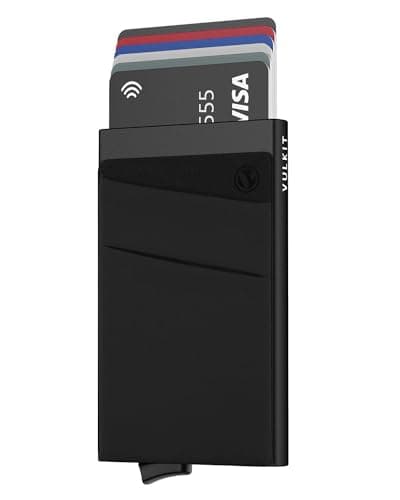
VULKIT Pop-Up Card Holder— for anyone who taps a card several times a day. Seven cards, RFID, leather of an unstated grade, and the mechanism. The best thing on this page and one of the best value objects in our registry.
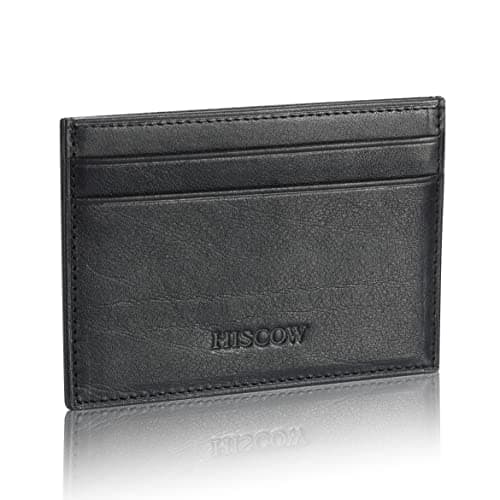
HISCOW Veg-Tanned Card Holder with ID Window— for the reader who wants the leather to be the point. Full-grain vegetable-tanned with a window, no RFID, and it will darken visibly over a couple of years rather than wearing out.
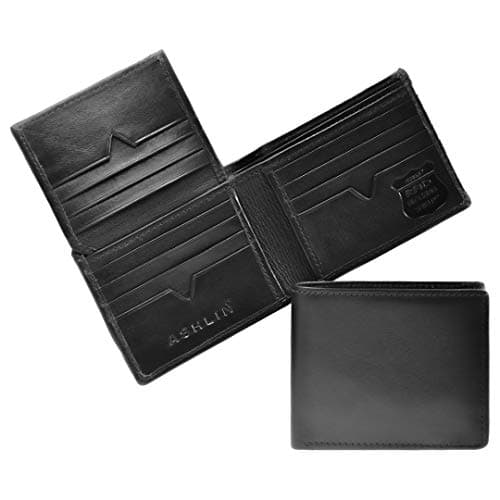
Ashlin 16-Slot Card Wallet— for construction, at the very top of the band. Sixteen slots, turned edges and a double billfold — the only pick here built like a more expensive wallet.
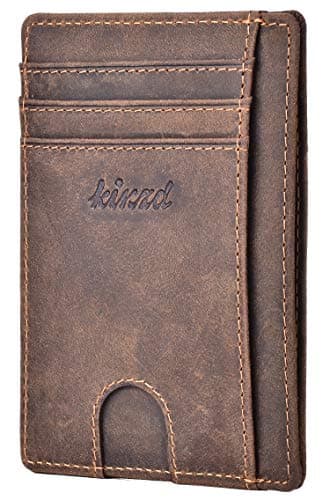
kinzd Slim Front Pocket Wallet— for ID. Eight to ten cards with a proper window, RFID, and the most conventional object on the page.
VULKIT Metal Card Case with Money Pocket— for the thinnest result that still takes a note. Aluminium, four to seven cards published, a published 0.31 in. Not leather, and we have said so.
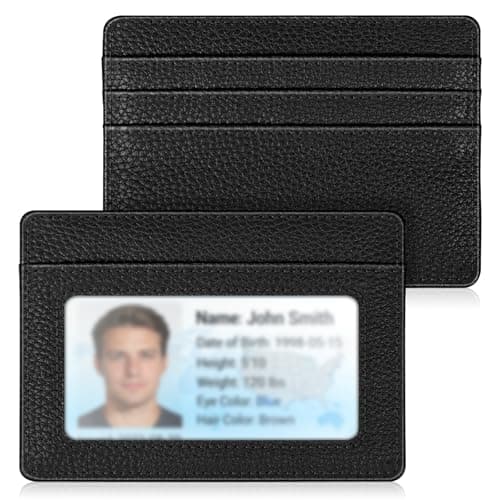
Fintie Slim Card Holder— the budget pick, and the cheapest thing in our registry that does the job. Six to nine cards with an RFID claim for under $6.
Buying notes
Decide about cash before you decide about cards
Three of these six have nowhere to put a note. That is the decision people get wrong most often when they downsize from a wallet, and the regret arrives at the first market stall or parking meter. If cash is part of your week, the options are the metal case with a money pocket here, a clip, or a holder with a cash channel — card holders that hold cash ranks those.
Slot count is a thickness budget, not a capacity
At ID-1 thickness each payment card is 0.68 to 0.84 mm, and a filled slot costs roughly 0.035 to 0.040 in once the leather is counted. Sixteen slots full is well over half an inch. Buy the slot count you will use rather than the one you might. Our how many cards fit in a card holder has the arithmetic.
What the premium end genuinely gets you
We will not pretend the $99 picks are a con. What they buy is a smoother mechanism that will still work in year five, a stated leather grade, machined rather than stamped aluminium, and a warranty. If a card holder is going to be the only thing you carry every day for years, that is a defensible spend — see our unconstrained card holder roundup and Ekster alternatives, which is the same question from the other direction.
Advice that earns us nothing
If you are buying a card holder to fix an overstuffed wallet, try carrying the overstuffed wallet with half the cards in it for two weeks first. Most people discover the problem was the cards, not the wallet, and the fix was free. Our what not to keep in your wallet is the procedure.