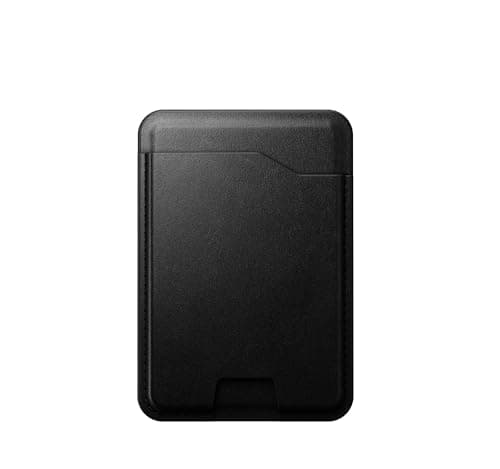
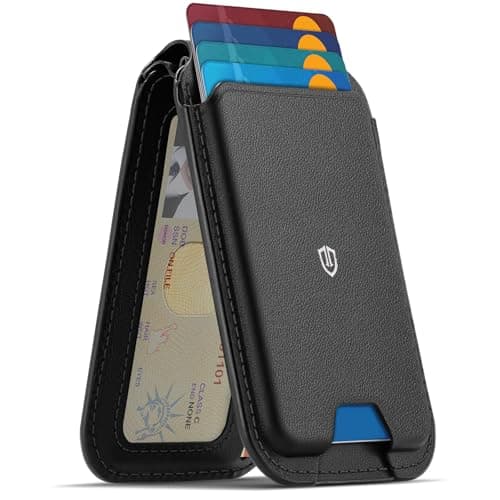
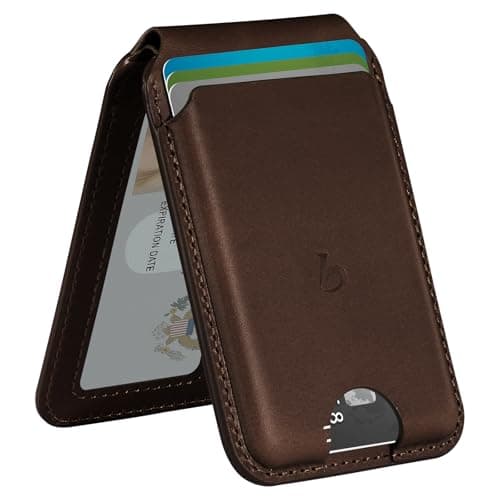
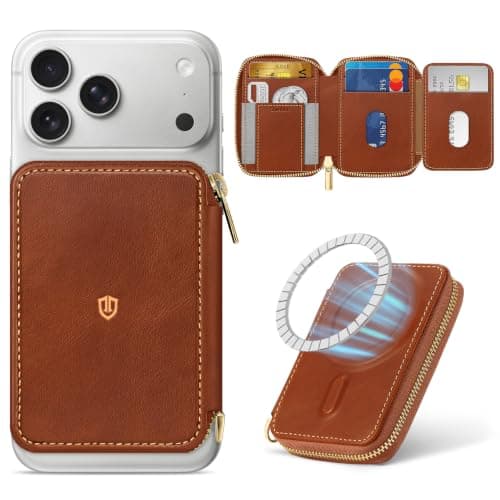
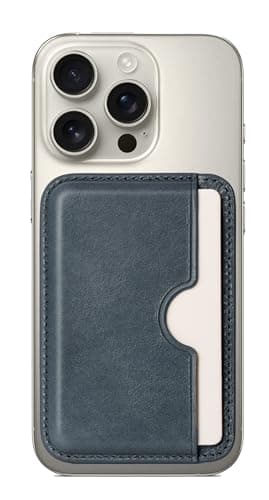
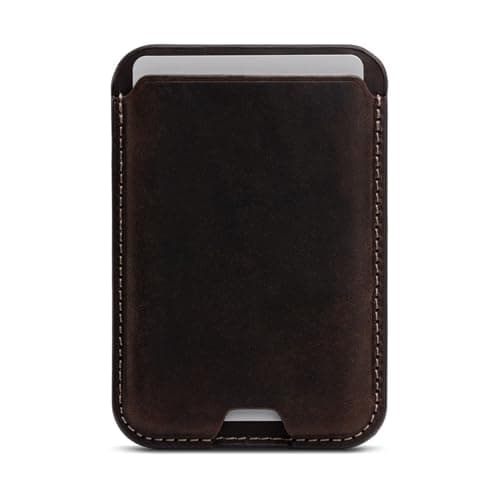
The short version: for most people the alternative to buy is the KORDIZ Oil-Waxed Full-Grain MagSafe Wallet— a named leather grade, strong magnets and a published card range, for well under half what a first-party phone accessory costs. If what you actually want is the findability, buy the Nomad Horween MagSafe Wallet, the only wallet we rank whose listing states integrated tracking with a rechargeable tracker card and a 5-month battery life. The budget pick is the Le Pelle Italian Leather MagSafe Card Wallet at under $20. And one thing before you read any further, because it is unusual and it is deliberate: this page does not quote Apple’s specifications, because we could not source them.
What we can and cannot tell you about Apple’s wallet
We tried to read Apple’s own product page for its MagSafe wallet and could not retrieve specification text from it. So here is the complete, honest state of what this page asserts about the original:
What we can source.Apple’s own iPhone User Guide carries an article titled “Add your iPhone Wallet with MagSafe to Find My on iPhone”. That is Apple’s documentation, it is linked in our sources, and two facts follow from it directly: Apple’s wallet integrates with Find My, and it has to be added to Find My rather than arriving already enrolled. That integration is the real reason this accessory has a reputation, and it is the thing the alternatives below are measured against.
What we will not state.Apple’s card capacity, its material, its price, its magnet specification, or the precise behavior of its Find My feature. Numbers for all of those circulate on reseller pages and in forum posts. We do not publish a competitor’s specification from a third party or from memory, and we are not going to start on a page that stands to earn money from the comparison. If you want Apple’s numbers, get them from Apple.
That constraint turns out to make the page better rather than worse, because it forces the ranking onto firmer ground: we rank these six on what each listing publishes about itself, not on how they stack up against a figure we had to borrow. Every claim in the table below traces to the product’s own live listing, checked on 9 November 2026.
Four things a leather MagSafe wallet publishes that a phone accessory does not
A phone company sells you a wallet as an extension of the phone. A leather-goods seller sells you a wallet as a wallet. The difference shows up in the spec sheet, and it is the reason this category exists at all:
- A named leather grade.Four of these six name one — full-grain oil-waxed, full-grain vegetable-tanned, top-grain oil-waxed. Our grade ladder explains what each rung promises, and the point here is simply that somebody is willing to name a rung.
- A card count.One to three, up to five, six, up to twelve — all four figures are published by the listing that claims them, which means you can match the wallet to your actual stack instead of guessing. More slots always costs thickness: a payment card is 0.68 to 0.84 mm on its own under the ID-1 standard.
- RFID blocking, stated.Three of the six claim it. We have never thought this should cost extra — see are RFID wallets worth it— but when it is free, take it.
- Functions a card sleeve does not have. A kickstand that props the phone up for video. A zip so nothing escapes. A coin pocket. A pocket for folded notes. None of these is available from an accessory designed to be two millimeters of woven fabric.
The one axis where Apple is hard to beat, and the one wallet that tries
Findability. A wallet that falls off the back of a phone is gone without a trace, and Apple’s answer is to put the wallet into the network the phone already belongs to.
Exactly one wallet we rank goes after that directly, and it does so from a different angle: the Nomad Horween MagSafe Wallet, whose listing states “integrated tracking” delivered by a “Wallet GPS Tracker Card” with “5 Months Battery Life, Rechargeable”, and which states it is “Compatible with iOS Only”. Those are the listing’s own words and they carry two real consequences we would rather you hear from us: a tracker with a battery is a tracker you have to recharge, which is a maintenance task a passive accessory does not have; and iOS only means iOS only, so an Android user should read this row as decoration.
The second-best answer to findability is not on this page at all, and we will point at it anyway: put a tracker in a wallet built to hold one. Our AirTag wallet roundup ranks the billfolds with a purpose-cut slot, and a phone-back card holder is a poor host for a tracker by comparison. If being able to find the wallet is your whole reason for shopping, that page is a better destination than this one.
The six, and who each one is for
1. KORDIZ Oil-Waxed Full-Grain MagSafe Wallet— for most people, and the best balance on the page. Full-grain oil-waxed leather, N52 magnets and a published one to three cards. It does the one job a phone-back wallet should do and it names its material doing it.
2. Nomad Horween MagSafe Wallet— for the reader whose actual requirement is finding the wallet again. Horween leather, up to three cards, and the rechargeable tracker card described above. It is the dearest pick here and the only one that competes with Apple on Apple’s own ground.
3. SHIELDON 6-Card MagSafe Wallet Stand— for anyone who watches anything on their phone. Six card holders, a kickstand, RFID blocking and an ID window, in genuine leather, for under $30. It is the pick that does the most things no first-party card sleeve does.
4. Belemay Vegetable-Tanned MagSafe Wallet— for the best hide on the page. Full-grain vegetable-tanned leather, up to five cards, an adjustable-angle kickstand and RFID blocking. Veg-tan darkens visibly with handling, which is the one thing a woven fabric accessory can never do.
5. SHIELDON 12-Card Zip MagSafe Wallet— for carrying more than a phone accessory is meant to carry. Up to twelve cards behind a zip, plus room for cash and coins. It is the heaviest, bulkiest option here and it replaces a wallet rather than supplementing one.
6. Le Pelle Italian Leather MagSafe Card Wallet— the budget pick, at under $20. Two cards and a published 0.26 in thickness, which is the only thickness figure anybody in this category prints. Note that “Italian leather” names an origin and not a grade — our Italian leather roundup is the long version of that point.
The honest case for buying Apple’s instead
Three reasons, and none of them earns us anything. If you want the accessory that is guaranteed to match the color and the fit of a first-party case, buy the first-party wallet. If you want findability with no battery to recharge, a passive accessory in the phone-maker’s own ecosystem is a cleaner solution than a tracker card you have to keep topped up. And if you want a single point of support when something does not work, one vendor beats two.
What the leather options give you instead is a material that improves with use, a stated grade, more cards, a stand, a zip and a price that starts under $20. Which of those two lists describes your problem is the whole decision, and it is not one we can make for you.
Buying notes
Magnets are the spec that actually decides this category
Every wallet here attaches by magnet, and a wallet that detaches in a pocket is worse than no wallet. Two of these publish a magnet grade (N52 and N52H); the rest say “strong magnet” and leave it there. Thick cases, metal plates and non-MagSafe cases all weaken the hold, which is why why does my MagSafe wallet fall off is one of the most-read guides on this site. Read it before you buy, not after.
Count your cards against the published figure, not the maximum
The published figures across this page run from two cards to twelve, and the honest working number is lower than the headline in every case. At ID-1 thickness a card is 0.68 to 0.84 mm, so six cards is roughly a quarter of an inch standing proud of the back of your phone. Our how many cards fit in a MagSafe wallet does the arithmetic properly.
A phone-back wallet is a second wallet for most people
This is the thing nobody selling one will tell you: unless your carry is genuinely two or three cards, a MagSafe wallet ends up being the thing you take to the gym and the coffee shop while a real wallet lives in a bag. That is a perfectly good outcome — it is just not the outcome the marketing describes. If you want one object, read slim wallets instead.
Advice that earns us nothing
Do not buy a MagSafe wallet to solve a bulk problem. The cards that make a wallet fat are usually the ones you could leave at home, and moving three of them onto the back of a phone while keeping the other nine in a billfold has not reduced anything. Our what not to keep in your wallet is the free version of this fix.