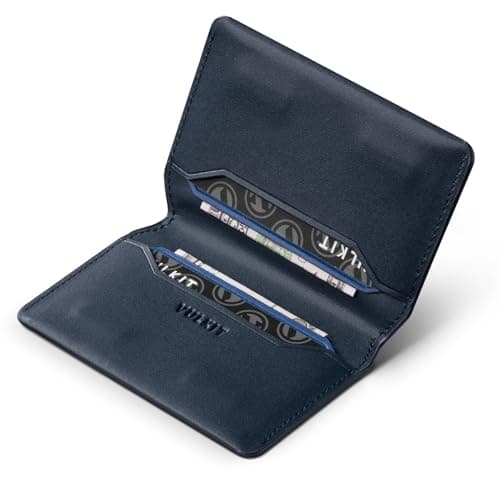
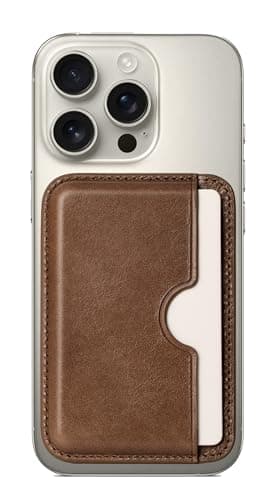
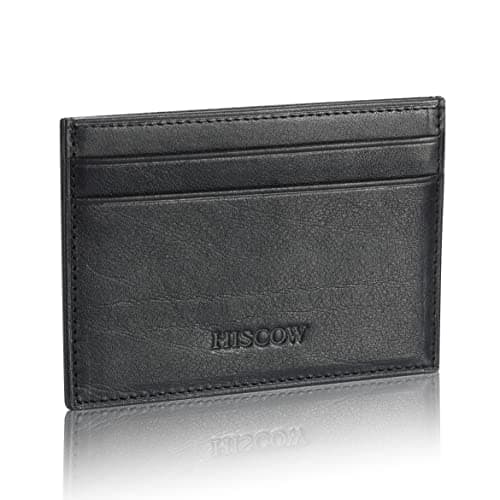
For most people the honest answer is yes, but a much smaller one— and the reason has nothing to do with paying for things, which phones solved years ago. Our pick for the carry that is left is the HISCOW Veg-Tanned Card Holder with ID Window, because the one job a phone structurally cannot do is hold a physical document where someone else can look at it. If you want the carry attached to the phone instead of in a pocket, the Le Pelle MagSafe Card Wallet publishes 0.26 inches and takes two cards, which is the minimum viable wallet.
Payment is not the question any more
It is worth conceding the main point immediately and completely: if the only thing your wallet does is pay, you do not need it. Phone payment is accepted at effectively every terminal that takes contactless cards, because it rides on the same 13.56 MHz standard, and the phone is more secure than the card it replaced — it needs your face or your passcode and the merchant never sees a number.
So the interesting question is not “can I pay with my phone”. It is what is left in your wallet once payment is removed, and does any of it have to be physical? For almost everyone, four things do.
The four things a phone cannot do
1. Be handed to somebody
This is the big one and it is structural rather than a matter of adoption. A document you hand over — a licence to a desk clerk, an insurance card at a reception counter to be photocopied, a card to a bartender to hold a tab, a card to a valet — has to be an object that leaves your hand. You are not giving anyone your unlocked phone. No software update changes that.
2. Work with a dead battery
A phone at 0% contains nothing. A card in a sleeve works at 0% because it is a piece of plastic. The consequences scale with how far from home you are, which is why even committed phone-only carriers tend to keep one card and some cash somewhere — not because they expect a flat battery, but because the cost of one is unbounded.
3. Be read by a machine that needs to see it
Plenty of readers are not contactless terminals: a hotel key slot, a parking garage, a gym turnstile, a transit gate on an older system, a barcode scanner at a pharmacy. Some of those have phone equivalents and many do not, and the ones that do not are exactly the ones you encounter when you are somewhere unfamiliar.
4. Hold cash
Cash is physical by definition. You may genuinely never need it; a lot of people find they need it three times a year, and all three times badly — a cash-only parking lot, a tip, a market stall. Our guide on how much to carry argues for a small fixed amount you never spend rather than a working float, which is a different thing from the wallet you would buy to carry a float.
On digital IDs, and what we are not going to tell you
A digital driver's licence in a phone wallet is real, it exists, and it is accepted in a growing list of places. We are deliberately not going to publish which states or which airport checkpoints, for a simple reason: that list changes on a timescale of months and this page will be read for years. Any site that gives you a count is giving you a number that is already drifting out of date.
What we will say is the part that does not change. Every digital-ID scheme we are aware of is an addition to the physical card rather than a replacement for it, which means the physical card is still the thing you must be able to produce. Check your own state's DMV page rather than a wallet blog — including this one — and plan your carry around the physical card until your own issuer tells you otherwise.
What to look for once payment is off the list
One document window, and that is the spec
If the thing a phone cannot do is show a physical document, the wallet you want is the one with a window for it. That is a surprisingly rare feature at the slim end of the market — most card sleeves skip it entirely, which is why one of our picks below is on this page specifically for having one. Our full ranking is on the ID-window page.
Two to four slots, not six
Count what is actually left: a licence, one backup payment card, maybe an insurance card, maybe a transit card. That is a two-to-four-card wallet, and buying a six-slot holder means the slots will fill back up with the things you just removed. The two-and-three-card page ranks that end of the market and explains the one counterintuitive finding there: below four cards, capacity stops mattering and retention starts.
Decide whether it attaches to the phone
A magnetic sleeve on the back of the phone is the logical conclusion of this whole argument — one object instead of two. The costs are real: it holds two or three cards, it is held by a magnet that is weak against a peel (see the retention guide), and it means a lost phone is also a lost licence. If you carry a tracker, that calculus changes.
Then buy nothing for a month
The cheapest version of this experiment is to carry your existing wallet with only those three or four cards in it for four weeks. If you never miss anything you took out, you now know exactly which format to buy. If you put two things back, you learned that too, and you have not spent anything.
Wallet phone case, or a wallet and a phone?
“Are wallet phone cases a good idea” is its own search and it deserves a straight answer: they are a good idea for a specific person and a bad idea for most. Three trade-offs decide it.
One object to lose instead of two — cuts both ways. You cannot leave the wallet at home if it is attached to the phone you check constantly. You also cannot lose the phone without losing the licence. Which of those matters more is a fact about you, not about the product.
A folio case is bulkier than a wallet. A flap-and-cover case adds thickness to the one object you hold up to your face and put on tables. A flat magnetic sleeve does not, which is why the sleeve format won.
Cash does not really work. A note is 6.14 inches long, so getting one behind a phone means folding it twice. One MagSafe wallet in our record has a zipped pouch for folded cash and coins; the rest have no cash provision at all. We set the published numbers out on the capacity guide.
What people who go phone-only actually report missing
Not payment. The pattern in the questions people ask is consistent, and it is worth knowing before you decide:
- The licence, at the moment someone else wants to hold it. Rental counters, notaries, pharmacy collections, hospital admissions.
- An insurance or health card that a receptionist wants to photocopy, which is a process built around paper.
- One backup card for the day the phone dies, the terminal is offline or the merchant is cash-and-chip only.
- A small amount of cash for the handful of transactions a year that do not take anything else.
Notice what that list is: it is a three-slot card holder with a window. Not nothing, and not a bifold either. That is the shape of the answer for most people, and it is why the slim category and the minimalist hub are the busiest parts of this site.
The advice that earns us nothing
Try it with the wallet you own. Four weeks carrying four cards in your existing wallet costs nothing and tells you more than any page can. We would rather you did that first and bought once, correctly, than bought a card sleeve now and a bifold in March.
If you only edit your carry, you have already won most of it. The bulk in a wallet is cards you do not use, not the wallet. The guide to switching to a minimalist wallet makes the same point: the format forces the decision, but you can make the decision without the format.
Do not throw the old wallet away. Keep it in a drawer for a month. The two-week drawer test in that guide is the honest way to find out whether you edited too hard, and it only works if the wallet still exists.
Prices, and what we earn
Prices are read from the live price layer and stamped with the date they were read. Buy links are affiliate links. See the editorial policy.