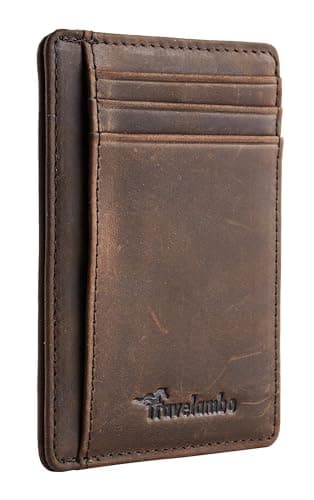
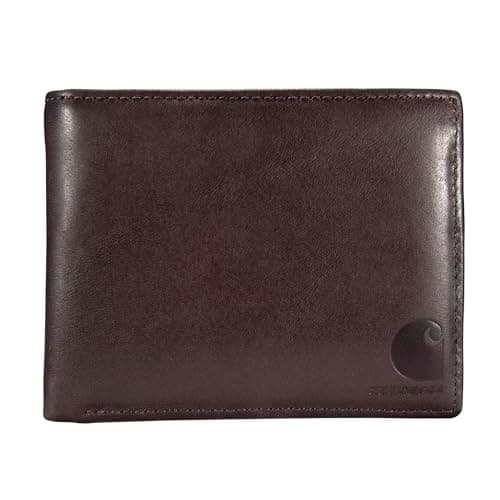
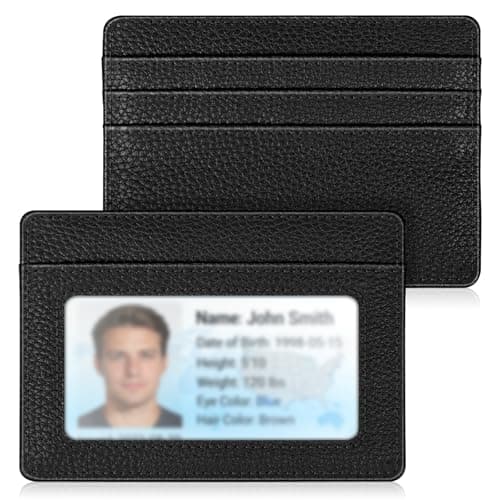
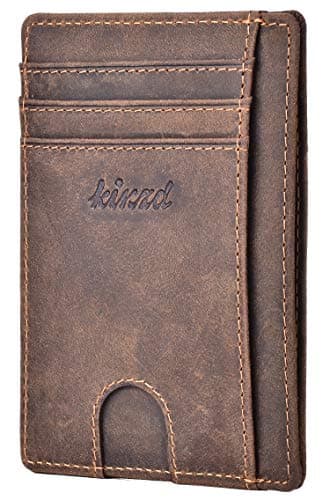
For most first wallets the pick is the kinzd Slim Front Pocket Wallet — it is cheap enough that losing it is annoying rather than expensive, and it is the one here with a proper ID window, which is the single feature a teenager actually needs on day one for a student card or a learner permit. If you want the cheapest real leather that will still hold a stack, the Travelambo front pocket wallet is the floor of the whole category. If the wallet is going to live in a work pocket and get wet, the Carhartt oil-tan is the one that will not care.
The rule for getting on this page
One condition, and it is not a quality condition: the wallet has to be cheap enough to lose without a conversation about it. That is the whole design brief for a first wallet and no listing will ever tell you so. Every pick here is real leather, every pick is a mainstream listing with a returns path behind it, and every pick sits at the bottom of the price band for its format. We have deliberately left off the full-grain and made-in-USA wallets we rank highest everywhere else on the site — a lifetime-warranty hide is a wonderful object and the wrong gift for someone who has not yet formed the habit of knowing where their wallet is.
The second filter is an ID window, or the absence of one. This is the detail people get wrong. An adult buying for themselves can take or leave an ID panel. A fourteen-year-old carries a school ID, a bus pass and eventually a provisional license, and all three are things that get shown to someone rather than swiped. Two of the five picks here publish an ID window and the other three do not, and that difference matters more than the leather does at this price. If the window is the only thing you care about, the ID-window roundup ranks the feature on its own across every price band.
What we would not buy for a first wallet
Three things, and they are all things that get recommended constantly.
Anything engraved
An engraved wallet cannot be returned, cannot be exchanged for a different color, and cannot be replaced identically when it goes missing in six months. It is a lovely gift for a thirtieth birthday and a bad one for a first wallet. If you want the gift to feel like a gift, we have a whole hub of leather gift picks and a page on personalized wallets for when the recipient is past the losing-things stage.
Anything with a mechanism
Pop-up cages and metal card cases are genuinely good products that we rank highly elsewhere, and they share a property that makes them wrong here: a friction-retained cage has a minimum card count as well as a maximum. VULKIT publishes it on its own listing — “at least 3 cards are needed for secure retention” — and a first wallet typically starts life with one card in it. A sewn leather slot has no minimum, which is exactly why the boring format is the right one. The full version of that argument is in how many cards fit in a card holder.
A wallet chosen on leather grade
Four of the five picks here are described by their own listings as “genuine leather”, which is the lowest rung of the real-leather ladder rather than a reassurance — our grade guide explains exactly what the words are worth. That is the correct trade to make here. A genuine-leather wallet will do three to five years of hard use, which is longer than the habits of a fifteen-year-old will last, and the one pick that goes further up the ladder does it with oil-tan rather than with a price increase.
Why the oil-tan pick is here
The Carhartt is the only entry whose listing names a tannage rather than just a grade, and oil-tanned leather is the one finish that genuinely does not mind being treated badly: the oils are in the hide rather than on it, so a soaking dries back without the stiff, cracked panel a surface-finished wallet gets. If the first wallet is going into a jacket on a building site, a farm or a sports bag rather than a school blazer, it is the pick, and the reason is in the oil-tan explainer.
How many cards does a first wallet need?
Fewer than any of these hold. A first carry is realistically a student ID, a debit card, a transit pass and a folded note — four positions, and every pick on this page publishes at least six. That is deliberate rather than sloppy: a wallet with room to grow outlasts one sized for today, and an under-filled sewn slot costs you nothing, whereas an under-filled cage drops cards. The argument for carrying fewer cards than your wallet holds is in how many cards a wallet should hold.
Cash, and the thing nobody mentions
A US Federal Reserve note is 6.14 by 2.61 inches and about 0.0043 inches thick. A bifold is roughly 4.5 inches wide, so a note has to fold — and ten of them folded in half add less than three payment cards do. Cash is almost never what makes a first wallet fat; a receipt habit is. The card slots are what fill up, and a payment card at the ISO thickness of about 0.03 inches is the unit of measurement that matters.
What to do when it gets lost
Plan for it rather than hoping. Two of these wallets cost less than replacing the cards inside them, which is the right ratio for a first wallet and the reason we have ranked on replacement cost at all. If the losing is chronic rather than occasional, the honest answer is not a better wallet — it is a tracker, and the AirTag wallet roundup ranks the leather wallets with a dedicated pocket for one. That page costs more and solves the actual problem.
Prices, and what we earn
Every price here is read live from the Amazon Product Advertising API and stamped with the date it was read, which is why there is not a single dollar figure in this prose. Buy links are affiliate links; the ranking is the one we would publish if they paid nothing, and the editorial policy explains how that is enforced.