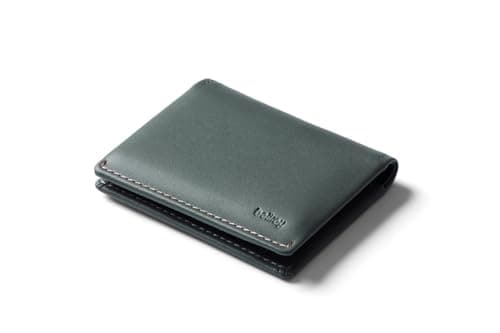
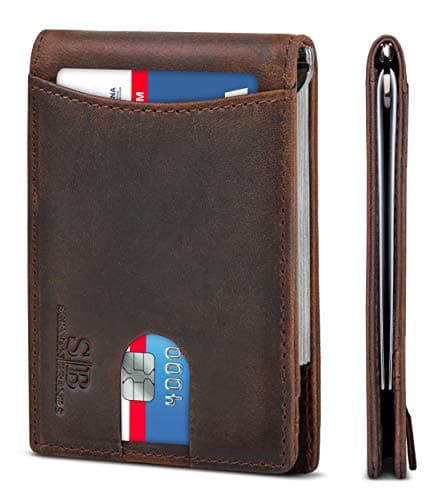
"Should I get an RFID wallet?" is one of the most-asked questions in this category, and the honest answer is calmer than the marketing. RFID blocking is a metallic layer in a wallet meant to stop a reader from wirelessly querying a contactless card through the leather. It is a genuine feature, but for most people it is a nice-to-have, not a must-have— and it is rarely a good reason to reject a wallet you otherwise love. To make the trade concrete we line up two slim leather wallets: the Serman Brands Slim Bifold, an RFID-blocking genuine-leather wallet that has been the internet's default "slim wallet under $30" for years, and the Bellroy Slim Sleeve, a premium non-RFID top-grain slim bifold. Here is what RFID actually does, how real the risk is, then both, priced live.
| Factor | RFID slim wallet (Serman Brands) | Non-RFID slim wallet (Bellroy Slim Sleeve) |
|---|
| RFID blocking | Yes — blocks contactless reads | No RFID version of this model |
| Leather | Genuine leather | Env-certified top-grain |
| Cards | 6–8 | 4–8 |
| Cash | Folds bills inside | Folds bills inside, dressier cut |
| Format | Slim bifold, front-pocket | Slim bifold, front-pocket |
| Backing | Lifetime-style warranty | Bellroy three-year warranty |
| Price | Budget, typically under $30 | Premium |
What RFID blocking actually does — and doesn't
RFID blocking stops a nearby reader from wirelessly powering up and reading a contactless chip through your wallet. That is the whole of it. It does nothing for a card that has been physically stolen, for online fraud, or for a card swiped or dipped at a compromised terminal — which is how the vast majority of real-world card fraud actually happens. It also does nothing for a magnetic-stripe card, which has no chip to read. So an RFID wallet protects against exactly one narrow attack: someone standing close enough to wirelessly skim a contactless card in your pocket.
How real is that attack? In practice, rare. Modern contactless bank cards have their own protections — each tap generates a one-time code rather than exposing your static card number, and the readable data is limited — which is a big part of why documented cases of pockets being skimmed for usable card fraud are hard to find. Our are RFID wallets worth it guide walks through the risk honestly. The upshot: RFID blocking is real and harmless to have, but it is closer to a seatbelt for an unlikely event than a must-have.
Choose the RFID wallet if...
...the peace of mind matters to you, or you carry contactless work badges, transit cards or building access cards you would rather not have read in a crowd — and especially if it costs nothing extra to get it. The Serman Brands slim bifold is a good example: RFID-blocking genuine leather with a front-pocket profile, a real card stack, folded cash, and a lifetime-style warranty, all for a fraction of a premium wallet. If two wallets you like are otherwise equal and one blocks RFID, take the RFID one — there is no downside. See the wider field in best RFID wallets.
Choose the non-RFID wallet if...
...the wallet you genuinely want does not offer an RFID version, and you are not willing to compromise on leather, slimness or design to get one. The Bellroy Slim Sleeve is a perfect case: it is one of the slimmest ways to carry cards and folded cash in real leather, it reads dressier and thinner than a traditional bifold, and it simply does not come in an RFID edition. For most people that is a fine trade, because the contactless-skimming risk is low and their bank card protects itself. Do not pass up a wallet you love over a feature you will probably never need — read the full Bellroy review or browse minimalist wallets.
The short answer
RFID blocking is a nice-to-have, not a must-have. If you can get it at no cost to leather, slimness or design — or you carry contactless access cards you want shielded — take it; the Serman Brands bifold shows how cheap that can be. But do not choose a wallet for RFID and settle for a worse one, because tap-to-pay cards already limit what a skimmer could read, and real card fraud almost never starts in your pocket. Pick the wallet you actually want; if it blocks RFID too, that is a bonus. The full risk breakdown is in are RFID wallets worth it.