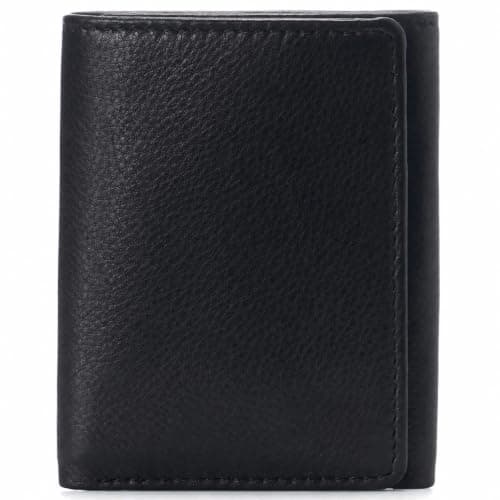
The Alpine Swiss Leon is the wallet a lot of people picture when they think "trifold": a classic folding leather wallet with rows of card slots, an ID window and RFID blocking, sold at a price that makes it an easy default. It is one of the most popular affordable trifolds online, and this is an independent, research-based review of whether it earns that popularity. To be clear up front, this is a judgment built from the brand's published specs, the trifold format, and the large pool of owner feedback a wallet this common generates — not a hands-on wear test. We do not claim to have carried it for weeks; we are reading the documented evidence honestly.
The short verdict: if you actually want a trifold — the format, the capacity, the layout — the Leon is a sensible, inexpensive way to get one, and it covers the fundamentals a trifold buyer cares about. If some part of you is hoping a trifold can also be slim, this is the wrong wallet and the wrong format, and it is kinder to say so now.
What it does well
The Leon's core strength is organization and capacity in a classic package. A trifold folds into three panels instead of two, and that extra panel buys a lot of slots: the Leon holds a genuinely large everyday load — roughly nine to thirteen cards — laid out in the vertical, hand-friendly arrangement that trifold fans specifically prefer over a bifold's horizontal pockets. Add the built-in ID windowand you have a wallet that carries a full, real-world everyday set: bank cards, loyalty cards, an ID you can show without pulling it out, and folded cash. For someone whose complaint about slim wallets is "where does everything else go," this is the answer.
Second, like the other budget bestsellers, it includes RFID blocking as standard, so the contactless-security box is ticked without paying extra for it. Third, it is genuinely easy to buy and easy to gift: it is real leather, it ships in a gift box, and it comes in at a low, uncomplicated price. A recognizable, well-reviewed trifold at a gift-friendly cost is a low-risk present, and it slots naturally into our budget leather wallet roundup as the trifold representative. If the trifold format is what you are after, it also anchors our dedicated trifold wallet roundup.
It is worth crediting the ID windowspecifically, because it is one of the features that separates a trifold like the Leon from the slim wallets that dominate the rest of this site. A clear window lets you show a driver's license or a work badge without pulling it out of a slot, which matters more than it sounds if you flash ID daily at a desk, a gym or a checkout. Slim bifolds and cardholders almost never have room for one; the trifold format does, and the Leon puts that room to good use. If your everyday carry genuinely includes an ID you show often, that single feature can be the whole reason to choose this shape over a slimmer one.
Put together, the appeal is straightforward: maximum organization, a familiar layout, RFID and an ID window, all for less than a night out. Judged on the trifold buyer's own priorities, the Leon delivers what they are shopping for.
The honest trade-offs
The first trade-off is inherent to the format, not the brand: trifolds are the thickest wallet shape once loaded. That third panel and its extra slots that make the Leon so capacious are exactly what make it bulk up in the pocket when it is full. Loaded with the nine- to-thirteen cards it is designed to hold, this is not a wallet that disappears into a front pocket — it is a back-pocket or bag wallet by nature. If bulk bothers you at all, no amount of admiring the slot count will fix that; the format is working against you. Our bifold versus trifold comparison lays out this thickness-versus-capacity trade in detail, and it is the single most useful thing to read before you decide.
The second trade-off is the leather. Like most wallets at this price, the Leon is made from genuine leather— real leather, but the lowest real-leather grade, with the value finishing that comes with the price. In practice that means it is not a patina wallet: it looks its best early and wears flat over time rather than darkening and softening into character the way a full-grain wallet does. If the reason you want a leather wallet is to watch it age into something better-looking, this grade will not give you that. Our full-grain versus top-grain versus genuine guide explains precisely why, and it is the context that keeps this review honest: the Leon is a value trifold, not a leather heirloom, and it is priced accordingly.
On construction, the fair way to judge the Leon is against its price rather than against a premium maker. The build is solid for a budget trifold — the slots hold their shape, the fold is clean, and the very large pool of owner feedback that a wallet this common accumulates means the fit-and-finish is a known quantity rather than a gamble. What you should not expect is heirloom assembly: the edges are finished to a cost, and like most wallets in this bracket it is best understood as a multi-year wallet rather than a decades-long one. That is the honest framing for its research-based build score — dependable for what it is, without pretending to be more than a value wallet.
Taken together, the trade-offs are coherent rather than damning. You are buying capacity and format at a budget price, and the costs of that choice are bulk and a leather that will not age. If both of those are acceptable — and for a lot of trifold buyers they genuinely are — the Leon is a fair deal.
Who should buy the Alpine Swiss Leon
Buy it if you want maximum organization and capacity for very little moneyand you actively like the trifold format. This is the wallet for the person who carries a lot — several cards, an ID, cash, maybe a couple of loyalty or transit cards — and who wants all of it laid out in the tidy vertical trifold arrangement rather than crammed into a slim bifold. If "holds everything and keeps it organized" matters more to you than "stays thin," the Leon is squarely aimed at you, and it is hard to beat on price for that job. It is also an easy, safe gift for someone who you know carries a traditional wallet and is not chasing minimalism. It earns its place in our trifold roundup for exactly these buyers.
Concretely, the ideal Leon owner is the person whose wallet is a small command center: the everyday bank cards, a backup card, a couple of memberships or transit cards, an ID they show regularly, and cash for the situations that still want it. For that carry, a slim wallet forces constant editing and a cardholder simply cannot cope, while the Leon holds the whole set without complaint and keeps it tidy in the vertical layout. If that description fits you, and you have made peace with a wallet that lives in a bag or a back pocket rather than a front one, it is a genuinely sensible, low-cost choice that will not leave you wanting for slots.
For this shopper, the research-based score tells the right story: high marks for capacity and value, a solid build score, and a deliberately low slimness score that simply reflects the format — not a flaw, just an honest description of what a loaded trifold is.
Who should skip it
Skip the Leon if slimness matters to you at all. A trifold is the least slim format there is, and this one is no exception; if a thick wallet in the pocket bothers you, you will not learn to love it, and you should not try. The honest redirect is to the opposite shape: a slim bifold or a cardholder that carries a trimmed-down set of cards without the bulk. Start with our minimalist wallet hub for the slim options, and read the bifold versus trifold breakdownif you are genuinely torn between capacity and slimness — because that is the real decision here, and it is worth making on purpose. The Leon is a good trifold. It is only a bad wallet if a trifold was never what you actually wanted.